

Working at an open outdoor location where you need to work long hours, but there is no place to charge a battery? The more practical starting point is a gas plate compactor. Does the application involve working in a partially enclosed area, indoors, under emission limits, in short cycles or with crew already operating a matched battery platform? First look at the electric unit. But don’t stop at the power source — your final decision on which gas vs electric plate compactor to buy will rely on the material, forward or reversible travel, centrifugal force, operating weight, baseplate, refueling or recharging logistics, and the actual spec sheet of the model.
Gas vs. Electric Plate Compactor: Quick Comparison
You’re comparing two systems that work, not just an engine and a motor. The compromises are reflected in the machine’s site mobility, recharging/fueling, and in its “footprint.
| Factor | Gas plate compactor | Electric plate compactor |
|---|---|---|
| Site mobility | No grid or charger required — travel with crew. | Corded: requires to be tied to a supply point and cord reach. Battery: bound to pack rotation |
| Refuel / recharge | Minutes with a portable fuel can | Corded: continuous while powered. Battery: charging time and reserve batteries |
| Local exhaust | Engine exhaust and CO — outdoor or ventilated use only | No local combustion exhaust at the machine |
| Maintenance items | Oil, air filter, spark plug, fuel system | Belt and exciter service — no engine fluids or filters |
| Power-system extras | Fuel storage and handling | Corded: cable management. Battery: charger(s) and spare packs |
| Best fit work pattern | Open outdoor sites, long or unpredictable work shifts | Enclosed or emission restricted sites, shorter shifts |
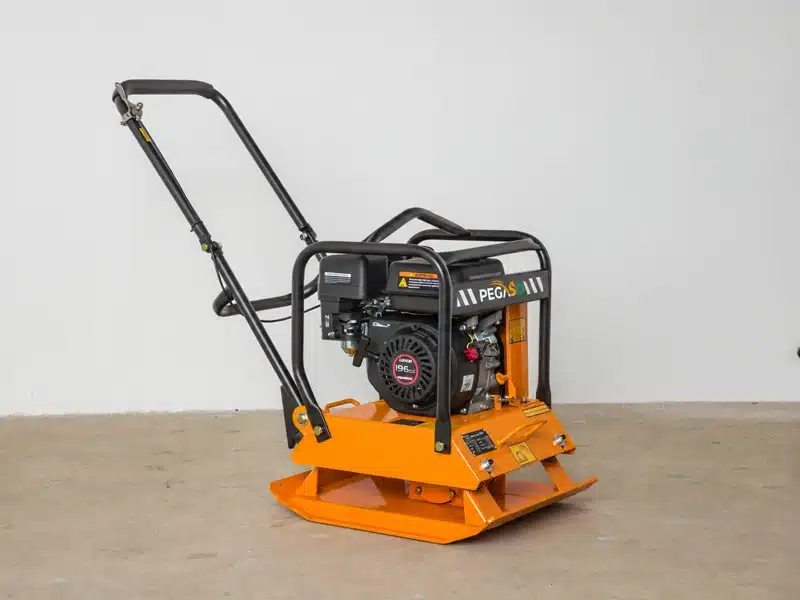
Don’t take “electric means less force” as a category rule. For instance, Multiquip offers plates for batteries that operate in the same centrifugal force range as equivalent gas units.12 So, are electric plate compactors good? Yes — but it depends on the spec sheet you are looking at, not the badge on the handle. Secure that call first before you make up your mind on the gas-only coverage or gas-plus-electric coverage for your catalog.
Where Gas Plate Compactors Have the Advantage
For many outside construction and rental fleets, gas remains the standard fueling option. It’s not about blanket performance, it’s about site independence and refueling rhythm.
Four factors will drive the call to a gas-powered plate compactor:
Husqvarna frames gas as being for “remote sites or jobs where charging isn’t an option.3 Think of it as a situation, not a rule.
Multiple shifts or irregular work schedules. For extended days, a spare fuel can keeps the machine running.
Two minutes with a jerrycan is better than waiting for a charge cycle.
A wider and well-known service and parts network. Many crews have the engine parts with them and know the drill.
Separate the forward gas plate from heavier reversible gas plate. If you need to bolt a larger HP forward plate, don’t — start with a reversible machine for large areas or for heavier duty, reverse travel. But a gasoline plate compactor that’s suitable for outdoor use doesn’t necessarily mean that every gas unit is good for heavy duty use; centrifugal force, operating weight, baseplate, travel speed and the OEM stated application are still checked line by line. That means a good match between the baseplate and the base course and not choosing a plate compactor for gravel based on horsepower alone.
How to Choose a Gas Plate Compactor
After gas is settled, risk passes to purchasing a model not suitable with the material and the job. First choose equipment class and then on same basis model data.
Match the Plate Type to the Material and Work Area
The basic tasks of a vibratory plate are the compaction of granular soils, sand or gravel base, and asphalt.4 A rammer or other machine (gas versus electric power is not an issue) may be appropriate for cohesive soil or a narrow trench. For small areas and easy turning, consider using a forward plate first; for larger areas, heavier duty or any job requiring forward-and-back travel, consider using a reversible plate. On an asphalt plate compactor, inspect the sprinkler system/water tank and baseplate material. On a compaction plate for pavers, inspect the approved mat or accessory.5 Forget about universal lift depths and pass counts — these are derived from the material, moisture content, desired density, equipment and a field test.
Compare the Model-Level Specifications
Create a spec table that includes travel direction, centrifugal force, operating weight, plate width, length, vibration frequency, travel speed, engine make and model, fuel consumption, tank capacity, water system, HAV and sound, transport dimensions and market documentation. However, the centrifugal force of the plate compactor isn’t the only factor to consider; only a field can be compared if the unit, the definition and the machine class are all the same. The weight of the plate compactor is telling you something else again — don’t use one number as a measure of performance.
Gas buyers validate a second level: engine service parts, air cleaner setup, low-oil protection, starting method, belt and exciter maintenance, spare-parts lead time and documentation for the destination-market engine-family. If the product page does not provide fuel consumption, tank capacity, sound, vibration, certification or price, take the figure from the nearest equivalent model and indicate it as an estimate – never leave a critical figure blank without trying to find it. The result is a technical table that can be taken directly into an RFQ, a sample request and quality verification. The same table applies when comparing forward and reversible plate compactor variants.
When an Electric Plate Compactor Is the Better Choice
There are some circumstances that are sufficient to turn the “default to gas” call. The electric plate compactor advantage is not a universal swap, but is dependent on site constraints and system configuration.
CO and exhaust are the hazard; indoor, underground, partly enclosed or EHS bans on combustion.6 Follow OSHA, OEM and site rules and use equipment that does not generate local combustion exhaust. This is where an electric plate compactor for indoor use comes in.
Urban sites or noise-sensitive sites. A candidate here is an electric unit, though it is not “silent” — compare the sound and HAV figures though.
Short-cycle repair, landscaping, and paving work and fleets with an existing battery platform that is compatible and has sufficient pack rotation and a charging source. Such a system reduces start-up and upkeep complexity.75
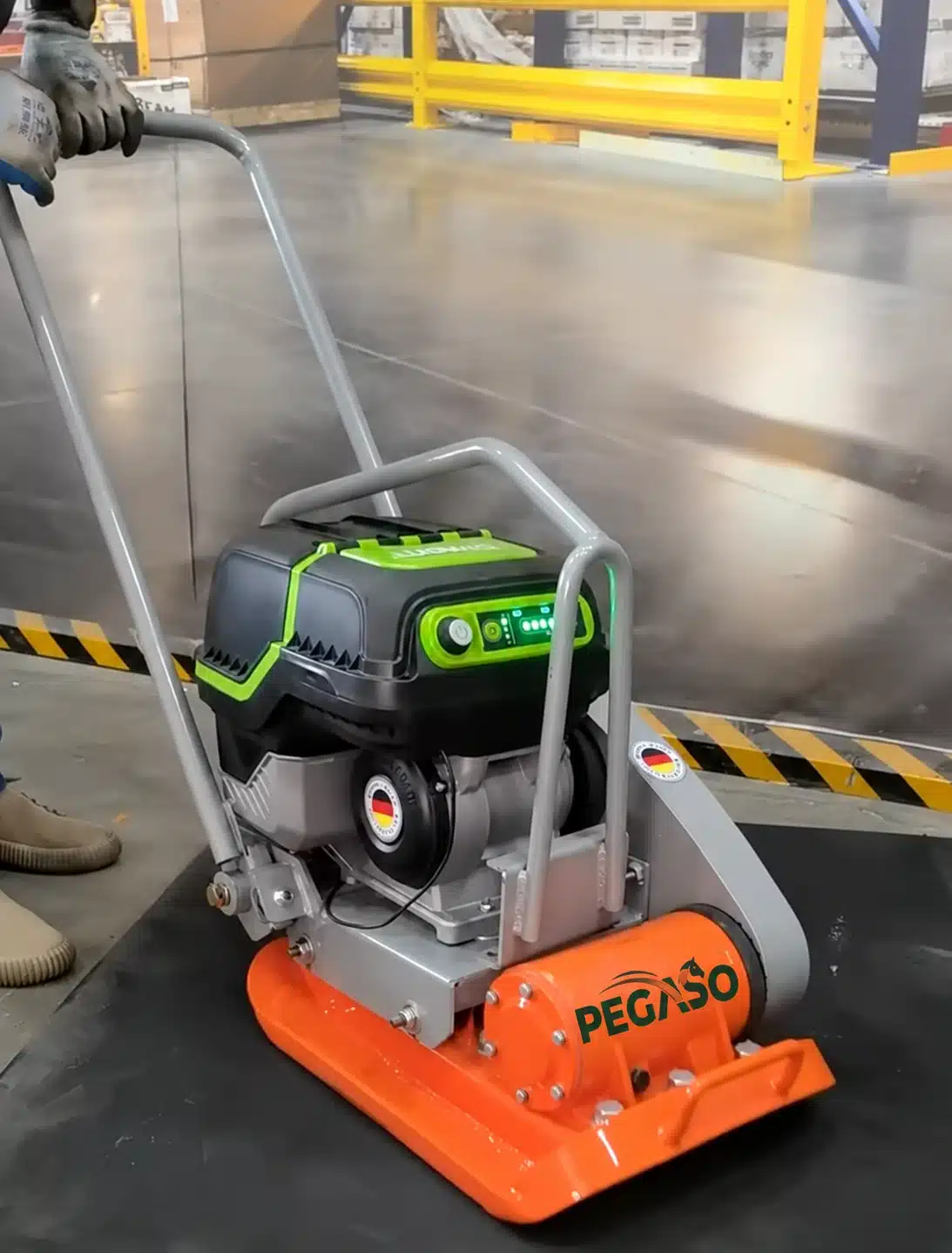
Divide the two electric formats. The corded electric plate compactor is appropriate for locations where power is available and cable runs are not a problem. The battery plate compactor offers increased mobility but requires a commitment to runtime, charge time, spare batteries and chargers at the outset. The “electric is only for light DIY” can no longer be used as a blanket statement since Wacker, Husqvarna, Multiquip, and DEWALT already have battery machines at varying force levels available.1378 The call then is reflected back into your inventory plan, or even whether you stock a battery platform, spare packs and chargers at all.
Cost, Runtime, and Maintenance: Compare the Whole System
One piece of the cost of the system is its purchase price and “low maintenance” does not mean “no maintenance.9 Avoid using a one number conclusion with no regional data to support it — create an RFQ/TCO field table instead.
| Cost / usage field | Gas | Electric |
|---|---|---|
| Machine price; engine or motor | Engine make/model, listed service schedule | Motor; corded or battery |
| Energy | Actual fuel consumption, tank, refuel frequency | Grid draw (corded) or per-pack runtime (battery) |
| Battery packs; charger(s) | N/A | Packs needed, charger count, kit inclusion, temp/storage limits |
| Routine service parts; annual hours | Oil, filter, plug, belt, exciter | Belt, exciter |
| Transport/storage; warranty; parts lead time; resale | Per OEM | Per OEM |
To determine the cost of gas vs electric plate compactor, record the actual fuel usage, tank size, fueling frequency, and the OEM service schedule for the gas side. If the runtime is not provided, try to approximate it from the fuel usage rate and the fuel tank capacity, but note that the number is an approximation. Record the stated operating conditions, charging time, spare packs and chargers needed, inclusion of kit and the temperature and storage limitations for each battery. Corded – record power and cord. Do not change the “up to / approx.” wording or the battery plate’s duty, speed or mode, or battery model, without qualifying the runtime. Without site-specific annual hours and local energy prices, don’t state a fixed payback period.
Final Conclusion
Start with gas for long shifts, start with outdoor site, unreliable power. Exhaust limits, short cycles, or existing battery ecosystem – “evaluate electric first”. In any case, land on same-class model data prior to placing an order. Please provide us with your material type, work area layout and shift plan, and we will match you with the appropriate specification and supporting documentation.
Frequently Asked Questions
Can you use gas plate compactor indoor?
Not safely. Carbon monoxide and exhaust fumes are generated by gas engines.6 If operated in an enclosed or poorly ventilated area, it is a serious CO exposure risk and is a violation of OSHA. Use an electric plate compactor (corded or battery) for indoor compaction.
How long does battery plate compactor run on a battery?
This depends on the type of battery, the mode of operation and the load.7 Most manufacturers specify that they will run 30-60 minutes continuously in standard conditions, but always check that against the conditions specified. Plan for at least one spare pack and a quick charger for 100% battery-powered compaction.
Is forward or reversible plate compactor better for asphalt?
A forward plate with a water tank does the job for small areas of asphalt and thin lifts. A reversible plate provides the travel control and operating weight needed for larger paving areas, thicker lifts or any job that requires back and forth travel over the mat. Always check the baseplate material and water system are rated for hot-mix work.
Sources
Multiquip — MVCi60VBW Battery-Powered Plate Compactor. Manufacturer specifications for centrifugal force, batteries, charging, and model-specific runtime. These figures do not establish a universal 30–60-minute runtime range. Accessed October 9, 2026. ↩ ↩
Multiquip — MVC60VTHW Gasoline Plate Compactor. Manufacturer specifications used with Source 1 to compare similar-class gasoline and battery machines. Accessed October 9, 2026. ↩
Husqvarna Construction — Forward Plate Compactors. Manufacturer discussion of remote sites, charging availability, fuel-driven and battery-powered models, and application areas. Accessed October 9, 2026. ↩ ↩
Multiquip — Soil Compaction Handbook. Manufacturer guidance on material types, moisture, compaction methods, and equipment selection. Accessed October 9, 2026. ↩
Husqvarna Construction — LF 60i LAT. Manufacturer information on asphalt and granular-soil applications, the paving kit, compatible batteries, and stated runtime conditions. Accessed October 9, 2026. ↩ ↩
OSHA — Portable Gas-Powered Equipment. Government guidance on carbon monoxide hazards from fuel-powered equipment in enclosed spaces. This safety guidance is not evidence that every indoor use automatically constitutes a specific OSHA violation. Accessed October 9, 2026. ↩ ↩
Wacker Neuson — APS Battery-Powered Vibratory Plates. Manufacturer information on battery-powered compaction, battery swapping, direct drive, and application-dependent runtime. Accessed October 9, 2026. ↩ ↩ ↩
DEWALT — Forward Plate Compactor Kit, DCPS7154AG2. Manufacturer product information on a battery-powered forward plate compactor and supplied system components. Accessed October 9, 2026. ↩
Multiquip — MVCi60 Operation Manual, Revision 0, November 12, 2024. Manufacturer maintenance, inspection, transportation, and storage requirements for a battery-powered plate compactor. Accessed October 9, 2026. ↩
