

In this article, we will explore the differences between these two augers and whether or not you can switch bits.Let's find out how these two augers differ and whether or not they can be swapped out.
Ice auger are designed to cut ice, while earth augers are designed to dig into soil. Avoid using either bit of material. Certain specific powerheads will accept either type of bit (provided they are compatible by model, connector, rotation, bit size, and instructions)<sup>1</sup>.
When you're standing on a frozen-over lake with an earth auger in your hand, or on a post hole with an ice auger, you may be tempted to simply switch out the bits. They're close enough in appearance. They both spin a spiral piece of metal into the ground. However, using these two tools as if they were the same is a quick way to damaging equipment or injuring yourself.
In this guide, we're going to dissect the distinctions between ice auger and earth augers. We shall examine why their cutting heads are designed as they are, and what you need to look for if you intend to use a common powerhead for both tasks.
Ice Auger vs Earth Auger: Key Differences at a Glance
An ice auger is designed to deal with ice, while an earth auger is designed to deal with earth.
What Each Tool Is Built to Drill
The only job of an ice auger is to slice the solid ice in the lake. It requires a uniform, compact, solid, glass-like structure.
Earth auger is a machine used for moving earth. It expects chaos. It is designed to cut through roots, clay, gravel and soil. Do not however, mistake "frozen soil" for "lake ice." The standard earth auger will be pushed beyond its capacity if it is pushed in a rock hard winter soil, which is frozen—this will need to be checked with the manufacturer for the specific soil type. On the other hand, no handheld earth auger is designed for boring through hard rock.
Cutting Head and Blade Geometry
It is the cutting head that tells the real story!
Look at an ice auger . The blades are razor thin and may be curved, or they may be designed to shear off thin slices of ice as the blade spins. Like an ice skate cutting a turn.
Now observe an earth auger. You won't find shaver blades. Rather, they will display rugged cutting teeth (which may be replaceable) and a sharp pilot point (the "fishtail") in the middle. The fishtail keeps the bit from drifting around the dirt, and the heavy teeth bite the dirt and roots.
Flighting, Hole Dimensions, and Debris
The metal wrapped in a spiral around the shaft is known as the flighting. It's function is to serve as a lift to take debris out of the hole so the cutting head does not choke.
Because water turns into lightweight ice chips, an ice auger’s flighting is optimized to efficiently clear slush and ice shavings. Ice auger bits are also typically sized for a particular fishing need – usually 6, 8 or 10 inches in diameter<sup>2</sup><sup>3</sup>.
The flighting of an earth auger must pull heavy clay and rocks to the surface, especially if the clay is wet. There are a ton of sizes of earth bits from 2-inch planting bits to 14-inch earth auger bits<sup>4</sup><sup>5</sup>. Also, different depths are required for different projects, such as planting bulbs or setting fence posts to a great depth, often necessitating the use of extension shafts.
Powerhead, Speed, and Torque Are Model-Specific
All ice augers do not spin faster, or all earth augers have more torque. Speed (RPM), gear ratio, torque output, and anti-kickback systems are all a part of the powerhead, not the bit.
These powerheads are tuned specifically by the manufacturer to the tool they are made for. But there are powerheads that can be used for both. For instance, there are models of products such as EGO and ECHO that can power both ice and earth bits<sup>1</sup><sup>4</sup>. This shows that there is no fixed speed of "high RPM for ice and low RPM for dirt." All of this depends on the individual engineering of that particular powerhead.
Ice Auger vs Earth Auger Comparison
| Feature | Ice Auger | Earth Auger |
|---|---|---|
| Target Material | Lake ice | Soil, clay, roots, gravel |
| Typical Job | Ice fishing holes | Post holes, planting, fencing |
| Cutting Head | Razor-sharp shaver or chipper blades | Pilot point (fishtail) and rugged cutting teeth |
| Bit Care | Sharpen or replace blades often | Replace teeth when dull or broken |
| Hole Size / Depth | Typically 6", 8", 10"; depth varies by model | 2" to 14"+; depth varies heavily by model |
| Reaction / Jam Concern | Caught at the bottom of the ice sheet | Snagged on large roots or buried rocks |
| Temperature Exposure | Built for sub-zero weather | Check model for cold-weather approval |
| Interchangeability | On approved shared powerheads (check model) | On approved shared powerheads (check model) |
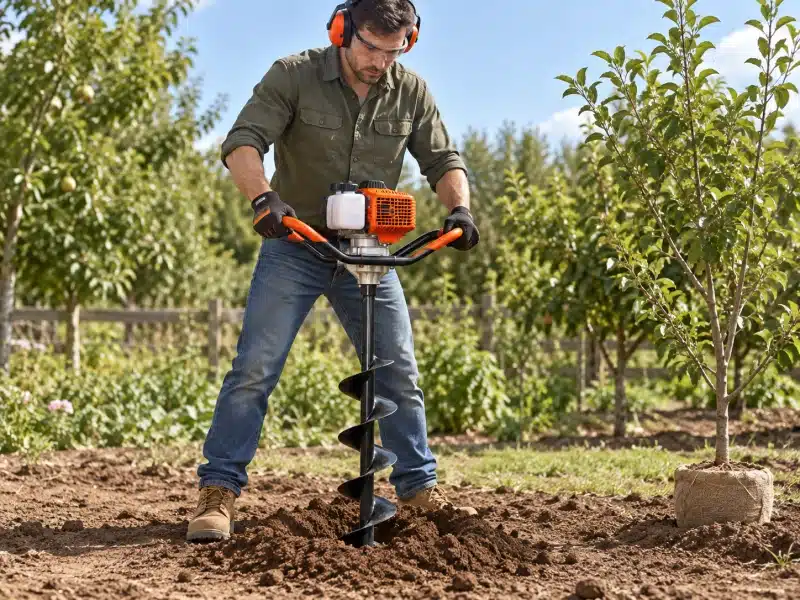
Can You Use an Ice Auger in Dirt or an Earth Auger on Ice?
Firstly, let's discuss the most prevalent temptation, which is using the tool you already have and making it work for the job you need now.
Ice Bit in Soil: Do Not Use It as an Earth Bit
If you take a razor-sharp ice auger bit and drive it into the dirt, you will destroy it.
Ice shaving blades will quickly become dull when exposed to rocks, gravel and sand. When the blades strike a buried root they will flex or chip in pitch. Instruction manuals which have been approved are quite specific: ice bits are for ice only<sup>1</sup>. Do NOT try it in “soft soil” just to see what happens. If you have a super specialized bit the manufacturer says can do both, then only follow the instructions in that particular bit manual; otherwise, for most ice bits available, dirt is a death sentence.
Earth Bit on Ice: Not as an Ice-Cutting Substitute
Likewise, it is not a good idea to take an auger bit on a frozen lake.
Pilot point and digging teeth are designed to cut soil, not ice<sup>1</sup>. It may forcefully bite through the ice, leaving a mess, and may bite violently. A heavy duty earth auger manual will state that it can be used on ‘frozen ground' but this does NOT mean it is safe or effective to be used on solid lake ice. If you have a powerhead that is approved for more than one scenario, you have to change to the ice cutting bit in the powerhead before you step onto the lake.
The Exception Is a Manufacturer-Approved Shared Powerhead
You can only safely cross these boundaries when the manufacturer has specifically made a shared powerhead for both jobs.
For instance, the documentation is specific to the manufacturer and for example the EGO EG0800, ECHO EA-410 and STIHL BT 131 all have individual documentation that outlines specific powerheads that can be used with different bits during different seasons<sup>1</sup><sup>4</sup><sup>6</sup>. If you have an approved powerhead, you can remove the earth bit, attach the official ice bit and go ice fishing.
Don't presume that if one brand is OK to do this, any bit can be used with any powerhead.
How to Check Whether a Powerhead Can Accept Both Bit Types
If you already have a powerhead and wish to purchase a new one for a different season, you have to check compatibility, otherwise you will waste your money.
Match the Shaft, Fastener, and Rotation Direction
Your first challenge is the physical one. The output shaft diameter (typically 7/8" or 1")<sup>7</sup><sup>8</sup> and fastening method (such as shear pin or bolt) must match. Importantly, it is necessary to verify the direction of rotation. If your powerhead rotates clockwise, and you purchase a counter-clockwise bit, you won't be able to cut into the ice or dirt, you'll only be polishing it.
Check Approved Diameter, Depth, Operating Conditions, and Safety Features
Don't assume that a bit can spin on the shaft.
The maximum approved bit diameter and depth must be obtained from the powerhead's manual. An oversized bit or too many extension shafts in combination can overload the transmission. In addition, ensure that the engine or battery system is rated for extreme cold weather use. Last, if you're going from ice to earth, make sure your powerhead has anti-kickback or braking<sup>1</sup><sup>6</sup> to keep you safe when a bit inevitably gets snagged in an underground root.
Ice Auger vs Earth Auger FAQs
Can an ice auger drill post holes?
No, not the ice, per se. Dirt and rocks will immediately ruin the ice-shaving blades. As far as the powerhead, you can drill post holes only if the manufacturer states that you can change the ice bit to an earth bit.
Can an earth auger drill frozen ground?
This will vary greatly according to the type of soil, and what powerhead and bit you are using. Follow manufacturer's guidelines. Never assume that an earth auger will work on frozen ground because it works on summer topsoil and don't mix drilling frozen dirt with drilling solid lake ice.
Can I fit an ice bit to any earth auger powerhead?
No, compatibility needs to be checked by the manufacturer's approved attachment list. Although the diameter of the shaft, connection pin and direction of rotation may be the same, the powerhead must be rated for the load and for cold weather.
Do ice augers always spin faster than earth augers?
Not a universal rule, speed and torque is a function of the gearing of the powerhead. As you can see, there are dual purpose powerheads that prove that the same RPM can do both bit types well, if they are designed right. Always refer to the specifications for your particular model.
What is the best auger to buy?
First, you will have to determine what kind of material you need to cut, the diameter and depth of the holes, and if you have a compatible powerhead already. Your best bet is to purchase a separate auger that is specifically recommended for the job you are looking for, if the manufacturer will not guarantee cross compatibility with your existing auger.
Are auger blades interchangeable across brands?
Do not assume that blades are interchangeable. Different SKUs from the same brand could have different blade geometry, mounting hole patterns, or blade rotation. Always check replacement part number for your particular bit.
Conclusion
The new rule is: For ice, ice auger; for dirt, earth auger. If you wish to use one tool for both of these tasks, you need to check with the manufacturer that the powerhead and bit combination you are using is approved for that purpose. Before purchasing, verify your model number with the official list of attachments in the manual.
Sources
- EGO POWER+ — Earth/Ice Auger Operator’s Manual, EG0800/IG0800
- StrikeMaster — Lithium 24V Ice Auger, 6- and 8-inch drill sizes
- StrikeMaster — Lithium 40V Ice Auger, 8- and 10-inch drill sizes
- ECHO — EA-410 Earth/Ice Auger
- VGT India — 14-Inch Earth Auger Drill Bit
- STIHL — BT 131 Instruction Manual
- EGO POWER+ — AIT0800 8-Inch Ice Auger Bit
- STIHL USA — 2025 Power Tools Catalog
