


An AC electric generator is a device that converts mechanical energy into alternating electrical energy by the process of electromagnetic induction<sup>1</sup>. The principle of operation is that a magnetic field is rotated by a prime mover with respect to the stator windings, thus generating an alternating voltage whose magnitude and frequency are dependent on the design of the machine, its speed, excitation, and control system.
How does an AC Electric Generator work?
An AC generator is a type of electrical machine which converts mechanical energy into alternating current (AC) electricity. Sometimes, the term “alternator” is used instead of AC generator, especially when dealing with synchronous machines in many industries.
Correct terminology must be used. An “electric generator” is a generic term for a machine that can generate either AC or DC, it is not necessarily a DC generator. The “generator head” or “alternator end” is just the electrical generating part, and does not contain the engine. The entire assembly, including the prime mover (engine), AC generator, controlgear and auxiliary systems, is referred to as a “generator set” or “genset.” An example is the standard ISO 8528-1<sup>2</sup> which is specially dedicated to RIC engine-driven AC generating sets.
Alternating current generators are found in various industrial, commercial, and utility applications.
What is the working principle of AC Electric Generator?
Principle of working of AC generator is electromagnetic induction. It does not necessarily be a fixed setup of “spinning magnets” or “spinning coils.” In its place, the relative motion between a magnetic field and conductors causes the magnetic flux linkage to vary with time and thus an EMF to be induced in accordance with Faraday's law.
Step 1, the shaft is rotated by a prime mover.
The shaft is turned by an engine, turbine or other prime mover that provides the mechanical torque.
Step 2, the magnetic flux changes.
The magnetic flux through the stator windings varies with the rotation of the rotor. Put simply:
If the magnetic flux linkage changes, then the induced EMF is proportional to the rate of change of magnetic flux linkage.
The induced voltage now flows in the opposite direction.
In a continuous rotation the relative position of the magnetic poles is changed. This also causes the induced voltage to change polarity every electrical cycle and results in an alternating wave.
A comparison of the Classroom Model to a commercial alternator was done.
A typical diagram of Faraday's law in the classroom features a rotating coil (armature) in a stationary magnetic field and slip rings. In most commercial AC generators, however, the armature (stator) is stationary and the magnetic field is rotated. Stationary terminals provide high-current output while brushless excitation<sup>3</sup> provides the main rotor field via an exciter and rotating diodes.
The frequency and voltage are both controlled by what?
The frequency of a fixed speed synchronous generator is dependent upon the number of poles on the generator and the speed of the rotor<sup>4</sup>:
f = P × n / 120
In the above, f is the frequency in Hertz, P is the number of poles and n is the rotational speed in RPM. A 4-pole machine produces 50 Hz at 1500 rpm and 60 Hz at 1800 rpm.
An automatic voltage regulator (AVR) varies the field strength which results in the control of the voltage at the terminals. The exception to this is an inverter generator which uses power electronics to control the final frequency, rather than relying solely on the engine speed. This is why any 50/60 Hz conversion or speed-control application must be carefully studied for evaluation.

What are the principle components of an AC generator?
To size and maintain an AC generator correctly, it's necessary to know the various parts of the generator and their functions.
- The armature and the stator windings are stationary. A typical rotating-field alternator has the primary armature windings in the stator. The three-phase stator winding is staggered to provide the three-phase electrical offset.
- The rotor rotates in the stator. The magnetic field is created by the field winding (permanent magnets).
- The excitation system is used to power the field, which is known as exciter, rotating diodes, and AVR. The output of the exciter rotor is AC and is rectified to DC by rotating diodes for use by the main rotor in a brushless alternator. The AVR senses the output and adjusts the excitation to control the output voltage.
- Simple rotating-armature design with slip rings to carry out the AC output. However, some wound-field machines use slip rings to provide a small DC current to the rotor for excitation, and a high-current AC output remains stationary.
- These include Shaft, Bearings, Frame, Cooling, and Terminals which offer mechanical support, heat dissipation, environmental protection, and electrical connections.
The engine, governor, fuel system, starting battery, controller, circuit breaker and base frame are all components of the complete generator set and are not the bare generator head.
What is the difference between an AC Generator and a DC Generator?
Both machines operate by means of electromagnetic induction, but in one the output current is in one direction, and in the other it is in the opposite direction and the induced voltage is used.
- Alternating voltage and current cross zero naturally in an AC generator. Mechanical commutation or electrical rectification is used to produce unidirectional output from a DC generator, although it is not necessarily a pure DC.
- Collection/Conversion: AC machines collect the power either by slip rings, stationary stator outputs or modern power electronics as per the design. In the case of traditional DC machines, a more complicated mechanical commutator is used, and modern systems might just rectify an AC source.
- Transformers can easily and efficiently raise or lower AC voltage, suitable for normal voltage distribution. Special power electronics are generally required to convert DC voltage.
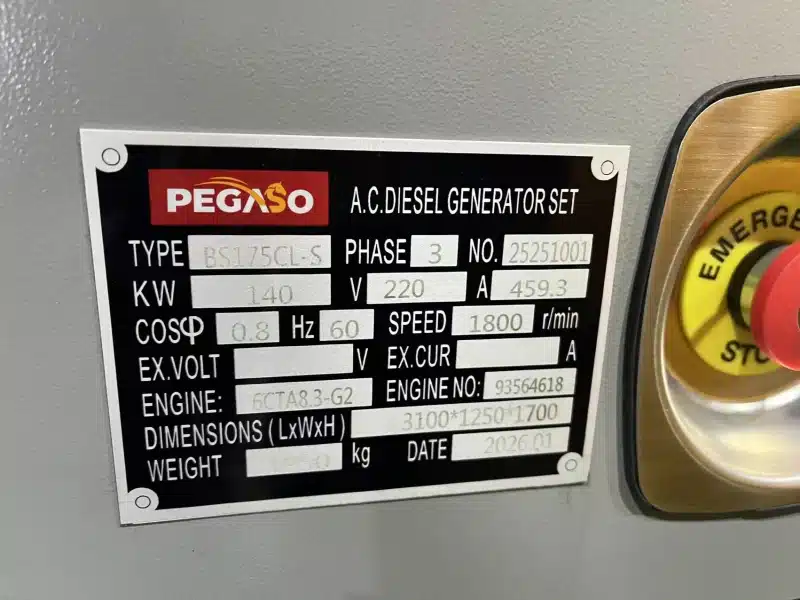
How to Interpret AC Generator Specifications.
When reading an AC generator nameplate, check the rated power but also check to ensure the machine is suitable for the application.
- Voltage, Phase and Frequency: Generator voltage and frequency should correspond to your load and distribution system. Depending on the equipment and distribution architecture, you can select between a single-phase generator and a three-phase generator. For a fixed speed synchronous machine, frequency is directly related to the rpm and the number of poles and the United States 60 Hz standard does not necessarily apply elsewhere.
- The difference between Generator kW and kVA is important to sizing; kW is the difference between kW and kVA and Power Factor. The power to do mechanical work is known as real power measured in Kilowatts (kW) and apparent power is measured in Kilovolt-Amperes (kVA). When operating under balanced conditions, generator power factor<sup>5</sup> relates the two:
kW = kVA × power factor. But selection of a unit based only on the standard 0.8 power factor may lead to overheating of the unit in facilities where the loads are highly nonlinear, impact or unbalanced. - Check the generator's AVR response, voltage regulation, total harmonic distortion (THD) and the generator's standby, prime or continuous rating to ensure it has the correct performance when subjected to actual load steps.
What are the applications of AC generators?
AC generators are used where a steady supply of AC current is needed. These include small portable models for RVs and home backup to large utility class synchronous alternators for hydroelectric and nuclear power plants. In the commercial and industrial environment, AC generator sets are used for prime power at remote mining sites, telecom towers and oil rigs and standby power for data centers, hospitals and manufacturing plants.
What is the advantage and disadvantage of AC generator?
Common Advantages
The biggest benefit of an AC generator is that they can power most building, commercial, and industrial AC loads. Transformers can be used to easily increase or decrease the output voltage. These units can be either single phase or three phase, to meet various power requirements. Excitation systems of synchronous alternators are also capable of exerting good control over the voltage and reactive power.
Practical Limitations
The speed of a conventional synchronous generator should be carefully controlled to ensure a constant frequency. Output quality may temporarily drop in response to a sudden change of load and voltage/frequency dips may result. Sizing is also more challenging when dealing with reactive, nonlinear, or unbalanced loads. If the AC generator is part of a fuel driven genset, you need to consider fuel storage, exhaust emissions, CO risks<sup>6</sup>, noise and electrical safety as well. Although AC power can be used in many ways, DC-specific equipment requires a rectifier or charger.
FAQ about AC Electric Generators
What are the main differences between AC and DC generators?
AC and DC generators both convert mechanical energy into electrical energy using the principle of electromagnetic induction. The key difference is the type of electrical current they produce and the way they are constructed.
What type of power does a generator create AC or DC?
This varies according to the machine and its output. Most of today's generator sets generate AC. In the past, traditional DC generators had a commutator that allowed them to produce unidirectional output, but in modern automobiles, the alternator produces AC, which is then rectified using diodes to provide the DC power needed.
Single-phase or Three Phase AC Generator – What is the difference?
One alternating cycle of the AC voltage is produced by a single-phase generator. The three-phase unit is a three-phase supply that is out of phase by 120 electrical degrees<sup>7</sup>. The selection of the generator is not only based on the physical size of the generator but the type of loads and distribution of locations.
AC Generators and Alternating Current Power
An AC (Alternating Current) generator is an electromechanical device that converts mechanical energy into electrical energy in the form of an alternating current, where the flow of electric charge periodically reverses direction.
Core Operating Principle
AC generators operate on Faraday's law of electromagnetic induction. When a conductor or coil of wire is rotated within a magnetic field, it continuously cuts through magnetic field lines. This motion induces an electromotive force (EMF), or voltage, in the wire. Because the wire rotates through alternating north and south magnetic poles, the induced voltage and resulting current switch directions continuously.
Key Components
- Rotor: The rotating part of the generator, usually driven by an external mechanical source like a steam turbine, gas turbine, water wheel, or internal combustion engine. It creates a rotating magnetic field.
- Stator: The stationary hollow cylinder surrounding the rotor. It contains insulated wire windings where the main electrical output is induced.
- Slip Rings and Brushes: Connected to the rotor shaft, slip rings rotate with the rotor. Carbon brushes press against these rings to maintain a sliding electrical connection, transferring the generated current to the external circuit. (In many modern large-scale generators, the magnetic field is on the rotor and the output is taken directly from the stationary stator, eliminating the need for high-current sliding contacts).
The Alternating Current Waveform
As the rotor completes a full 360-degree rotation, the generated voltage rises from zero to a peak in one direction, drops back to zero, rises to a peak in the opposite direction, and returns to zero, forming a sinusoidal wave.
- Frequency: Measured in Hertz (Hz), frequency dictates how many complete cycles occur per second. In the United States, the standard grid frequency is 60 Hz, meaning the current completes 60 full cycles (reversing direction 120 times) every second.
- Three-Phase Power: Most commercial power generation relies on three-phase systems. Instead of a single coil, the stator holds three separate coils spaced 120 degrees apart. This produces three distinct AC waveforms offset from one another, delivering a smooth, constant power supply ideal for heavy industrial loads and efficient transmission.
How does an ac generator works?
An AC generator operates on Faraday's law of electromagnetic induction. When a mechanical force rotates a coil (armature) inside a magnetic field, the magnetic flux through the coil changes continuously. This continuous change induces an alternating electromotive force (EMF) and current that reverses direction every half-rotation.
Key Elements of the Principle
Energy Conversion: Changes mechanical energy into electrical energy.
Faraday's Law: Voltage is induced whenever the magnetic field lines (flux) passing through a closed loop change over time.
Direction of Current: Governed by Fleming's right-hand rule, which dictates current flow based on the motion of the conductor and the magnetic field
Can an AC Generator charge a battery?
Yes, but it is not possible to connect raw AC to a DC battery. You must have an appropriate rectifier, charger, and battery voltage and current controller designed by a competent professional.
What Size Generator Will Run a House AC?
The required generator size depends heavily on the air conditioner’s running watts, compressor starting surge (LRA), voltage, and any other loads operating at the same time. You cannot size it from cooling tonnage alone.
Is an Inverter Generator Still an AC Generator?
Yes. An inverter generator is an AC generator because its final output is alternating current. It first generates AC, rectifies it to DC, and then converts it back into a highly regulated AC waveform<sup>8</sup>, so engine speed does not strictly determine the output frequency.
Conclusion
Prior to requesting a model recommendation, specify the application, voltage, phase, frequency, kW/kVA, power factor, largest step load, duty, operating environment and required standards of the AC generator or complete generator set to be compared.
Sources
- UK Ministry of Defence — AP3456, Volume 14: Basic Electricity
- ISO 8528-1:2018 — Reciprocating Internal Combustion Engine Driven Alternating Current Generating Sets, Part 1
- STAMFORD | AvK — AGN 093: Excitation System
- Cummins Power Generation — Generator Set Application Manual T-030
- Cummins Power Generation — Application Manual, Appendix G
- OSHA — Using Portable Generators Safely
- ANSI/NEMA MG 1-2016 (Revised 2018) — Motors and Generators, Part 0
- Honda Power Equipment — What Is an Inverter Generator?
