

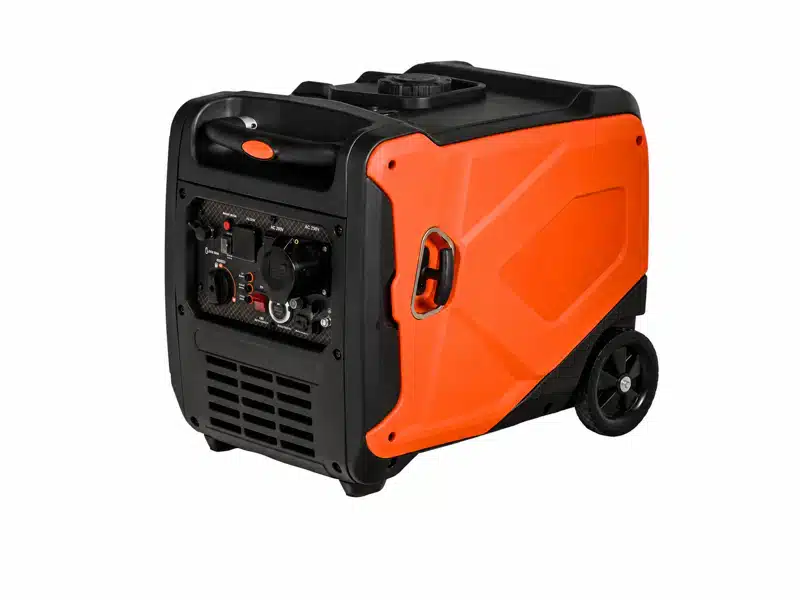
A 5000 watt generator can power a wide range of items.
A 5000 watt generator will typically power a few essential circuits during a power outage, provide 30 amp power to an RV with load management, or power one high starting load at a time. A refrigerator, sump pump, gas-furnace blower, lights, communications equipment, and some kitchen appliances should be able to be turned on, but not simultaneously.
The answer is rooted in one aspect of products that is not always apparent on the label: what does 5000 watts mean – running power or short-duration starting power? Check rated output, maximum output, voltage, limits on outlets and fuel-specific ratings before creating a load plan or comparing a 5000-watt gasoline generator.
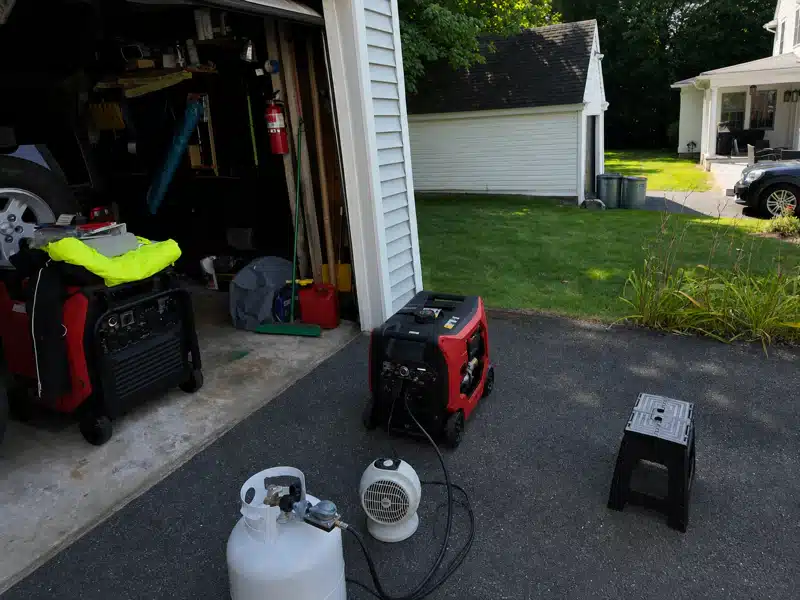
Is 5000 Watt Rated or Starting Power?
Do not presume that all generators labeled “5000 watts” are operating at 5,000 watts all of the time.
This is because of two current manufacturer specifications:
| Published generator class | Running output or rated output | Starting output or maximum output | Meaning to your load plan |
|---|---|---|---|
| Honda EM5000SX | 4,500 W | 5,000 W maximum, with a separate 7,000 W ten-second iAVR rating | Your continuous loads must stay within 4,500 W |
| Champion 201445 on gasoline | 4,000 W | 5,000 W starting | Your continuous loads must stay within 4,000 W |
- Propane fuel – Champion 201445 – 3600W, 4500W starting – less output when changing fuel.
- Natural gas – Champion 201445 – 3,240 W 4,050 W starting – The gasoline rating is not re-usable for natural gas sizing.
Honda EM5000SX specifications (from Honda’s power equipment site) and Champion 201445 specifications (from Champion’s power equipment site).
This distinction alters which you can work concurrently. In both cases, the largest of the published numbers would overestimate the continuous capacity by approximately 11% or 25% — before taking into account limitations from outlets or fuel.
Running Watts and Starting Watts
Running watts are those watts that are required when a device is operating. Starting Watts: The minimum short duration required to start a motor/compressor.
Such as refrigerator, air conditioner, pump, compressor and saw usage can consume a lot of power on start-up compared to when it is in use. Resistive loads have a moderate to small motor starting surge, and usually consume a significant proportion of a generator’s capacity, such as many heaters and cooking elements.
If the starting watts are listed on the appliance table, this is the sizing method to use:
Required Starting Capacity = (Total running watts) + (largest difference between running watts and starting watts).
If the manufacturer specifies “additional starting watts”, then use that number as the additional running load. Only one of the main motors starts at a time is assumed for the calculation. Two compressors can cycle on together, so more headroom or active load control is required.
A 5000 Watt generator can run what?
The following values are taken from the Honda Generator Wattage Estimation Guide. These are not intended to be substitutes for the nameplate or manual of your equipment.
| Appliance/Tool | Approx. running watts | Approx. starting watts | Practical decision |
|---|---|---|---|
| Energy Star refrigerator or freezer | (132–192 W compressor) | or (1,200 W compressor) | Usually OK, compressor can cycle |
| Sump pump, 1/2 HP | 1,050 W | 2,150 W | Usually suitable if other motor starts are controlled |
| Gas/Oil furnace fan, 1/2 HP | 875 W | 2,350 W | Usually OK, check voltage and wiring |
| Window air conditioner, 10,000 BTU | 1,500 W | 2,200 W | Usually suitable with load management |
| Microwave oven, 1,000 W class | 1,500 W | 1,500 W | Suitable, but use it as a temporary high load |
| Flat-screen television, 46 inch | 190 W | 190 W | Low impact on the load plan |
| Laptop | 200–250 W | 200–250 W | Low impact, subject to actual charger rating |
| Electric water heater | 4,500 W | 4,500 W | Can use almost the entire rated capacity. |
| Outside this generator class | 6,750 W | Electric clothes dryer | 5,400 W |
| 1 HP Air compressor | 1,600 watts | 4,500 watts | Usually used separately; hard to use in conjunction with a motor load |
| Heavy-duty circular saw | 1,400 W | 2,300 W | Usually will work if a compressor won’t start |
A power table will indicate if a particular device can run. It doesn’t indicate if your suggested combination will be safe or not. The next step is to model the loads that will be used concurrently.
What can it run at the same time?
Electricity is essential for certain home circuits.Some of the circuits in the home require electricity.
Given those estimates, let’s now take a look at this outage load:
| The load | Running watts | Starting watts |
|---|---|---|
| Refrigerator | 192 W | 1,200 W |
| Sump pump, 1/2 HP | 1,050 W | 2,150 W |
| Furnace fan, 1/2 HP | 875 W | 2,350 W |
| Five lights | 300 W | 300 W |
| Flat-screen television | 190 W | 190 W |
| Laptop | 250 W | 250 W |
| Total running load | 2,857 W | — |
The furnace fan requires the highest extra start-up requirement: 2,350 W – 875 W = 1,475 W. So, the estimated requirement for start should be:
2,857 W total running load + 1,475 W additional surge = 4,332 W.
This may be suitable for a unit with a 4,000 running watt rating and a 5,000 starting watt rating, if the loads conform to the ratings and if no major motors start simultaneously. Even if they are the same names it is still important to check each individual nameplate and where possible sequence the sump pump and furnace fan.
Use the following example to help you solve similar problems.
The same source estimates are used to calculate the running watts of a refrigerator, 1/2 HP sump pump, 10,000 BTU window air conditioner, five lights and a TV, which sum to about 3,232. The biggest extra increase is approximately 1,100 W from the sump pump, and it estimates the starting requirement at 4,332 W.
Very limited space for a microwave, kettle, hair dryer or space heater. A practical approach is to maintain the cold and/or refrigeration systems running and turn off one high load system before it is cooked.
Example 3: Jobsite Tools
Total running watts are approx. 3,300 for a 1 HP air compressor, circular saw and 300 W of lighting. The compressor, however, requires approximately 2,900 W of extra power on start up in addition to its running load, making for an additional 6,200 W requirement.
Tools are not combined, they fit one by one. If both are required, you can:
- Run them in an order.
- Use a compressor that has a lower start-up requirement.
- Use soft-start or manufacturer-approved motor-control solution (if applicable).
- Calculate the load and move to a 6500 watt gasoline generator.
That’s why it’s best to make a jobsite decision based upon the largest motor start (not the watt summation of the motor running).
What size generator is needed to run a house?
A 5000 watt generator can supply electricity to certain circuits, but should not be used as a whole house generator.
It can often provide refrigeration, simple lighting, internet equipment, a furnace blower and one pump or small A/C for a managed schedule. It probably will not be able to power central air conditioning, an electric water heater, electric range, and electric dryer.
When connecting the generator to a building’s electrical system, a transfer switch or approved interlock system should be installed. Always do not take a 30 amp receptacle for granted as proof that a generator is “whole house ready.”
Is it suitable to run central air conditioning?
Don’t make this decision based on tonnage. Check:
- Compressor rated-load amps and locked-rotor amps.
- Supply voltage and phase.
- Blower loads and outdoor-unit loads.
- Generator rated and short duration output.
- If a soft starter is permitted for the particular system.
While a soft starter can help minimize startup demand, it does not ensure compatibility.
Will it operate a furnace or well pump?
Most gas or oil furnace systems primarily need electricity for the furnace blower and controls and would be considered in this category of generators. An electric furnace is a different load, and is typically larger than the furnace.
Well-pump requirements will depend upon the horsepower, voltage, depth and design of the motor. Use a motor nameplate and motor control box instead of a generic “well pump” figure. A 120 V pump cannot be used with a 120 V generator, even if it is rated for that many watts.A 120 V pump will not operate a 120 V generator, no matter how many watts the generator is rated at.
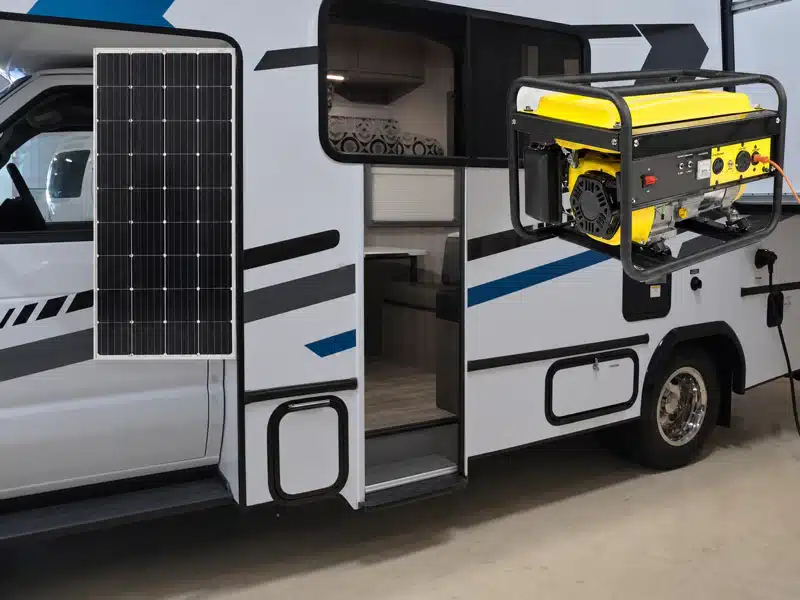
Do you need a 5000W generator for your RV?
A 30 amp RV circuit at 120 volts is a theoretical 3,600 watt circuit limit. The minimum power is the generator’s output, the receptacle breaker, the cord or the adapter, or the RV distribution system. The 4,000 running watts don’t make the 5000 starting watts a 5,000 watts running connection.
However, you might be able to use one RV air conditioner to refrigerate, charge, and use light electronics, but you should figure out the air conditioner’s startup demand and not start the air conditioner when the microwave or the electric water heater is running. When quiet operation and power quality are important, make comparisons with inverter generators and not assume that all open-frame units are the same.
What is the amount of amps that a 5000 Watt generator produces?
For single-phase loads:
Amps = watts ÷ volts.
| Actual continuous output | At 120 V | At 240 V |
|---|---|---|
| 5,000 W | 41.7 A | 20.8 A |
| 4,500 W | 37.5 A | 18.8 A |
| 4,000 W | 33.3 A | 16.7 A |
These figures are used for the total output at the given voltage.
How long will a 5000 watt generator run?
No universal run time for this power class. There are four values needed:
- Fuel type.
- Usable fuel capacity.
- Average output rating for that fuel.
- Runtime at % of load.
The 6.2-gallon Honda EM5000SX lists a 10.5 hour rating at half load and a 7.1 hour rating at rated load.
These are not the averages, but test points for specific models. A higher run time number could be due to a lower draw on the power, a bigger tank, different engine strategy, or a different fuel. If the load percentage and available output is not specified, compare runtimes.
Use manufacturer’s consumption figures for fuel calculations for outage planning at expected load. Next, determine if the unit can be run around the clock, if the unit requires refrigeration, pumping or charging batteries can be planned.
Generator Type and Fuel Choice
Conventional Portable Generator
An open-frame conventional unit will typically focus on ease of construction, motor-starting ability, and ease of servicing. Ideal for building, agricultural application, and home backup systems. Do not assume that all open-frame models operate the same—compare actual noise data and rated output.
When noise isn’t the primary concern, but output per purchase cost and serviceability are more important, see the wider range of petrol generators.
Inverter Generator
An inverter generator changes the speed of its engine and electronically modifies the output. This can lead to lower noise and fuel consumption in partial load and lower harmonic distortion for sensitive electronics. Note that the term “Inverter” does not necessarily imply a certain level of THD, but ask for the specified level and test condition.
Dual-Fuel or Tri-Fuel Generator
The use of multiple fuels provides greater fuel flexibility, but not the same power. The Champion listed above drops from 4000 running watts (gallon) to 3600 watts (propane) to 3240 watts (natural gas).
A battery power station or solar generator.
A battery system comes with two battery ratings:
- Number of watts, indicating its performance and capability to start and run.
- Stored energy in watt-hours, indicating the approximate operating time.
The 5kW inverter rating doesn’t indicate battery run time. There is no combustion exhaust for a battery power station during discharge, but any fuel source generator operating to recharge the battery station should be operated outdoors with the same CO precautions.
When shopping for a generator, it is important to compare the specs.
A good comparison should allow you to duplicate the supplier’s statement and decide if the machine is a good fit for your market and load.
| Specification to verify | Why it changes your decision | Evidence to request |
|---|---|---|
| Running and starting output on each fuel | Defines continuous and motor-starting capacity | Complete specification sheet and load-test method |
| Voltage, frequency, and phase | Determines equipment and market compatibility | Nameplate, wiring diagram, and model-specific manual |
| Receptacles and breaker ratings | Limits the power available from each connection | Control-panel drawing and breaker schedule |
| Voltage regulation and THD | Affects motors, controls, and sensitive electronics | Measured values with load conditions |
| Runtime and consumption | Determines fuel logistics and operating cost | Fuel curve or runtime at stated load percentages |
| Noise | Affects residential, event, and campsite use | dBA value with distance and load condition |
| CO shutoff and market compliance | Affects safety and legal market access | Applicable test reports and certification records |
| Parts, warranty, and service documents | Affects downtime and repeat-order risk | Parts list, warranty terms, and service manual |
If the load you intend to run is comfortably under 4,000 W, then a 4000 watt gasoline generator might be something to consider. If there is a need for two large motors, central cooling or less load rotation, then the upward move must be done after determining the new starting requirement. You can also see the complete range of generators by power class and configuration.
Frequently Asked Questions
Is the power output of a 5000-watt generator enough to run a house?
Generally not in the way of running each circuit on the regular. It can sometimes provide a specific set of vital circuits when the total running and the largest startup surge for the selected circuits are within the model’s ratings. Common load shedding or a larger system is required for electric water heating, electric cooking, clothes drying, or central HVAC.
Which brands are the most reliable for 5000 watt generators?
When looking for a reliable generator in the 4,000-to-5,000-watt range (often classified as mid-sized portable or inverter generators), reliability usually comes down to small-engine build quality, clean power output (low Total Harmonic Distortion), and ease of maintenance.
Can it be used for central air conditioning?
Do not assume so. The required data for the compressor is the data on the compressor’s running and locked-rotor curve, the blower load, supply voltage and the time of generator surging and all other connected loads. The use of a compatible soft starter could reduce the startup demand, but the outcome still needs to be calculated and, for a home connection, professionally reviewed by the electrician.
How long can a 5000 watt generator run continuously??
Runtime is dependent on the model, the tank, the fuel and the load. A 5,000-watt portable generator can often run continuously for many hours, but the actual duration depends on fuel supply, electrical load, and maintenance, not just its wattage.
Typical runtimes on a full tank are:
At about 50% load (around 2,500 watts): 8–12 hours for most gasoline-powered models. At full load (5,000 watts): often 4–8 hours, depending on the generator’s fuel tank size and efficiency. If you keep refueling and perform the required maintenance (such as checking and changing the oil at the intervals specified by the manufacturer), many generators can operate for days during an extended outage. However, most manufacturers recommend shutting the generator down periodically for: Refueling (never refuel a hot, running gasoline generator). Oil level checks and scheduled oil changes. General inspection and cooling if needed. If you know the make and model of your 5,000-watt generator (or its fuel tank size), I can estimate its runtime much more accurately.
What are the main features to consider when choosing a 5000 watt generator?
When choosing a 5000-watt generator, it is important to evaluate several key features to ensure it matches your power needs, safety requirements, and lifestyle.
Is 5000 watts the same as 5 kW?
Yes, mathematically 5 kW is 5,000 W, but on a product label, it can represent rated output, maximum output or starting output. When comparing models, always identify the type of rating and fuel.
Final Decision
A 5000 watt generator works best for a controlled group of circuits, an RV air conditioner and controlled secondary loads or for single tools with a high starting requirement. It is not a substitute for a load calculation.
Prior to choosing a configuration, make note of your voltage, frequency, all continuous loads, largest motor start, preferred fuel requirements, required outlets, and applicable market requirements.
