

Generator Interlock vs Transfer Switch
What Is a Generator Interlock Kit?
A generator interlock kit is a special mechanical switch that is mounted directly to your home’s main electrical panel. It offers a safe way to tie in a portable generator and allows back up power to flow through your existing circuit breakers so that it is safely protected against electrical back-feeding to the power grid.
How a Generator Interlock Kit Works
You operate it by means of a sliding strip of metal or plastic secured on the panel cover between the main utility breaker and the generator breaker. This physical boundary makes sure that you cannot switch ON both power sources at the same time.
- Utility Mode: The metal plate holds your generator breaker in the OFF position while your main utility breaker is in the ON position.
- Generator Mode: You must switch your main utility breaker OFF first. This enables you to slip the interlock plate over and unlock the generator breaker to switch ON the generator.
The interlock kit helps you avoid the dangerous condition of power backfeeding, which could put a lineworker at risk, and does so mechanically by establishing an “either/or” condition.
Interlock kits offer you a wide range of features and benefits, such as:
The features and benefits you get from interlock kits include:
| Feature | Core Benefit |
|---|---|
| Full Circuit Flexibility | You can supply power to the entire panel and select circuits on or off according to your generator capacity. |
| Cost-Efficient | You face much lower hardware and labor costs than with a separate subpanel installation. |
| Save Space | You mount it directly to your electrical breaker panel and do not require extra wall space. |
| Safety | You get equipment that 100% meets requirements for manual transfer equipment when used with your panel. |
What Is a Generator Transfer Switch?
You use a generator transfer switch, an electrical safety device, to permanently join a generator to your home’s main electrical panel. It cuts your electrical system off the main grid so you can use critical appliances via your home wiring system.
When you compare an interlock vs transfer switch for generator power back up, the transfer switch is known for its safety. It prevents backfeeding, a dangerous situation in which your generator power flows back into the power grid, putting power line workers at risk as they work to repair the grid.
You can use both manual and automatic transfer switches.
You can use manual or automatic transfer switches.
You have two main choices when it comes to generators, depending on your power needs and the type of generator you’re looking for:
- Manual Transfer Switches (MTS): You use these mainly with portable generators. When you lose grid power, you manually switch the switch to draw the generator set power.
- Automatic Transfer Switches (ATS): You use these with permanent standby generators. The switch constantly checks the power coming from the grid, and automatically starts your generator and switches your building’s power load to it within seconds of the outage.
| Feature | Manual Transfer Switch (MTS) | Automatic Transfer Switch (ATS) |
|---|---|---|
| Compatible Generator | Portable generators | Whole-house standby units |
| Operation Type | You operate it manually | Fully automated (hands-free) |
| Installation Cost | Lower cost | Higher upfront investment |
| Best Used For | Your targeted circuit backup | Your continuous uninterrupted power |
How a Transfer Switch Operates
You use a transfer switch to segregate electrical circuits and ensure uninterrupted and safe operation:
- Grid Monitoring: In normal circumstances, your power flows from the utility lines, through the switch into the circuit breaker.
- Break-Before-Make Separation: When you transfer to generator power, this type of switch physically disconnects the utility line before connecting the generator line.
- With Targeted Circuit Powering, you safely power only your home circuits or main breaker panel.
- Safe Utility Reconnection: After your main power is restored, the generator feed is turned off, allowing you to reconnect to the grid without electrical problems or surges.
The difference between Interlock Kit and Transfer Switch is quite significant.
Comparing the initial price, circuit flexibility and daily use of your generator can help you narrow down the choice between an interlock vs transfer switch for generator backup power.
| feature | Generator Interlock Kit | Generator Transfer Switch |
|---|---|---|
| Average Installed Cost | $150 – $500 | $500 – $2,500+ |
| Power Flexibility | You can access all circuits at the main panel | You can access only specific load circuits at the main panel |
| Installation Time | 1 to 2 hours | 3 to 6 hours |
| Operation Type | You manage the panel 100% manually | You have manual or fully automatic options |
Installation Cost and Complexity
- Interlock Kit: Your least expensive choice. You can have it installed right on your existing breaker panel with virtually no wiring changes.
- Transfer Switch: You need an extra switch subpanel or hard wiring into electrical lines, which raises your hardware costs and labor time.
Power Coverage and Circuit Control
- Interlock Kit: You gain access to all of your main electrical panel. Each time you want to use your generator, you select the breakers you wish to operate depending upon the wattage of your generator.
- Transfer Switch: You can only supply electricity to pre-selected critical appliances like your refrigerator, lights and HVAC. You cannot power unassigned circuits in the event of an outage.
Safety Standards and Electrical Code Compliance
- Interlock Kit: This mechanism prevents you from turning on the main utility breaker at the same time as the generator breaker, which helps prevent dangerous grid backfeeding. You need to match the brand of your panel for NEC compliance.
- Transfer Switch: You get a stand-alone, factory-tested switch designed to separate utility power from back-up power. It complies with all national electrical requirements and the strict municipal codes, as delivered.
Ease of Operation and Convenience
- Interlock Kit: You operate it 100% by hand. In a blackout, you must manually shut off the main breaker, move the interlock bracket, turn on the generator breaker and manage individual load switches.
- Transfer Switch: With manual models, you use a switch toggle on each circuit. With automatic transfer switches (ATS), you get automatic detection of power loss and seamless switching between power sources without manual intervention.
Pros and Cons of Generator Interlock Kits
When you determine which option is best for your home, your decision between an interlock vs transfer switch for a generator protection switch hinges on two factors: cost and convenience. Generator interlock kits provide you with a simple, code compliant, affordable method to power your home.
Several benefits to using a generator interlock kit.
- Low Equipment and Installation Costs: You get budget-friendly interlock kits that require less equipment and lower installation costs compared to a transfer switch.
- Whole-Panel Access: You can access all of the main electrical panel breakers, allowing you to choose which rooms to power.
- Space-Saving Build: You mount it directly on your existing breaker panel faceplate, so you do not need a large sub-panel on your wall.
- Simple Mechanics: You get simple, heavy duty metal plates that do not fail easily and do not need to be replaced.
Limitations of Generator Interlock Kits
- Manual Load Balancing: You need to manually switch off high-wattage breakers (such as central air or water heaters) to avoid putting too much strain on your generator.
- Strict Panel Compatibility: You need each kit to be compatible with your electrical panel (brand, model, breaker spacing, etc.).
- No automatic transfer: You must manually go to the breaker box each time the power goes out.
Pros and Cons of Generator Transfer Switches
You receive our recommendation to use transfer switches if you value safety and smooth operation, based on our role as a generator manufacturer providing backup power solutions to the world. When you compare an interlock vs transfer switch for generator hookups, transfer switches provide you with a powerful, high-performance power management solution.
The benefits of generator transfer switches
- Automated Power Switching: You get this from automatic transfer switches (ATS), which automatically sense a loss of power on the grid and switch to the back up power.
- Maximum Electrical Safety: You keep generator power out of the grid, preventing backfeeding dangers to utility workers and your home electronics.
- Pre-wired Subpanel designs: You get targeted load control, allowing your generator to power only essential loads such as refrigeration, pumps, and heaters, thus avoiding generator overload.
- Strict Code Compliance: You get compliance with National Electrical Code (NEC) and local regulations on safe residential generator connections.
The disadvantages of generator transfer switches
- Higher Upfront Cost: You pay substantially higher equipment prices and much more expensive specialized electrician installation fees than for a basic interlock kit.
- Fixed Circuit Selection: With standard subpanel transfer switches, you can only energize circuits that you have previously selected, which means you cannot energize different circuits on a whim.
- Complex Installation: You need a lot of wiring and electrical panel work and professional labour for proper installation.
How Does an Interlock Work With a Portable Generator?
You use an interlock kit as a safe, mechanical method of directly connecting a portable generator to your home’s main electrical panel. Its sliding metal plate attaches to the panel cover and prevents you from turning on the main utility breaker while the generator double-pole breaker is on. This prevents backfeeding into the utility grid and enables you to backpower your main panel if the power goes out.
You can follow the easy step by step operation sequence below:
- Utility Power Off: Disconnect from the grid by switching off the main utility breaker.
- Slide the Interlock Plate: Slide the mechanical interlock device up or side to side. This movement mechanically operates the main breaker to the OFF position and unlocks the generator breaker.
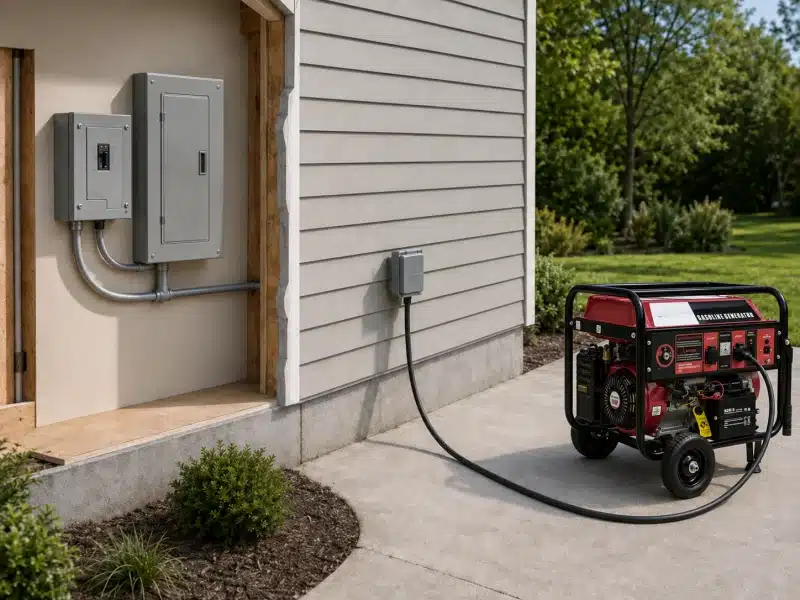
- Connect the Portable Generator: Use a heavy duty generator cord from your portable generator to the exterior power inlet box from the panel.
- Start and switch on your portable generator; switch the dedicated generator breaker to ON and allow the generator to warm up.
- Select Circuits: Independently power on or off individual branch breakers to control how much power you use for your generator’s wattage capacity.
Then, when utility power comes back, you just do the same thing: power off the generator breaker, move the interlock plate back into place, power on the main utility breaker and turn off the generator.
How Does a Transfer Switch Work With a Portable Generator?
You use a transfer switch, a special control device, to plug your portable electric generator straight into your home’s electrical system. You use it to isolate specific circuits and provide safe, clean electricity to critical loads, preventing the back-feed from the critical load to the utility grid.
- Connect the generator: Use a heavy-duty power cord to connect your portable generator to an outdoor power inlet box that is directly wired to the transfer switch.
- Start the engine in an open, well-ventilated area, outdoors, allowing it to level off.
- Switch the control toggles on the transfer switch panel between Line (utility power) and Gen (generator power).
- You directly power pre-selected breakers, providing electricity to essential appliances such as refrigerators, well pumps, heating systems and lighting circuits.
Once grid power is restored, just switch back to utility power and de-rate the generator. You get a 100% dedicated system that provides backup power in a controlled environment and is designed to safeguard your home electronics and utility line workers.
Interlock vs. Transfer Switch: Which Is Right for Your Home?
Your choice between an interlock vs transfer switch for generator power is simply a matter of cost, panel arrangement and convenience. You can choose from our power units of all types, configurations and sizes, but you must identify the right power source for the connection method to guarantee safe and reliable back-up power during power failures.
| Factor | Generator Interlock Kit | Generator Transfer Switch |
|---|---|---|
| Best For | Your budget-friendly, whole-panel flexibility | Your dedicated critical circuits & automation |
| Upfront Cost | Lower equipment & installation costs | Higher equipment & installation costs |
| Circuit Selection | Flexible (you can power any circuit within generator capacity) | Fixed (hardwired to your specific chosen circuits) |
| Operation | You operate it manually | You have manual or fully automatic options |
When to Choose a Generator Interlock Kit
Use a generator interlock kit for the highest circuit flexibility at the least cost.
- You need less equipment and less labour time for an electrician to set up.
- With whole-panel access, you can switch each circuit on or off individually with an individual breaker, up to your generator’s wattage capacity.
- Simple manual backup: Ideal if you are more comfortable taking care of power use during a power outage.
When to Choose a Transfer Switch
If you primarily focus on safety, seamless power switching and automatic operation, select a generator transfer switch.
- Automatic power transfer: You get automatic activation of backup power when the grid goes down with automatic transfer switches (ATS), best for standby generators.
- Essential circuit isolation: You get essential circuit isolation for refrigeration, sump pumps, HVAC, medical equipment and more.
- Strict local codes: You comply with strict municipal codes, in which interlock kit connections for back-up generators may not be allowed.
Frequently Asked Questions
Where can I buy reliable generator interlock kits and switches?
You can find reliable, safety-certified (such as MET or UL listed) generator interlock kits and manual transfer switches through several major nationwide retailers, specialized electrical suppliers, and direct manufacturer.
What are the main types of generator interlock kits available?
Generator interlock kits are classified primarily by the brand and model series of the electrical panel they are designed to fit, rather than generic universal styles. Because breaker spacing, main breaker orientation, and deadfront configurations vary completely from one manufacturer to another, using a mismatched kit will result in an improper and unsafe fit.
Which transfer switch is best for a home backup generator?
When choosing the best transfer switch for a home backup generator, the right option depends primarily on whether you are using a portable generator or a permanent standby generator.
How do I install a generator interlock switch safely?
Installing a generator interlock switch is a critical home safety project. The primary purpose of an interlock mechanism is to mechanically prevent your utility main breaker and your generator backfeed breaker from being in the “ON” position at the same time. This stops dangerous electrical backfeeding, which can electrocute utility linemen or destroy your generator when grid power returns.
Can a generator interlock kit be used with any generator model?
No, a generator interlock kit cannot be used with just any electrical panel, though it is largely independent of the generator model itself.
Thoughts: Generator Interlock vs Transfer Switch
Your choice between an interlock vs transfer switch for generator backup power depends on what you value more: safety, convenience or budget. You have our strong recommendation to use a transfer switch for its many protection features, ease of use and reliability.
