

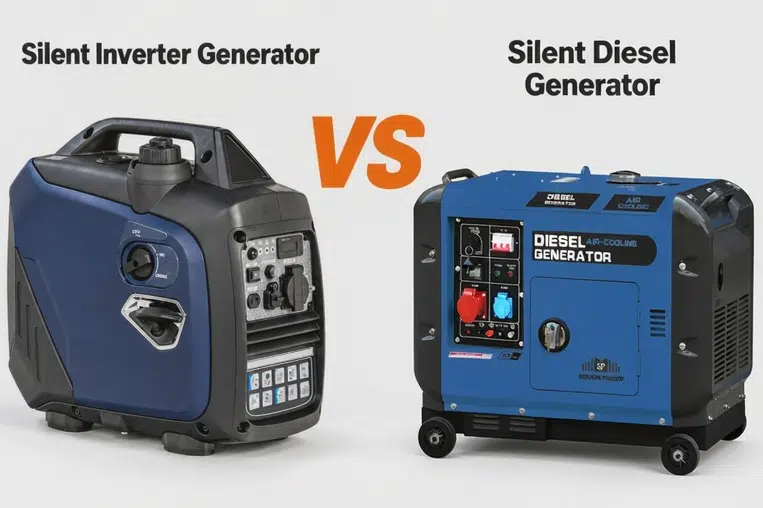
When selecting a generator, many users often compare diesel generators and inverter generators on the same basis, and even consider them to be interchangeable product types. In fact, this is a very common misconception in the generator industry.
Diesel generators belong to fuel type, while inverter generators belong to power generation technology. For example, diesel AVR generators, diesel inverter generators, and gasoline inverter generators, all of which are commonly found on the market.
Through understanding what’s the difference between diesel generator and inverter generator, you’ll have a more clear decision about which kind of generator is best for your needs.
U.S. Market Example: Diesel Generator vs. Inverter Generator
Here are two commercially available generators with similar power ratings, providing a quick side-by-side comparison of their prices and key specifications.[^1]
| Diesel Generator | Inverter Generator | |
|---|---|---|
| Fuel Type | Diesel | Gasoline |
| Running Power | 5,000 W | 5,500 W Rated (7,000 W Peak) |
| Price (MSRP) | \$4,689 | \$4,899-\$4,999 |
| Runtime | 32.4 hr @ 50% Load | Up to 16 hr @ 25% Load |
| Fuel Tank | 12 gal (45.4 L) | 5.1 gal (19.3 L) |
| Weight | 252 lb (114 kg) | 263 lb (119 kg) |
| Noise Level | Typically higher (open-frame diesel design) | 52-58 dBA |
| THD | <6% | Inverter-quality clean power for sensitive electronics |
What is a Diesel generator?
A diesel generator is a power-generating device that uses a diesel engine as its power source.
Advantages of Diesel Generators
- High torque: High levels of torque can be produced at low RPMs.
- High fuel efficiency: Uses less fuel to produce a given level of power than many of its counterparts.
- Long runtime: Long runtimes can be achieved.
- High power: Reliable high power output, suitable for demanding commercial and industrial situations.
As a result, diesel engines have been the go-to option for medium to high power within the industry.
If you need a power source for a number of hours or even days then diesel generators will be a more cost-effective option. Diesel engines will have lower fuel consumption rates compared to petrol generators. A 10kW diesel engine will run at around 2.5-3.0L/hr when running at full load whilst a petrol generator of similar class will typically run at 4-5L/hr. This means that diesel engines can often have a better TCO.[^2]
What is an Inverter Generator?
An inverter generator does not refer to a specific type of fuel. It describes a method of handling electrical energy.
Traditional generators use an AVR in their output circuit. Inverter generators, as a newer technology, are capable of keeping THD within 3% to 5%. Traditional AVR units, on the other hand, often operate within a range of 5% to 15% or even higher, depending on the design and load conditions.[^3]
Benefits of Inverter Generator
- Cleaner Power Output: Produces clean, stable electricity with low THD (Total Harmonic Distortion) so can be used on sensitive electronics.
- Lower Noise Levels: Produces less noise thanks to variable engine speeds and noise reduction technology, especially when under partial load.
- Better Fuel Efficiency at Partial Loads: Improved fuel efficiency under partial loads thanks to engine speed being adjusted to suit the required power.
Diesel Generator vs. Inverter Generator: Understanding the Difference

Power Range
Most inverter generators will have between 1 and 8kW of power. Some premium models go up to 10-15kW but they aren’t that common. This level of power will provide you with power to run your fridge, lights, TV, computer and even some air conditioners around your home.
In contrast, diesel generators cover a much wider range of power outputs. Diesel engines are very common in applications ranging from small backup units of around 5 kW to industrial units capable of generating several megawatts.
- Residential backup diesel generators: 5–20 kW
- Commercial building backup power: 20–500 kW
- Hospitals, data centers, and industrial parks: 500 kW to several MW
There are even diesel generators on the market with a single-unit capacity exceeding 2,000 kW, yet there are virtually no corresponding inverter generator products in this power class.
Runtime
Diesel generators will have an advantage over invert generators with regards to running time. This is because they already have a higher thermal efficiency than gas powered engines and will therefore use less fuel. They will also often have bigger fuel tanks. A 5-10KW diesel generator will often have a large fuel tank of 15-30L or more, which means it can be run constantly for 10-20 hours, or even longer if run at 50%.
Conversely, most inverter generators have smaller fuel tanks to keep their size and weight down. A common 2–4 kW inverter generator usually has fuel tank capacities of around 4–10 L and can run for about 6–18 hours at 25%–50% load. Although inverter technology can improve fuel efficiency by automatically reducing engine speed, due to limitations in engine displacement and fuel tank capacity, their overall runtime is still shorter than that of comparable diesel generators.
Load Compatibility
Both diesel and inverter generators can power a range of equipment, however they have their specialties when it comes to what load they can power. In general diesel generators will be more suitable for high power, heavy and continuous loads. Whereas inverter generators will be more suitable for electronic loads where high power quality is required.
| Comparison Factor | Diesel Generator | Inverter Generator |
|---|---|---|
| Heavy-Duty Equipment | Better suited to water pumps, air compressors, welding machines, and construction equipment. | Better suited to smaller motor-driven equipment within its starting and rated power capacity. |
| Starting Surge | In most cases, it handles high starting currents more effectively, depending on engine and alternator capacity. | Limited by its rated and surge output capacity. |
| Sensitive Electronics | Suitable when equipped with adequate voltage and frequency regulation. | Provides stable voltage, frequency, and typically lower THD for sensitive electronics. |
| Variable-Speed Equipment | Can power variable-speed HVAC systems, refrigerators, and heat pumps if output specifications are adequate. | Offers stable power for electronically controlled motors and appliances. |
| Extended Operation | Better suited to sustained, heavy-duty operation when rated for continuous or prime power. | Portable models are often better suited to intermittent or variable loads. |
| Typical Applications | Construction sites, mining, agriculture, and industrial facilities. | Camping, mobile workstations, residential backup, and electronic equipment. |
Maintenance Requirements
Diesel Generator
Maintenance of diesel generators primarily focuses on the engine system. Because diesel engines operate with high compression ratios, they are subjected to significant internal mechanical stress.
Therefore, the engine oil, oil filter, fuel filter, and air filter must be replaced regularly. At the same time, long-term storage of diesel fuel can lead to contamination from moisture, impurities, or microorganisms, so the fuel system also requires regular inspection and maintenance. For commercial and industrial units, manufacturers will specify basic maintenance every 250 to 500 operating hours. Although diesel generators have a long service life, maintenance is required relatively frequently.[^4]
Inverter generator
Inverter generators usually have simpler routine maintenance. Maintenance procedures are similar to those for standard small engines and include oil changes, cleaning the air filter, and inspecting the spark plugs.
However, inverter generators include additional components such as rectifiers, inverters, control boards, sensors, and power electronic modules. When these electronic components malfunction, repairs are often more complex than with traditional diesel generators.
Which Generator Should You Choose? Matching Technology to Operating Conditions
There is no single generator that is best for every application. The right choice depends on how the generator will be used, what types of loads it will power, and how long it is expected to operate.
Diesel Generator is more suitable for:
- Need sustained power for extended operating hours or continuous heavy-duty applications.
- Operate high-power equipment, such as industrial machinery, water pumps, air compressors, and construction equipment.
- Require high starting capacity to handle large motor loads and starting surges.
- Need a high-capacity power source for construction sites, mining operations, agricultural facilities, or industrial applications.
- Have access to regular engine maintenance and diesel fuel supplies.
Inverter Generator can be your first considerations if you:
- Need clean, stable electricity for sensitive electronics, computers, medical devices, and communication equipment.
- Prioritize low noise levels for residential, recreational, or noise-sensitive environments.
- Frequently operate at partial loads and want engine speed to adjust to changing power demands.
- Need a compact, lightweight generator for transportation, outdoor activities, or mobile workstations.
- Require portable backup power for short-term or intermittent applications.
Why are most inverter generators on the market gasoline-powered?
Although diesel inverters are technically feasible, gasoline-powered inverters still dominate the current market. There are three main reasons for this:
Initial cost
The inverter unit includes rectifier modules, power electronics, DSP controller and cooling systems. However, diesel engines are more expensive to produce than petrol engines, so combining both can cause the product price to increase significantly. In the 3-8kW portable market, where price is highly sensitive, petrol driven inverters are more competitive.
Weight
Diesel engines are more heavy-duty and have higher compression ratios. So a 3kw petrol inverter generator can be very lightweight at just 25-35kg but the diesel equivalent could be over 70kg. Because of this they are not ideal for camping, RV’s and other mobile applications.
Market Demand
The largest user groups for inverter generators are RVs, camping, and home backup power. The advantages of diesel generators are not what these users value most. The target markets for the two do not completely overlap.
Conclusion
At present, inverter generators are a more modern product. They have become more popular with changes in market demand. Users now are more interested in how well their generator can provide quality power, low noise, portability and smart features. Diesel generators were created in an age where having reliable high power was key. So they were designed to be reliable and provide high power.
FAQs: Diesel Generator vs Inverter Generator
Can a diesel generator be an inverter generator?
Yes. Diesel and inverter are two different terms. Diesel generators can also use inverter technologies to provide a stable AC output.
Are diesel generators more fuel-efficient than inverter generators?
Not necessarily. Diesel generators will perform very well under constant high load conditions. Inverter generators can cut down on fuel consumption by varying the engine speed when under partial loads.
Which generator is cheaper to maintain?
Inverter generators will be simpler to carry out basic maintenance on. Additional work will be required on the fuel system of diesel generators. Repairs to the inverter module can be expensive. It depends on the model you have and the conditions they are being used in.
