

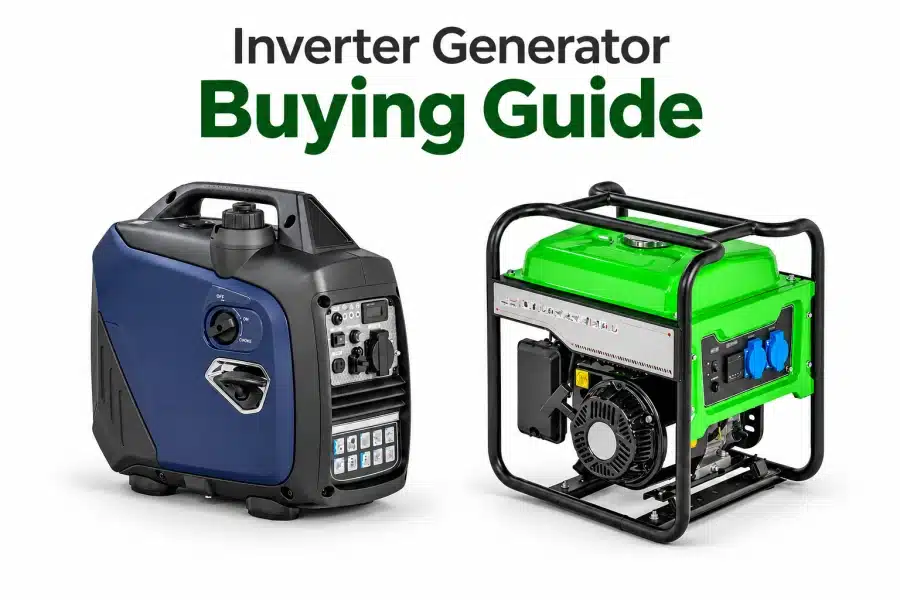
Bulk purchasing an inverter generator can be a complicated process. There are many things you will want to consider, from the power capacity, fuel type and running costs. Below we have outlined each of these in detail to help you make informed purchasing decisions and create a product portfolio that meets your requirements and market demands.
Define Power Capacity Requirements Before Ordering
Consider Rated Watts and Starting Watts
- Rated Watts is the amount of power you can expect to get out of your generator continuously over a long period of time. It is your main benchmark for regular usage.
- Starting Watts is the extra amount of power needed to start your equipment. This will only last a few seconds.
An inverter generator with a rated power of 4500W could provide between 5000-5500W.[^1]
Calculate Generator Capacity for Bulk Procurement
A common mistake when buying devices in bulk is to consider just the power rating of individual devices. A calculation should be performed considering the total load. Add an adequate percentage depending on the application:
- Emergency backup: 20%-25%
- Commercial usage: 25%-30%
- Future proofing: 30%+
We recommend using Capacity Groups to pair inverters of varying power ratings to your application.
| Capacity group | Typical rated output | Potential applications |
|---|---|---|
| Small capacity | Below 2,000W | Small tools, portable equipment |
| Medium capacity | 2,000–4,000W | Jobsite tools, mobile operations |
| Large capacity | 4,000–7,000W | Multiple tools, larger equipment |
| Extra-large capacity | Above 7,000W | Higher-demand commercial applications |
Account for Operating Conditions When Selecting Capacity
The nominal output power measured under laboratory conditions may not be fully achievable in actual field conditions. Due to high altitude, high ambient temperatures and continual use, there will be a decrease in the output capacity. Many engineers will only operate the load at 70% to 80% of the generator rated power to give greater reliability and a longer service life.
Consider Motor Loads and Starting Demand
Start-up loads are often the primary cause of incorrect capacity selection. The start-up current of common equipment can reach the following multiples of the rated operating current:
- Refrigerator compressors: 2–3 times
- Water pumps: 3–5 times
- Air compressors: 4–7 times
- Some HVAC motors: 6 times or more
For example, an air compressor rated at 2,000 W may require up to 6,000 W on start up. If there are several motors in the system then a 6-8kW generator may be required even though the total running load is only 4,000 W. Therefore, when purchasing, you should confirm:
What is the equipment with the highest starting current?
Will they start simultaneously?
Will soft starters or variable-frequency drives be used?
Verify Electrical Specifications and Compatibility
Voltage and Frequency Requirements
Before buying any inverter generators in bulk, make sure they can provide the correct voltage and frequency. Most portable inverter generators available on the market in the U.S. are either:
- 120V / 60Hz: Perfect for lighting, office equipment, communication systems and small tools.
- 120V / 240V / 60Hz (Dual voltage): The 240V is great for using air conditioners, water pumps, large electrical motors or building equipment.
Output Waveform and Total Harmonic Distortion (THD)
Many devices require a clean AC wave of the correct voltage. Pay particular attention to whether the device produces a true sine wave and has a low total harmonic distortion (THD) when buying.[^2]
| THD Level | Typical Application |
|---|---|
| < 3% | Servers, UPS systems, medical equipment, telecommunications |
| < 5% | Computers, TVs, battery chargers, electronic controls |
| > 10% | Primarily suitable for basic resistive loads and some power tools |
Outlets, Connectors, and Parallel Capability
The configuration of output outlets directly affects on-site operational efficiency. Even if two generators have the same power rating, there may be significant differences in the actual number of loads they can support. When purchasing, check for the following:
- 120V household receptacles
- 120/240V locking outlets
- TT-30 RV outlets
- USB charging ports
- Industrial connectors
For example, a 5 kW inverter generator that provides only two 120V outlets may not be able to meet the demand for multiple devices to be connected simultaneously. However, a model equipped with L14-30R locking outlets can be connected to a distribution panel to supply power to multiple circuits.
Parallel capability has become an essential feature of many inverter-based generators. By using a special parallel operating kit, 2 units of the same inverter generator can be connected together to provide a higher output than a single unit. The ability to operate in parallel provides more flexibility for hire companies, chain stores and procurement teams working on multiple project sites.
Compare Fuel Types and Operating Costs
Gasoline vs. Propane vs. Dual-Fuel Inverter Generators
| Factor | Gasoline | Propane | Dual fuel |
|---|---|---|---|
| Fuel availability | Depends on local supply | Depends on local supply | More flexible |
| Fuel storage | Requires appropriate storage | Requires suitable cylinders | Requires both |
| Runtime | Depends on tank capacity and load | Depends on cylinder capacity and load | Depends on selected fuel |
| Maintenance | Fuel-system maintenance required | Different fuel-system requirements | More components to maintain |
Many procurement professionals tend to compare runtime directly, but this often does not accurately reflect a product’s operating costs. A more reasonable approach is to compare fuel consumption rates under the same load conditions. We recommend requesting the following operating condition data from suppliers:
- 25% load
- 50% load
- 75% load
Even if two products perform similarly, the fuel preference can be quite different. Typically urban and suburban housing would use gasoline models. Areas with a propensity to experience natural disasters like hurricanes and blizzards would prefer dual fuel models for their ability to switch fuels.
Evaluate Noise Performance Through Standardized Testing
Inverter generator noise is typically measured in dB(A). A-weighting simulates the human ear’s perception of sounds at different frequencies, making it the most common method for evaluating noise in the generator industry. It is important to note that decibels are not a linear unit of measurement. A difference that appears to be only a few decibels may be quite noticeable in actual use.
When purchasing, you should also confirm which measurement method the manufacturer uses, Sound Pressure Level (SPL) or Sound Power Level (SPL). Since the vast majority of promotional materials for inverter generators use SPL, purchasers must further verify the test conditions.[^3]
When comparing suppliers’ products, you should request that they provide complete noise test conditions. We recommend focusing on verifying the following:
- Measurement Distance: 10 ft or 23ft.
- Operating Load: 25% Load, 50% Load, 75% Load, and 100% Load.
- Testing Environment: Whether exist sound-reflecting surfaces or background noise interference.
Some manufacturers publish the minimum noise level and eco mode noise level. However, these figures typically correspond to minimum load conditions. Purchasing personnel should prioritize understanding typical operating noise and rated load noise. Because these figures more closely reflect real-world operating conditions.
Check Spare Parts Availability
Before placing an order, confirm the availability of key replacement parts, including:
- Air filters and spark plugs
- Recoil starters and ignition components
- Carburetors and fuel-system parts
- Inverter modules and control boards
- Voltage regulators and electrical components
- Control panels, outlets, and switches
For inverter generators, electronic components such as inverter boards are often the most expensive and time-consuming parts to replace.
Verify Batch Consistency and Production Quality
Assessing whether the products were produced in a production batch that would give reliable performance. If two inverter generators with the same rated power show large performance variances such as real power and run time, this could indicate problems with the engine, inverter module or quality assurance of the product during manufacturing.
Pre-shipment inspection (PSI) is an important part of bulk purchasing. Suppliers may be required to provide test documentation from the manufacturing facility to show basic performance and functionality tests have been completed.
Verify Certifications and Regulatory Compliance
It should not be assumed that all certifications apply to every inverter generator. Purchasers should verify applicability based on product design, target market, and sales requirements.[^4]
Common Certifications and Standards for the U.S. Market
| Certification / Standard | What to verify |
|---|---|
| EPA | Applicable emissions compliance requirements |
| CARB | California emissions requirements, where applicable |
| ANSI/PGMA G300 | Applicable portable generator safety requirements |
| UL 2201 | Applicable carbon monoxide safety and performance requirements |
| FCC | Applicable electromagnetic compatibility requirements |
| CSA | Relevant certification requirements for the Canadian market |
Conclusion: Choose a Supplier, Not Just a Generator
When purchasing Inverter generators in bulk, you will need to consider many factors such as quality, supply chain and running costs. You will also need to consider the product value of the generators when purchasing compared to an individual customer. Ensuring that the models you purchase are suitable for your business in the long term.
Often when purchasing, you will not want to purchase the most powerful or cheapest option available but instead find a balance between performance, reliability, cost and support. By having criteria for how you select your suppliers and purchasing processes in place, you can reduce risks associated with your purchase, improve your stock management and provide a more consistent product for your end customers.
