

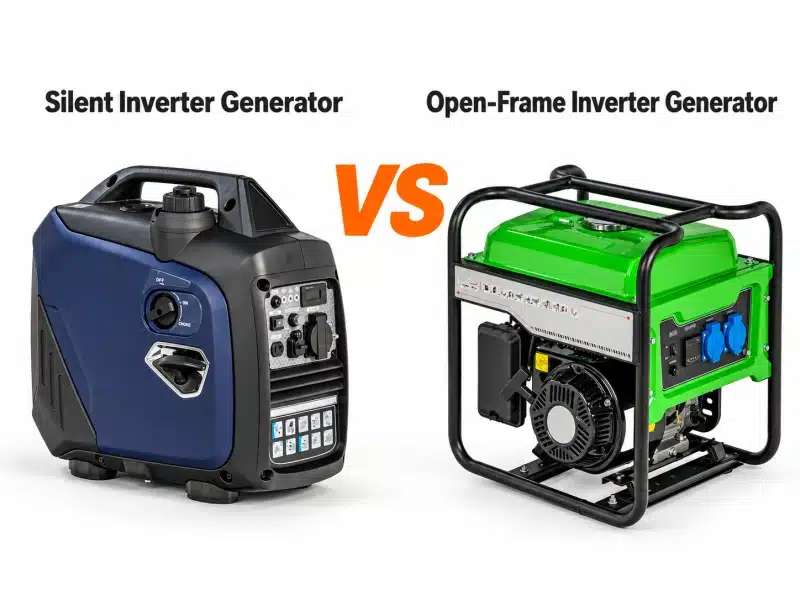
When considering inverter generators, there’s no real difference in the quality of the power delivered by open frame or closed frame. They both produce a clean sine wave with low harmonic distortion electric power. However, there are some considerations when choosing one type of generator over the other.
Open-frame inverter generators offer great value for budget and have excellent cooling and ease of maintenance. Unfortunately they are much louder and also offer very little protection. Closed-frame inverter generators have sound dampening casings so produce less noise. However, they are maybe more expensive, heavier and harder to maintain. In this article we’ll look into why you might be faced with this problem and consider the main factors when choosing a generator: noise, cooling, protection and maintenance.
Quick Overview Chart: Open-Frame vs. Closed-Frame Inverter Generators
The following comparison uses two gasoline-powered inverter generators with the same rated and maximum output. Their specifications illustrate differences between two specific models, not universal performance differences between all open-frame and closed-frame generators.
| Factor | Open-Frame | Closed-Frame |
|---|---|---|
| Rated output | 3,000 W | 3,000 W |
| Maximum output | 3,300 W | 3,300 W |
| Weight | 26 kg | 22.5 kg |
| Visibility | Components are exposed | Components are enclosed |
| Cooling | Air-cooled | Air-cooled, with enclosed housing |
| Noise | 72 dB(A) at 7 m | 68 dB(A) at 7 m |
| Maintenance | Easier access to components | May require opening service panels |
| Best for | Construction sites, workshops, and outdoor work | Camping, RV use, and noise-sensitive environments |
Both products are gasoline-powered inverter generators; while their rated and maximum power outputs are identical, they differ in terms of engine displacement, fuel tank capacity, and operating modes.
What Is the Difference Between Open-Frame and Closed-Frame Inverter Generators?
The main difference is the physical enclosure surrounding the engine, alternator, inverter, and related components.
Open-frame inverter generators feature exposed engine and generator components protected by a steel-tube frame, lacking a fully enclosed casing. In contrast, closed-frame inverter generators are housed within a completely enclosed shell made of plastic or composite materials, concealing their internal components.
Noise Levels
The casing of a closed-frame inverter generator can reduce the transmission of engine and mechanical noise to the outside. Therefore, in terms of noise control, closed-frame models are usually superior to open-frame generators.
If the interior of the shell is lined with sound-absorbing materials and the air inlet and outlet are also designed for noise reduction, the overall noise reduction effect of the closed-frame model will be more significant.
When comparing the noise levels of open and closed frame inverter generators, consider the following:
- Sound Level (dBA): This is the value of the A-weighted sound level measured under certain conditions.
- Distance: For example 7m (approximately 23ft). The sound level will change depending on the distance.
- Load Level: 25%, 50% or 100%. Low load information will not give you an accurate idea of how noisy it will be at full load.
- Operating mode: Check whether Eco Mode is enabled, since it may reduce engine speed under lighter loads.
- Testing Conditions: Ensure that the test is being done using the same conditions. This includes where the noise was measured, background noise in the area and standards adhered. How it was tested will affect the numbers given. This could be sound pressure level (dB(A)) or sound power level (dB).
Some products will list their noise level as “51 dBA at 25% Load (22ft)”. This gives you a better idea of how to compare.
The difference in noise levels isn’t purely down to it being an open or closed frame. The overall noise level will depend on several factors, such as engine size, speed, mufflers, fans, load and sound insulation.
If the data has been gathered under differing conditions then you won’t be able to compare it. Try to look for values given by manufacturers under the same conditions.
Cooling and Airflow
Open-frame inverter generators will generally offer better cooling abilities. Whilst a closed-frame model will have a specially designed intake and ducting for the cooling air to flow through, therefore more reliant on fans and thermal management inside.
Products in the market will give specifications on how they are cooled, for example air-cooled engines, cooling fans, or airflow. The airflow can be given in units of CFM or m3/h. If the airflow is given by the manufacturer you can compare the values but should also consider resistance in the ducting and airflow distribution.
If you are comparing the thermal performance of two generator designs, it is recommended to prioritize looking for the following data:
- Cooling airflow
- Operating temperature
- Rated output at high ambient temperatures(>40°C)
- Component temperature
Notice: Cooling performance should be evaluated by whether a generator can maintain its rated power output under high ambient temperatures. A well-designed cooling system helps prevent overheating and power derating, allowing the generator to deliver stable output under demanding thermal conditions.
Maintenance Accessibility
Open-frame inverter generators generally provide more direct access to internal components. Maintenance can easily be carried out with the ability to check the condition of components, connections and clean any dust. Some models have quick drain oil lines or easy access drain bolts to allow access when changing the oil. The operation manuals will give detailed information on how to carry out tasks like draining oil, cleaning air filters and checking spark plugs.
Closed-frame inverter generators need to open or remove access panels to reach internal parts. This adds extra steps to certain maintenance tasks. However, an enclosed design does not necessarily imply that maintenance is difficult. Some models feature tool-less side access panels that allow direct reach to the oil filler port and air cleaner, while others, designed 10 years ago, may require a screwdriver to remove a panel for access to the muffler. The actual level of maintenance difficulty depends on the location and opening mechanism of the access points, as well as the layout of the internal components.
How to Choose the Suitable One Between Open-Frame and Closed-Frame Inverter Generators
Choose an open-frame inverter generator if you prioritize:
- Power supply capacity: The rated power of open-frame inverter generator products on the market is concentrated between 4000W and 9500W. Many closed-type models fall within the 2000W–7000W range.
- High-temperature environments or prolonged continuous operation: When the ambient temperature reaches 35°C or higher and the unit operates under a sustained load of 80%–100%, an open-frame design offers superior thermal management.
- Long-term maintenance: Open-frame inverter generators are more convenient to maintain on a daily basis.
Choose an closed-frame inverter generator if you prioritize:
- Quiet operation: For units of the same power rating, open-frame models usually produce 65–75 dB(A), while closed-frame models produce 52–65 dB(A). A difference of around 10 dB is very noticeable to the human ear.
- Backup power supply near the residence: The devices that usually require a power supply in a household do not operate at full capacity continuously. In addition, residential environments usually place more emphasis on appearance and space management.
Match the Generator to the Application
| Application | Key selection priorities |
|---|---|
| Construction and outdoor work | Power capacity, durability, service access |
| Workshops | Noise, operating hours, servicing |
| Camping and RV use | Noise, weight, runtime |
| Residential backup | Required loads, runtime, safe placement |
| Commercial fleets | Service time, operating cost, parts support |
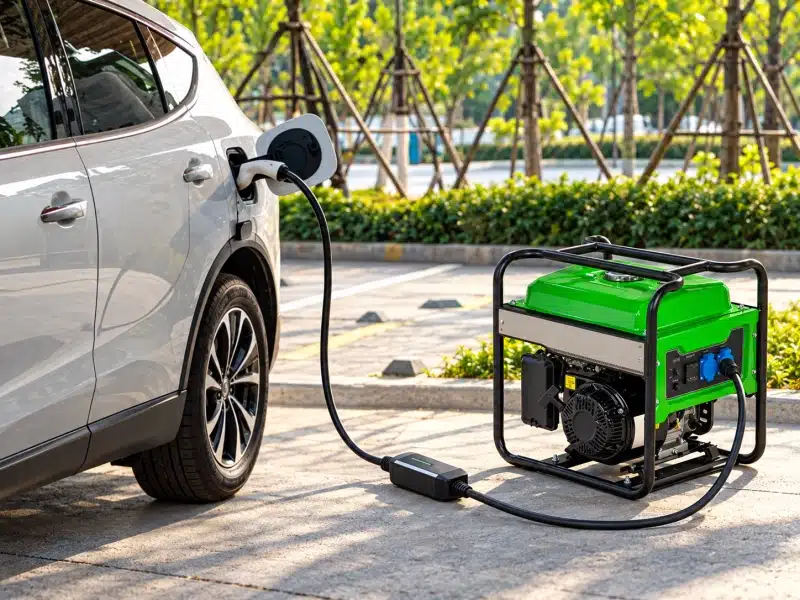
Does a Closed Frame Mean Waterproof?
In reality, a closed-frame inverter generator isn’t waterproof. Water can get into the generator through the vents, air intake and cooling system when it rains. There is a build up of snow or a high level of moisture. This means closed-frame inverter generators can often not be used in the rain.
However, the closed-frame’s housing will indeed help protect the engine, inverter and electrical parts from getting dusty, leafy, dirty and messy. It can also provide extra protection when the generator is being stored and transported.
If you need to use your generator in bad weather, use a purpose-built generator cover, a protective tent, or a dedicated, permanent generator enclosure. Check the manufacturer’s instructions and any documented ingress protection (IP) rating1. Do not infer a product’s water resistance from its appearance or the presence of an enclosed housing.
FAQs: Open-Frame vs. Closed-Frame Inverter Generators
Are closed-frame inverter generators better for camping and RV use?
Generally, yes. Closed-frame inverter generators tend to be quieter and more compact. Before purchasing, evaluate sound levels, weight, power and cooling requirements.
Are open-frame inverter generators more powerful?
Not necessarily. The amount of power produced by an inverter will depend on the engine, alternator and inverter. You should compare the rated and starting watts.
Are closed-frame inverter generators easier to transport?
Not always. Although closed-frame inverter generators tend to be smaller they can be heavier due to the casing. You better compare the total size, weight and if there are handles or wheels.
Which is more cost-effective, an open-frame or closed-frame inverter generator?
Generally open-frame inverter generators can be cheaper to purchase. They are great for job sites and regular outdoor use. Closed-frame inverter generators can be more expensive due to the casing and sound dampening. The best value will depend on purchase price, how much fuel it uses, how much it will cost to maintain, and what you will be using it for.
Sources
International Electrotechnical Commission (IEC). IP ratings. Source linked in the original article for ingress protection ratings. ↩
