

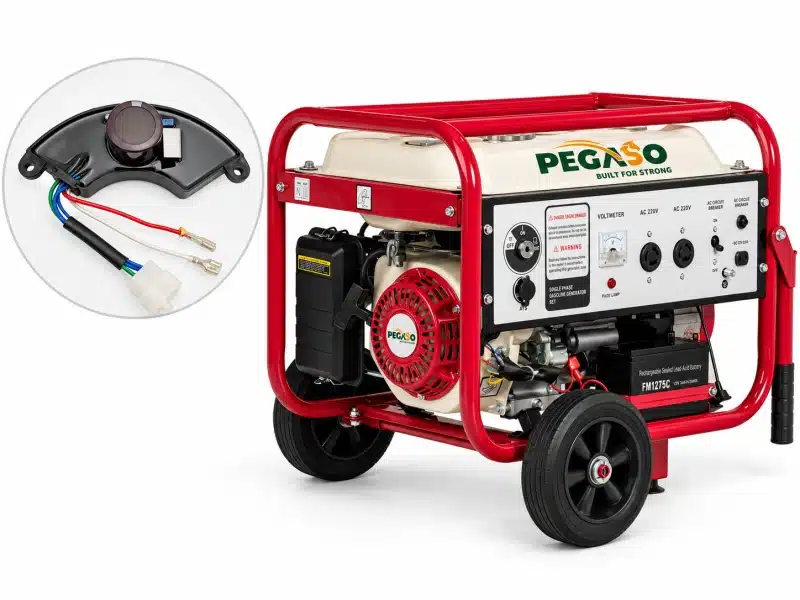
When selecting a generator, voltage stability does not necessarily mean it can reliably power all equipment. Motor startup can cause voltage sags, sensitive electronic devices may have higher power quality requirements, and non-linear loads can also affect the generator’s output performance. AVR and inverter generators use different voltage regulation methods, and their load adaptability depends on their specific design and rated parameters.
This article will compare the differences between these two technologies in terms of voltage regulation, response to sudden load changes, and load compatibility, helping you choose the right generator based on your actual power needs, rather than making a decision based solely on the “AVR” or “Inverter” label.
AVR vs. Inverter Generator: What is the Difference?
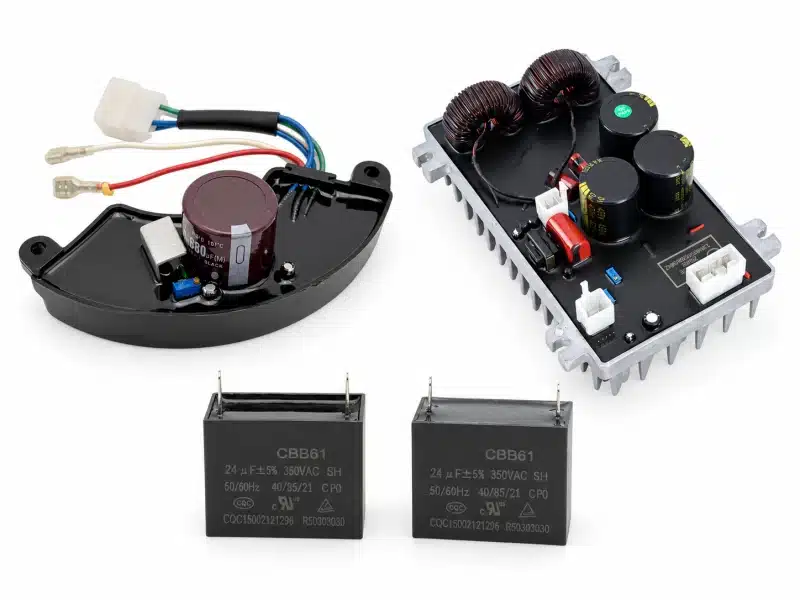
AVR (Automatic Voltage Regulator) refers to a voltage-controlled device, not a single type of generator. Primarily used to regulate the generator’s output voltage, keeping it as stable as possible when the load changes.
Inverter generators use rectification and inversion technology to control the output power. The power generation process typically begins by rectifying the generated electrical energy into direct current, which is then converted by an inverter into the required alternating current.
| AVR Generator | Inverter Generator | |
|---|---|---|
| Technology | Automatic Voltage Regulation | Rectification and Inversion |
| Voltage control | Stabilize voltage by adjusting the excitation current | Control the output voltage via an inverter |
| Frequency Control | Closely related to engine speed | Controlled by the inverter and does not need to directly follow the engine speed. |
| Waveform quality | Depends on generator design and load conditions | Relatively stable output waveform |
AVR Generator not equal to conventional generator:
- Conventional generator: Generators not equipped with an AVR are generally referred to as capacitor-excited generators. They rely on large capacitors and rectifiers to produce their output current and voltage.
- AVR Generator: Emphasizes generators equipped with AVR voltage regulators.
- Inverter Generator: Use rectification and inverter technologies to control the output electrical energy of generators.
Therefore, AVR and inverter are not the same. An AVR is a voltage regulation device, while an inverter is a power conversion technology. When comparing products, you should examine the technical specifications of the specific models.
AVR vs Inverter Generator: Voltage Regulation
Both AVR Generator and inverter generator can control voltage, but the control methods are completely different, so there are obvious differences in voltage stability.
AVR Generator: Regulating Excitation Current
In simple terms, the generator directly outputs alternating current, and the AVR just constantly corrects the voltage level. However, AVR does not control the waveform, nor does it directly control the frequency.
Inverter Generator: Regenerate electricity
The alternating current generated by the engine is first rectified into direct current, and then the inverter module uses power electronic devices and a microprocessor to re-synthesize new alternating current. Therefore, it not only controls voltage, frequency, and waveform, but also keeps all three stable simultaneously.
When comparing the voltage stability of two technologies, the following metrics can be used:
- Steady-state voltage deviation: The difference between the output voltage under a stable load and the rated voltage.
- Transient voltage deviation: Maximum voltage deviation occurring during a sudden load change.
- Voltage recovery time: The time required for the output voltage to recover to the specified range.
- Frequency deviation: The difference between the output frequency and the rated frequency.
For example, a generator with a rated output voltage of 120 V may briefly drop to 110 V during a sudden increase in load, then recover to 120 V. Looking only at the final voltage does not fully reflect its performance. Therefore, when comparing two specific products, one should, as much as possible, use the same load variation range, power factor, rated output conditions, and measurement methods. Only when test conditions are comparable do voltage regulation data provide meaningful reference value.
AVR vs Inverter Generator: Load Compatibility
The core difference between AVR generators and inverter generators regarding load compatibility is not simply a matter of which one can power more devices; rather, it lies in how each type handles inrush currents, fluctuations in load, and requirements for power quality.
Whether many devices can operate stably does not depend on whether the voltage is 120V, but on:
- Is the voltage stable?
- Is the frequency stable?
- Whether the waveform is clean (THD)
- Whether it can withstand instantaneous impact loads
- Whether it is compatible with nonlinear electronic loads
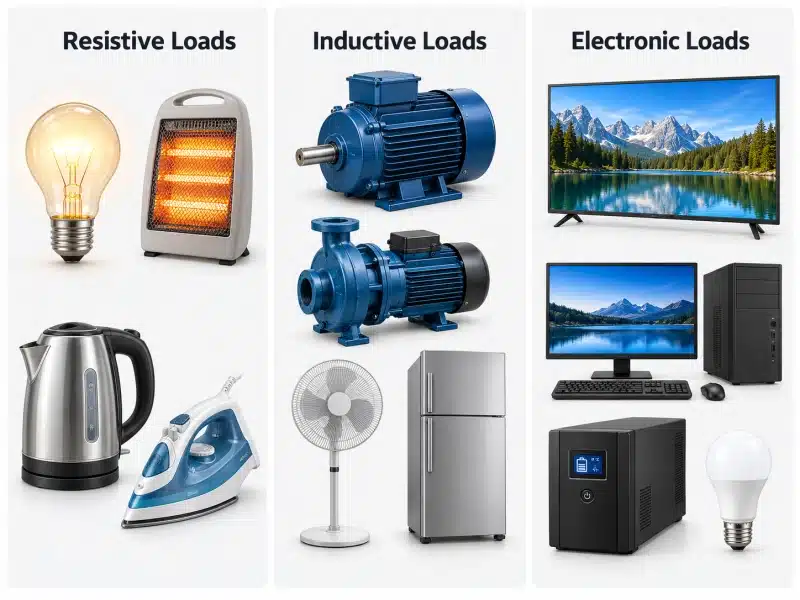
From the perspective of generators, loads can roughly be classified into four categories:
| Load Type | Typical Equipment | Focus |
|---|---|---|
| Resistive load | Electric heaters, incandescent lamps | Power |
| Inductive load | Water pumps, air compressors, and electric motors | Starting current |
| Electronic load | Computers, servers, televisions | Waveform quality, THD |
| Nonlinear load | UPS, inverter air conditioners, EV chargers | Harmonics, voltage stability |
1.Motor Loads
AVR generators generally offer good compatibility with equipment that draws high inrush currents, such as water pumps, air compressors, power tools, and cutting machines. These devices are classified as inductive loads, which can generate inrush currents ranging from 3 to 6 times the rated current or even higher at the moment of startup.
Traditional AVR units are often equipped with larger alternators and higher rotational inertia, enabling them to provide strong transient surge capacity. As a result, they are widely used on construction sites, in agricultural irrigation, and in industrial settings. Even if the voltage drops briefly, motor-type loads can usually start and operate normally.
For example, a 5-kW motor has an operating current of approximately 20 A, while its starting current can reach 60 to 120 A. Many AVR units can withstand instantaneous surges of 200% to 300%.
Early inverters suffered from insufficient surge capacity. However, many products have since been improved. Their starting capacity often reaches 1.5 to 2 times the rated power. Nevertheless, overall, they are still generally less capable than AVR units of the same power rating.
2. Sensitive Electronics
For sensitive electronic loads such as laptops, servers, medical devices, and communications equipment, power quality is often more important than power capacity. These devices extensively utilize switching power supplies and precision electronic components internally, making them relatively sensitive to waveform quality.
Industry data shows that the total harmonic distortion (THD) of traditional portable AVR generators usually ranges from 5% to 10%, whereas mainstream inverter generators can generally keep THD below 3%, with many products even falling below 2.5%, approaching the quality of utility grid power. Therefore, in scenarios requiring extended operation of computers, network equipment, or medical devices, inverter generators are generally considered the more reliable choice.
3. Nonlinear Loads and Dynamic Load Changes
Inverter-based air conditioners, heat pumps, inverter-based refrigerators, and certain electric vehicle charging stations are typical examples of nonlinear loads. The power requirements of these devices fluctuate continuously, and they contain a large number of power electronic components. Therefore, they place higher demands on the stability of the input power supply than traditional loads.
In practical applications, inverter-based generators typically adapt better to this dynamic load environment. They are particularly effective at maintaining stable operation when compressors start and stop frequently or when the load fluctuates continuously. While traditional AVR generators can power such devices, they generally require a larger power margin during rapid load changes to prevent frequent protection trips or operational instability.
4. UPS and Server Loads
UPS1 and server systems are among the applications that best illustrate the differences between AVR and inverter generators. When an AVR generator experiences frequency drift or high THD due to load fluctuations, the UPS may detect this as an abnormal power source and frequently switch to battery power mode, resulting in increased battery wear and even compromising the system’s stable operation.
In contrast, inverter generators with low THD typically offer better compatibility. Therefore, for data centers, communication base stations, network equipment rooms, and other critical IT facilities, the industry generally prefers power supply solutions with THD below 5%, or even below 3%.
Conclusion
Inverter generators offer more advanced power conversion technology. As the technology matures and manufacturing costs in China become more competitive, inverter models are becoming an increasingly attractive choice over conventional AVR generators, even at the same power output. This trend may gradually reduce demand for traditional AVR models.
Can a Generator Have Both AVR and Inverter Technology?
Yes. In the real-world market, AVR and inverter are not necessarily mutually exclusive.
Some high-power or hybrid power generation systems utilize both technologies to ensure both power generation stability and output power quality. However, for the portable inverter generators that most users encounter, whether or not a unit is equipped with an AVR is often not a key consideration when selecting a model.
Many mainstream inverter generators on the market already deliver excellent voltage stability and low-harmonic output. From a purchasing perspective, a generator labeled as both an “AVR” and an “inverter” does not necessarily outperform a standard inverter generator. Similarly, the mere presence of an AVR does not guarantee that the output quality will meet the requirements of sensitive electronic equipment.
Sources
Lenovo. UPS glossary. Source linked in the original article for the term UPS. ↩
