

The process of conversion of chemical energy in gasoline into electrical energy by a gasoline generator is done in two major parts; these include the internal combustion engine and the alternator. The fuel is burnt to drive the crankshaft, while the alternator changes the rotational force into electrical energy using electromagnetic induction.
To run a normal portable gasoline generator, you should first switch off the circuit breaker, ensure that the choke is closed, and also put the fuel valve to the ON position. Pull the recoil to start the engine and open the choke gradually when the engine starts running. When the generator runs smoothly, switch the circuit breaker on and connect the appliances to the power outlets of the generator.
However, how does a gasoline generator work between the pull of the starter rope and the power supply of the appliance? This manual will provide a full explanation of the process of gasoline combustion in the engine and electricity generation from the alternator.
How Does Gasoline Generator Work
Four steps in a set order.
Carburetor blends gasoline with air. Cylinder burns the blend, and expanding gas pushes a piston driving a steel shaft. The shaft rotates a magnetic field across the stationary copper windings and induces electric current. And the voltage regulator regulates voltage to produce usable power.
All gasoline portable generators work the same, performing all four steps from the fuel tank to outlet.
| Stage | Main components | What happens | Form of energy |
|---|---|---|---|
| 1. Fuel and air mixing | Fuel tank, petcock valve, air filter, carburetor | The carburetor meters liquid fuel and atomizes it with filtered outside air into a combustible mist. | Chemical potential energy |
| 2. Combustion and rotation | Cylinder, piston, spark plug, connecting rod, crankshaft | A timed spark lights the compressed mixture. Expanding gas drives the piston down and turns the crankshaft. | Thermal energy into mechanical energy |
| 3. Electromagnetic induction | Rotor (rotating magnetic field), stator (stationary copper windings) | The rotor’s magnetic field sweeps across the stator coils and moves electrons back and forth. | Mechanical energy into raw AC |
| 4. Voltage regulation and output | Automatic Voltage Regulator (AVR) or inverter board, circuit breakers, outlets | Electronic controls stabilize voltage and frequency before current reaches the receptacles. | Conditioned AC electrical power |
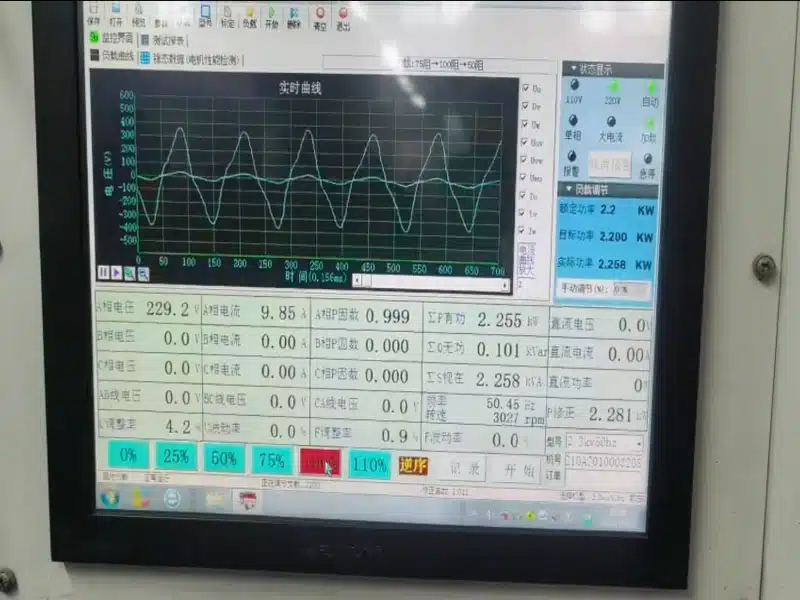
Each stage depends on the one before it. Starve the carburetor and the engine slows down. Change engine speed and the outlets feel it immediately.
Core Components Inside a Gasoline Generator
Open the frame and you find two assemblies bolted face to face. Engine on one side, alternator head on the other. They share the crankshaft, so every engine revolution is also one revolution inside the alternator.
[Fuel Tank] ---> [Carburetor] <--- [Air Filter]
                      |
                      v (Atomized Fuel-Air Mist)
           +---------------------+
           | Cylinder & Spark Plug|  (ENGINE SIDE: Converts chemical
           |       [Piston]      |   energy into linear motion,
           |          |          |   then spins the crankshaft)
           |     [Crankshaft]    |
           +----------|----------+
                      | (Direct Mechanical Coupling)
           +----------v----------+
           |       [Rotor]       |  (ALTERNATOR SIDE: Spins magnetic
           |  (Inside [Stator])  |   field inside copper coils to
           +----------|----------+   induce AC electricity)
                      |
                      v (Raw AC Current)
         [Voltage Regulator / AVR] ---> [Control Panel Outlets]
The engine side meters the fuel, burns it, and gets rid of the heat:
- The fuel system is a gravity-fed steel or plastic tank, a shutoff valve, and a carburetor that mixes fuel with incoming air.
- Combustion happens inside a cast-aluminum cylinder block. It gets intensely hot, so deep fins on the outside of the block and a flywheel blower fan work together to hold the engine below its maximum operating temperature.
- The piston, connecting rod, and crankshaft catch the downward force of combustion and turn it into torque.
- The spark plug and magneto are the high-voltage ignition system. Magnets on the flywheel trigger the spark near the top of the compression stroke.
- A mechanical governor senses engine speed and moves the carburetor throttle plate as the electrical load changes.
The alternator side picks up where the engine block ends:
- The rotor, or armature, is the moving magnetic component. It sits on the tapered end of the crankshaft.
- The stator is a stationary ring of insulated copper windings around the rotor. The two never touch.
- An Automatic Voltage Regulator (AVR) module or an electronic inverter board keeps voltage spikes off your appliances.
- The control panel holds the circuit breakers and receptacles, typically 120V/240V in the US or 230V in Europe. Thermal breakers trip when the current draw is too high.
How Fuel and Air Mix in the Generator Engine
The small spark will not ignite liquid gasoline in the cold cylinder; hence, the carburetor breaks the fuel into mist and mixes it with oxygen.
The fuel valve opens and the gasoline travels through a rubber line into the carburetor float bowl where it is measured by a floating plastic piece which floats on the surface and blocks the fuel intake valve when the bowl is full. This is what ensures that a constant stream of gasoline is available under the air inlet passage of the carburetor.
Pull the recoil cord or the electric start button to make the piston move down and create a vacuum. This pulls the outside air into the carburetor through a paper or a foam filter and into the narrow passage that is known as the carburetor throat.
- The airflow becomes greater when it moves through the restriction.
- With increased velocity comes a reduction in the static pressure relative to the atmospheric pressure affecting the gasoline contained within the float bowl.
- It results in a pressure gradient and forces the gasoline to rise up in a fine brass tube called the main jet and splits it up into tiny particles due to the fast-moving airstream.
- A round brass butterfly valve known as the throttle plate determines the proportion of the mixture delivered to the engine by a mechanical or electronic governor that constantly acts on it so that engine revolutions remain constant during starting of heavy appliances.
The main jet and its passages can measure less than one millimeter across. Fuel condition matters a lot at that size. Old gasoline breaks down and evaporates, and it leaves a sticky, gummy film called varnish. The film clogs the jet, the engine runs short of fuel vapor, and it fights you on every pull of the cord. Fuel that stale will not burn itself clear, either. You have to drain the old gas and clean the varnish out of the carburetor to get the engine back.
Combustion and Mechanical Rotation by the Piston and Crankshaft
Spray about 14.7 parts of air to one part of gasoline in weight into the cylinder, and it will start converting chemical potential energy into mechanical rotation. Almost any modern portable generator is equipped with a four-stroke Otto-cycle reciprocating engine1. One power impulse involves four strokes of the piston.
- Intake and compression. The intake valve opens; the piston goes down; the fuel-air mixture gets inside the cylinder; the intake valve closes. The kinetic energy of the flywheel of cast iron shoves the piston upward, compressing the mixture to one-eighth of its original volume. This increases the temperature and pressure of the mixture.
- Ignition and rotation. When the piston approaches the top of its stroke, the magneto produces high-voltage discharge in the spark plug’s gap. The mixture ignites, expanding very fast and driving the piston downward. The piston is connected to the crankshaft journal by means of a connecting rod made of steel, converting linear motion to rotary motion.
- Exhaust. With the opening of the exhaust valve, the piston goes up again, pushing the products of combustion out of the cylinder through the muffler.
Carbon monoxide warning. Every exhaust stroke puts out colorless, odorless carbon monoxide (CO) in high concentration. Read the CDC generator exhaust safety guidelines2 before you run one. Keep a gasoline generator outdoors and at least 20 feet from windows, doors, and vents. Do NOT run it in a garage, a basement, a shed, or a covered porch, even with the doors wide open.
How the Alternator Uses Electromagnetic Induction to Create Electricity
By now, the engine has created torque but not electrical energy. Torque won’t power a fridge. In the alternator, torque will be turned into electricity. This is done through the principle that Michael Faraday discovered, called electromagnetic induction.
Electromagnetic induction is the process of producing electrical current by having a magnetic field move past a conductor like copper coils. The changing magnetic field causes free electrons in the copper coil to move. If the direction of the magnetic field is reversed, then the direction of the flow of the electrons is also reversed, and that is Alternating Current (AC).
Function of the Rotor and the Stator
There are two electromagnetic components inside the aluminum housing of the alternator; they are kept apart by an air gap that is just a few millimeters.
- Rotor is the rotating magnet. The rotor is mounted on the crankshaft and contains wire coils on iron core or permanent magnets on small generators. Small DC excitation voltage activates the wire coils to produce the magnetic rotor.
- Stator is the fixed copper coils. The stator is made from a thick cylinder of steel plates, slotted to hold bundles of insulated wires. The ends of the coil are connected to the voltage regulator and further on to the control panel terminals.
The rotor passes through the air gap and does not come in contact with the stator so that magnetic poles and stationary winding never touch each other.
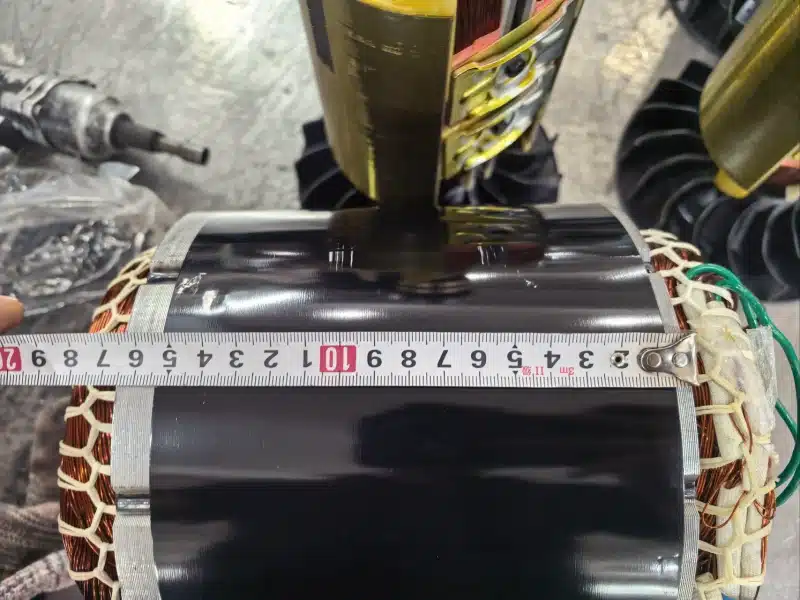
How Electromagnetic Induction Works Inside the Alternator
Spin the rotor fast and its north and south poles take turns sweeping past the stator’s copper coils. A north pole pushes electrons through a coil one way, which is a positive voltage peak. A fraction of a second later, the south pole passes the same coil and pushes them back the other way, which is a negative peak.
Repeat that reversal and you have Alternating Current (AC) in a sine-wave pattern. In the United States, a conventional portable generator with a two-pole alternator typically runs its engine at 3,600 RPM, or 60 revolutions per second, to produce a 60 Hertz (Hz) alternating current waveform that completes 60 full cycles per second. In Europe and most other regions using 50 Hz power, the same principle puts the engine speed at 3,000 RPM, or 50 revolutions per second.
Sizing the stator is a separate question. It has to carry both the continuous running watts and the starting surge from inductive loads, and that calculation rests on the relationship between active, reactive, and apparent power in AC systems3.
Voltage Regulation and Usable Electrical Output
Connect an appliance to the stator directly by its bare copper wires and you won’t have that appliance very long. Generator output depends both on the rotor speed and the size of the load attached to it.
Connect any heavy device, like a pump or an air-conditioner compressor, and it starts exerting magnetic resistance against the stator. This is known as the counter-electromotive force and it lowers the rotor speed and output voltage for some time. Disconnect the heavy equipment and the voltage will rise faster than the mechanical governor adjusts the throttle.
Generators get rid of this problem in one of the two ways before the current reaches your outlets.
In most traditional gasoline generators that have an open frame, the Automatic Voltage Regulator (AVR) plays a role in ensuring that the output voltage remains constant when the electrical loads fluctuate. The AVR controls the output voltage of the generator by regulating the excitation of the alternator magnetic field. The AVR does not produce any electrical energy. On the other hand, the engine governor regulates the throttle to control the speed of the engine.
In contrast, the inverter generator does not rely solely on the engine’s constant speed to determine the AC frequency but regenerates the waveform by first converting the raw AC voltage output by the alternator into Direct Current (DC).
Choosing Between AVR and Inverter Output for Household Appliances
The Total Harmonic Distortion (THD) number is the measurement of waveform purity. Household appliances controlled by microprocessors require a low THD value that corresponds to IEEE 519 harmonic control standards4 in order to avoid overheating circuit boards or disruption of zero crossing timing signals.
The regulation system you have will determine what devices you are able to use during the power outage.
AVR generators usually provide sine wave output at 5% to 20% THD levels. Old induction motors and simple resistive loads are not sensitive to this degree of waveform distortion along with brief frequency fluctuations from 58 Hz to 62 Hz. Standard open-frame AVR generators will operate incandescent lighting, LED work lamps, resistive heaters, coffee pots, old-style refrigerators and chest freezers with mechanical thermostats, standard sump pumps, and universal motors of tools such as circular saws and drills.
An inverter generator holds pure sine-wave THD below 3%, and some loads need exactly that. Devices with sensitive microprocessors, digital clocks, or solid-state rectifiers can malfunction on distorted AVR power, refuse to charge, or lose a control board to it. Inverter output is the better match for a modern high-efficiency gas furnace, whose control board may simply lock out on a rough waveform, and for CPAP machines, oxygen concentrators, desktop computers, and Uninterruptible Power Supply (UPS) battery backups. A UPS on AVR power may switch itself on and off repeatedly, because it rejects the wider frequency drift of a mechanical governor.
What Happens When This Energy Conversion Chain Breaks Down?
Fuel mixing, combustion, magnetic induction, and voltage regulation are one chain, not four separate systems. Break a link and you hear it in the engine or see it at the outlets.
Three failures show up most often in the field, and each one starts at a specific stage.
| Symptom | Stage | Possible cause | Remedy |
|---|---|---|---|
| Generator engine works fine, but there’s no electricity coming out of outlets. | Electromagnetic Induction (stage 3) or Electrical Output (stage 4) | The most frequent problem lies with the broken Automatic Voltage Regulator (AVR); another common cause may be severely worn carbon brushes. More rarely, it could be the alternator that is malfunctioning because of overload, burnt windings or broken wiring. | First, check the circuit breaker. After that, check the AVR, replace the brushes if worn, see the alternator windings and wiring for any possible damage. |
| Voltage fluctuations, hunting or surging of the engine. | Stages 1: Fuel-Air Ratio, 2: Governor Control | Varnish left over from the use of old fuel partially clogs the pilot or main carburetor jet; lean fuel-air mixture leads to surging; surging is regulated by the governor. | Replace the old gasoline, clean brass jets using carburetor cleaner (liquid)and wire(tool). |
| Heavy load pulls out the breaker or stalls the engine during starting | Stages 2: Torque on Crankshaft, 3: Magnetic Flux Stator | The starting current of inductive motor exceeds capacity of magnetic field and/or torque on engine crankshaft until opening the throttle by the governor. | Prevent repeated motor starts, fit start capacitor to AC compressor, or install new generator with higher surge watts. |
Work backward from the symptom to the stage, and you stop replacing parts at random.
Conclusion
There are four conversions. The carburetor is used to mix fuel and air. The combustion of spark ignition pushes the piston and causes rotation of the crankshaft. Rotors and stators convert this rotation into crude AC using the electromagnetic induction principle. The AVRs or inverter board controls the electrical output.
Know these processes will help you select the generator, detect problems, and ensure steady electricity output. If you are experiencing difficulties starting your generator, encountering power output issues, or if your business has a need for power generator equipment, PEGASO—over 13 years of experience in the power generator and supply export—is ready to assist you. Please contact our team.
FAQ About Gasoline Generators Generate Electricity
How Are the Engine and Alternator Connected in a Gasoline Generator?
A single shaft is used. The power of the combustion causes the piston to move and rotate the crankshaft at its other end, which rotates the alternator’s magnetic rotor relative to the fixed copper windings.
What Converts Reciprocating Motion into Rotational Motion of the Generator?
It is the connecting rod. Its purpose is to connect the piston to the crankpin at some distance from it, thereby transforming the linear motion of the piston into rotational one similar to the operation of a bicycle.
Is It True That the Gasoline Generator Generates Electricity from Burnt Fuel?
No, the burning of fuel generates only heat and motion in the cylinder. The fuel is burnt by the engine and the electricity is generated in the alternator.
Why Is Voltage Regulation Required for the Electrical Output of the Generator?
Because raw electrical output varies each time the load device changes state and thus the engine speed. Voltage regulation is achieved through changing the magnetic field strength of the rotor or recreating the AC signal electronically.
Sources
ONSITE SYCOM Energy Corporation. Review of Combined Heat and Power Technologies, October 1999, Section 2.1: Reciprocating Engines. Source linked in the original article for four-stroke engine operation. ↩
Centers for Disease Control and Prevention (CDC). Generator Safety Fact Sheet. Source linked in the original article for generator exhaust and carbon monoxide safety. ↩
Schneider Electric, Electrical Installation Guide. Definition of reactive power. Source linked in the original article for active, reactive, and apparent power. ↩
IEEE Power and Energy Society, Harmonics Working Group. IEEE 519 Standards Development. Standard-development source linked in the original article; not a product-specific THD test report. ↩
