

The key differentiating factors that separate an inverter generator from a conventional gasoline generator are the control of the engine speed and waveform of the electricity produced. An inverter generator adjusts engine speed according to demand and generates a pure sine wave of energy with a maximum THD of below 3%. Normal noise levels are 50 to 60 dB, while a reduction of 40% in fuel consumption is possible under partial load conditions. The above combination is ideal for laptops, smart appliances, and other devices with sophisticated circuitry.
A conventional gasoline generator maintains constant engine speed at 3,600 RPM and generates high-wattage AC electricity. This generator tends to be noisy, producing noise levels of 70 to 80+ dB, with an output level of THD of 9% to 30%. In addition, despite being inferior to an inverter generator in quiet operation and waveform quality, this generator excels in powering job site heavy tools and inductive motors.
Inverter generator vs Gasoline Generator: Quick Comparison
| Specification | Inverter generator enclosed | Inverter generator open-frame | Regular gas-powered generator |
|---|---|---|---|
| Power quality (THD) | Pure sine wave with THD less than 3% | Pure sine wave with THD less than 3%-5% | Sine wave standard or modified, 9%-30% THD |
| Engine Speed | Variable, throttles down in Eco Mode | Variable, throttles down in Eco Mode | Fixed at 3,600 RPM for 60Hz |
| Typical sound level | 50-60 dB (same as normal conversation) | 62-70 dB (moderately quiet) | 70-80+ dB (similar to vacuum or lawn mower) |
| Fuel Efficiency | Saves up to 40% on fuel consumption at light loads | High efficiency at partial loads | Lower efficiency at partial loads |
| Typical Wattage range | 1,000 W – 4,500 W | 4,000 W – 11,000 W | 3,000 W – 15,000 W+ |
| Weight and portability | 30-50 lbs, carried like a suitcase | 80-160 lbs, wheel kit available | 100-250+ lbs, iron structure |
| Parallel ability | Yes, can connect two generators to double capacity | Available in some models | Not possible, phases cannot be synced |
| Upfront cost per watt | The highest | Moderate to high | The lowest |
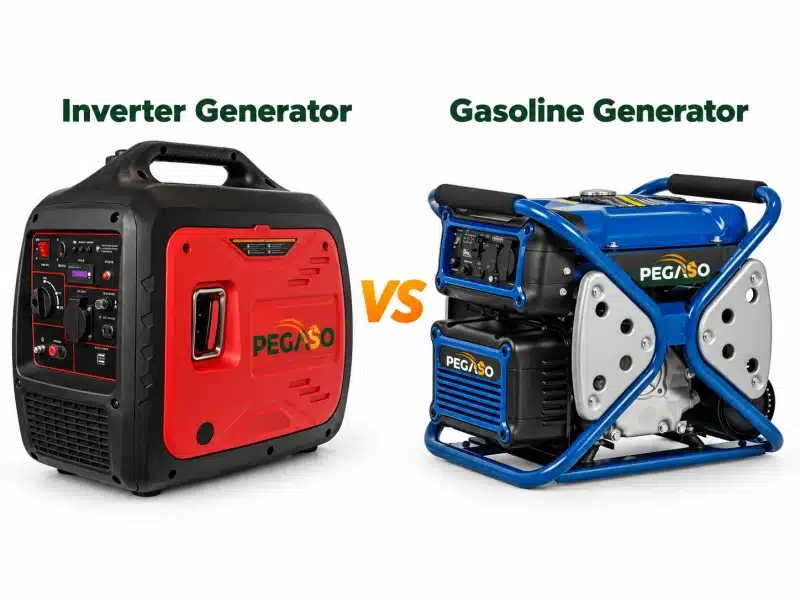
Pros and Cons of Inverter and Conventional Gasoline Generators
Peaks of wattage are not everything that needs to be taken into consideration while making a purchasing decision. The issues such as stability of output, price and ability to be repaired should be considered by homeowners, distributors of equipment and procurement department. All devices and machines have their characteristics in terms of two values of power: running watts that show continuous power consumption and starting watts that refer to power peak used when starting motors.
Pros and Cons of Inverter Gasoline Generators
This type of devices is made for customers that are focused on the cleanliness of generated electricity, noise reduction and mobility. Voltage and pure sine wave generation protects electronic appliances like laptops, medical equipment and electronic control boards. Enclosed acoustic shells are appropriate for campgrounds and densely populated areas, and variable speed throttling provides reduction in fuel consumption during nighttime use. Compact 2,000W suitcase inverter is easy to be carried by one person up to truck’s back.
Such generators are more expensive, and small units have less power peaks, therefore cannot support a whole-house central air conditioner alone. Failure of sealed inverter module will cost a lot to repair or replace, as specialized electronic components and technical expertise are often required.
Pros and Cons of Gasoline Generators
The traditional portable generator features high mechanical energy and robust design. It provides the lowest cost per kilowatt among other available options; this enables people to make their equipment budget go further. The larger ones provide 120/240V split-phase current, allowing powering of deep well pumps, air compressors and commercial tools. In addition, the open frame design allows for easy access to both engine and alternator and easy servicing.
The disadvantages include noise, excessive fuel consumption, and poor quality of power. Continuous operation of an engine at 3,600 RPM results in a considerable amount of emissions and noise. The engine consumes fuel fast even when the only attached device is a phone charger. According to the alternator type, the voltage and waveform changes while working with the load might result in malfunctions of appliances controlled by microprocessor.
A traditional generator with proper functioning automatic voltage regulator is capable of charging phones and operating televisions, as well as the big inverter runs heavy tools. The right choice depends on the load to be used most frequently. A generator that matches your typical power needs can help reduce fuel consumption and operating costs over time.
How Inverter and Conventional Generators Produce Electricity
Both designs make use of the four-stroke gasoline engine that rotates the magnetic rotor in copper winding of the stator. The main difference is in what happens after the electricity is generated by the alternator.
Conventional Gasoline Generator: Direct AC at 3,600 RPM
Conventional gasoline generator operates on the principle of direct mechanical generation in two steps. Since there is no intermediary in the connection from the alternator to the outlet, engine speed regulates electrical frequency.
- The gasoline engine rotates the alternator rotor at a governed speed. The required rate in North America is 3,600 RPM for a two-pole alternator to produce the 60 Hz electrical energy. In Europe the speed for 50 Hz grid is 3,000 RPM.
- Alternating current generated by the spinning rotor passes through Automatic Voltage Regulator (AVR) to the outlet panel.
When a heavy inductive load, such as table saw, is turned on, additional physical load is added to the rotor. Engine speed may momentarily fall below 3,600 RPM as the mechanical governor responds to the increased load.The time of the slow-down is one second or so, and in that brief period, the generator’s output frequency and voltage may temporarily drop before returning to their normal operating levels.
Inverter Generator: Three Stage AC-DC-AC Conversion Process
The inverter generator decouples engine speed from frequency generation using an electronic process in three stages.
- The engine drives a small permanent magnet alternator that generates unfiltered multiphase AC power at a very high frequency.
- The solid state rectifier converts the AC generated to DC and large capacitors filter it.
- The inverter control circuitry employs pulse width modulation to produce computer-controlled 120V/240V AC at precisely 60Hz or 50Hz when necessary.
The microprocessor regulates the output frequency electronically without the need for the engine to be maintained at 3,600 revolutions per minute. With the Eco, or load sensing, feature enabled, a 400 watt load causes the engine to stabilize at an idle level and then accelerates only when the load increases.
Power Quality and Total Harmonic Distortion Explained
The Total Harmonic Distortion indicates the degree of similarity between the waveform generated by the generator and the perfect sine wave provided by the utility company. IEEE 519 harmonic control standards1 determine the acceptable range of voltage and current distortion in order to avoid deterioration of equipment on the power system. Low THD levels mean clean electricity.
Gasoline inverter generator produce pure sine wave power rated below 3% to 5% THD. On an oscilloscope, that waveform appears as a smooth, continuous curve. A conventional portable generator may produce a sine wave with higher harmonic distortion, depending on the alternator design and operating load. Even with an Automatic Voltage Regulator (AVR), some waveform distortion may remain, making the trace appear less smooth on an oscilloscope.
The importance of wave quality is that household appliances and RVs utilize microprocessors to utilize the sine wave’s zero crossing as the clock. Some of the issues which can arise from power with 20% THD include:
- Laptop power brick and cell phone charger have to work hard to remove harmonic distortion, hence getting too warm.
- Some electronic appliances may malfunction or shut down when excessive harmonic distortion interferes with their control circuits.
- Amplifiers, PA systems, and LED lighting driver could produce 60Hz hum or flicker.
- A home office uninterruptible power supply will see the grid fault due to high THD or slight frequency increase over 61Hz. This will cause the UPS to click continuously and drain its battery rather than charge it.
Matching Appliances and Tools to the Right Generator Load
The people who ask questions about the required size of generators that use gasoline tend to begin the whole process by totaling all watts used by the different appliances. The calculation is useful, but it does not give an insight into the kind of reaction of the electrical load on the electronic overload protection circuit or mechanical flywheel energy storage system. Studies carried2 out on motor load voltage sag at the Lawrence Berkeley National Laboratory have realized that motor loads utilize too much reactive current.
| Load of appliance or tool | THD sensitivity | Starting surge | Recommended generator | Tips on eco mode |
|---|---|---|---|---|
| Laptops, CPAPs and desktop UPS systems | High; less than 5% needed | No; electronic load | Enclosed inverter | Keep on to enjoy silence and save fuel |
| Smart refrigerators and gas furnaces with high efficiency | Moderate to high | 2 to 3 times running watts | Enclosed or open frame inverter | Keep on or switch off if compressor stalls |
| Air compressors, table saws, and sump pumps | Low | High; 3 to 5 times LRA surge | Conventional or high output open frame inverter | Switch off before starting the motor |
| RV air conditioners 13,500 to 15,000 BTU | Moderate | High; 3,000W + without soft start | 3,500W + inverter or two parallel inverter | Switch off during compressor cycling |
| 240V deep well pumps and central air conditioners | Low to moderate | Very high; split phase LRA | 7,500W + conventional or large 240V inverter | Switch off for quick rotor response |
| Space heaters, toasters and halogen work lights | None; resistive load | 1 times running watts; no surge | Any; conventional is the most cost-effective one | Keep on; engine will reach necessary wattage |
Sensitive Electronics and Variable-Speed Appliances
Electronics powered by digital control circuit boards, touch screens, or inverter compressors operate well with low THD.
Manufacturers of medical electronics need pure sine wave power for CPAPs and oxygen concentrators to avoid motor and heating malfunction during sleep. Home office electronic items including computers, Wi-Fi routers, and desktop UPS battery backups also need proper voltage and frequency regulation.
Smart refrigerators and energy-efficient washing machines have inverter-type compressors and digital defrost timer circuits instead of the old mechanical type control circuits. Poor power quality may damage the main control board. A gas furnace is an example of a mixed load. Its blower motor is an inductive load, while its diagnostic control circuit board requires less than 5% THD to ignite the flame safely and function properly.
High-Surge Inductive Motors and Eco-Mode Lag
An inductive load has wound electromagnetic coils. They require a brief and high current start-up referred to as Locked Rotor Amps (LRA). A 1/2HP cast-iron sump pump or pancake air compressor that consumes 1,000 watts under normal operation may require 3,000 to 4,000 watts momentarily during start-up.
This is how both generator types respond to such a demand. With a consistent speed of 3,600 RPM, the standard generator maintains significant mechanical inertia of its heavy iron rotor and flywheel. It is helpful in dealing with a high current demand of the circular saw or compressor during their start-up. There is temporary voltage drop, strain on the engine, but the thermal-magnetic breaker stays shut.
However, inverter generators deal with such a surge electrically. Imagine that your generator operates on idle and runs at 2,200 RPM in Eco mode. You connect a 15-amp miter saw which demands 4,000 starting watts. Just when the inverter board reaches its instantaneous current capacity, the engine takes from 500 to 1,000 milliseconds to gain its operational speed. An overload indicator may glow and disconnect the current before the engine reaches the required speed.
Do not turn on the Eco mode before using an inverter generator to power an air compressor, table saw, sump pump, or RV air conditioner without a soft start capacitor. Keeping the engine running at full operating speed will allow maximum current flow upon starting the motor.
Resistive Loads and 120V vs 240V Split-Phase Demands
The resistor load generates heat or light through the flow of electricity through a metallic component. Space heaters, coffeemakers, simple toasters, and incandescent or halogen work lights lack any startup surge, and therefore have equal starting and operating watts. The THD will have no effect on them, and they run efficiently on a cheap conventional generator.
Another good filter is the voltage requirement. Portable suitcase inverters that come in capacities between 1,000W and 3,500W are 120V single-phase units. They typically include common 20A household plugs (NEMA 5-20R) and 30A RV outlets (TT-30R), but are unable to deliver a 240V split-phase load.
In case of an emergency where one needs to use a 240V submersible well pump, a water heater, or an entire house manual transfer switch using a 30A (L14-30R) or 50A (14-50R) inlet, a completely different machine is needed. The available choices would be either a conventional generator capacity of around 5,000W and higher or a 120/240V open-frame inverter in the 7,000W to 11,000W capacity.
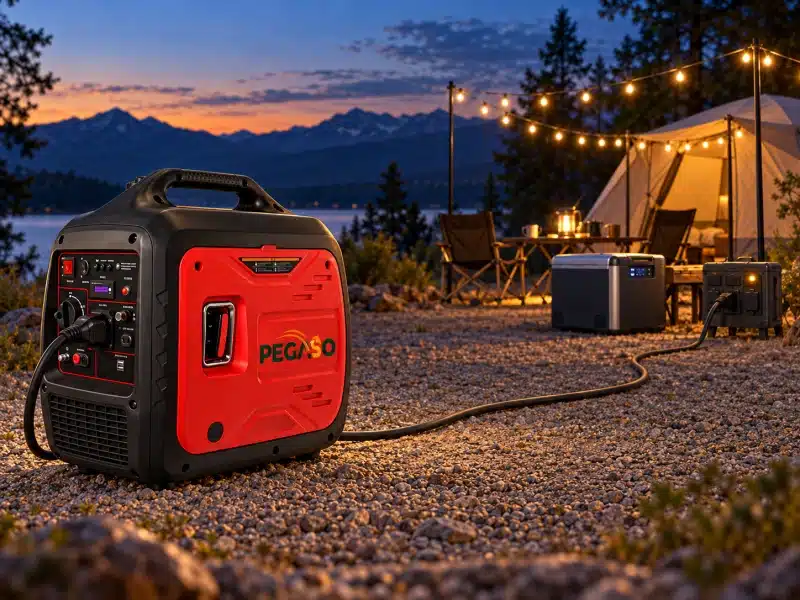
The Balance of Trade-Offs Between Fuel Runtime, Noise Level, and Servicing
Apart from electrical performance, the issue of how often one wants to interact with fuel cans, proximity to other people, and servicing of the equipment also plays a role in ownership.
Fuel Savings vs Fuel Tank Size
When it comes to intermittent or low load demands, the efficiency of an inverter generator allows one to save up to 40% on fuel consumption. With an overnight blackout and only a fridge and a couple of LED lights, the inverter might consume 0.1 to 0.2 gallons of fuel per hour.
The efficiency of the engine is just one side of the runtime equation. The compact size of the enclosed inverter generators makes them weigh much less and thus the fuel tank of such devices is typically small – 1-2 gallons. At 80% jobsite load, an inverter operates at full speed, which makes it almost equal to conventional machines in terms of runtime – it takes about 3.5 to 4 hours to drain the fuel tank.
Noise Levels, Frame Design, and Portability
The decibel scale is logarithmic. An increase of 10 dB corresponds to ten times more sound energy and is perceived as roughly twice as loud by the human ear. An enclosed suitcase inverter produces 50–60 dB at a distance of 23 feet (7 meters), which makes a normal conversation possible nearby. These generators typically weigh 38–50 lbs and can be transported in the back of a car or the storage compartment of a recreational vehicle.
A conventional generator has an open iron roll cage and limited sound insulation. It produces around 70–80+ dB at a distance and may sometimes exceed 85 dBA near the control panel. According to NIOSH occupational noise exposure guidelines3, prolonged exposure to noise at 85 dBA or higher increases the risk of hearing loss, so operators working in such environments need hearing protection. Contractors buying fleet equipment from an open-cage gasoline generator manufacturer accept higher noise levels in exchange for protection against impacts, improved air cooling, and easier movement across muddy ground with a two-wheel kit.
An open-frame inverter combines features of both designs. Models with output ratings from 4,000W to 11,000W use inverter electronics in a traditional open iron roll cage. They cost 20%–30% less than enclosed inverter generators with similar power ratings, offer 240V split-phase outlets, and produce around 62–68 dB of noise.
Upfront Cost, Parallel Scaling, and DIY Repairability
A conventional generator costs roughly $100 to $150 per kilowatt of capacity. An enclosed inverter costs about $250 to $450+ per kilowatt. Many small inverters offset their lower individual capacity with parallel operation. A parallel kit can synchronize two 2,200W suitcase models and supply as much as 4,000W through one 30A RV outlet. Each generator still weighs only 45 lbs for single-person handling, and the second unit can be brought along when an RV air conditioner needs the extra capacity.
Conventional designs are easier to repair over the long term. Both types require the same basic engine work, including 10W-30 oil changes, air-filter cleaning, and spark-plug replacement. An open frame simply makes the carburetor and oil drain plug easier to reach.
Fixing electrical components is different. In case the traditional generator ceases generating energy, an experienced owner will have no trouble replacing the carbon brushes or installing a universal Automatic Voltage Regulator for $25 in 20 minutes. The inverter generator’s circuit board is sealed with epoxy in order to make it resistant to humidity and vibration. It cannot be fixed component-by-component. If the voltage surge damages the board, the proprietary replacement will cost between 40% and 60% of the generator’s price.
How to choose the Best Generator Type for Your Scenario
You first consider the equipment that is required for running the generator as well as the circumstances in which it will be run. CO Safety is important for all gasoline-powered generators. All gasoline-powered generators produce deadly, odorless CO. Adhere to the CPSC portable generator positioning rules4. Operate your generator outside at least 20 feet from doors, windows, and vents. Exhaust should face away from any buildings.
Home Emergency Backup:
Select a 2,000W-3,000W enclosed inverter in case you live in a heavily populated suburb with stringent noise policies and need extension cord power supply for your smart refrigerator, gas furnace blower, CPAP machine, and Wi-Fi equipment.
In case you have a 240V home transfer switch with a well pump and some delicate modern appliances, an 7,000W-11,000W open-frame inverter will be more appropriate than the noisy conventional generator.
When the utmost 240V starting capacity is the primary concern for powering central air conditioners and deep well pumps during occasional storms at a lower equipment cost, choose a 7,500W-12,000W conventional generator.
Camping, RV, and Tailgating:
In case you are camping and need silent power supply, go for a 2,000W-3,500W enclosed inverter or parallel units. A gasoline generator for camping in this class will also meet the noise requirement set by the National Park Service (i.e., 60 dB). A 2,200W inverter will allow you to charge the RV house batteries and run a microwave. Parallel units or a single 3,500W inverter will be enough to run a 13,500 BTU RV roof top air conditioner.
Construction and Commercial Jobsites:
A 5,000W to 10,000W conventional generator is ideal for teams using circular saws, air compressors, concrete mixers, and grinders which require high in-rush all day. It will also give the required big 7-gallon tank capacity and fast field serviceability needed in such sites.
For distributors and importers, selecting the right generator also means ensuring it meets the requirements of the target market. At PEGASO, our generators have obtained international certifications, including CE, RoHS, REACH, EPA, and EU Stage V, helping our customers meet safety, quality, and environmental requirements across different markets.
Conclusion
The best generator is the generator which matches the real load. Inverter generator is ideal for running microprocessor devices, medical equipment, air conditioners, and everywhere where noise matters. Pure sine wave and variable engine speed can protect your sensitive machines and consume less fuel in light loads.
A traditional 3,600 RPM generator appears to be a better choice for compressors on construction sites, deep well pumps, resistive loads, and applications where a powerful 120/240V split-phase capability is required. It will cost you less money at the beginning and will be much easier to fix by yourself later.
If you are looking for generators for your business or need assistance in choosing between inverter and traditional models, PEGASO has over 13 years of generator manufacturing experience, OEM/ODM options, and technical expertise to assist you. Contact our team to learn about our options.
Frequently Asked Questions
Will a traditional gasoline generator harm modern refrigerators or furnaces?
Old mechanical refrigerators and furnaces can usually withstand the raw AC power. Modern smart refrigerators and efficient gas furnaces utilize microprocessor control boards that will malfunction if the THD exceeds 5% or 10%.
How is it possible to parallel inverter generators and not conventional ones?
The inverter control board synchronizes the voltage waveform and 60 Hz frequency within microseconds before transmitting power through the parallel output. The synchronization of two rotors of 3,600 RPM from the different traditional generators is technically feasible only through expensive industrial switchgear.
Should you deactivate Eco mode of an inverter generator?
Disengage the Eco, or load sensing, mode if you connect your generator to a surge-demand inductive load such as circular saw, air compressor, sump pump, or RV air conditioner. When reaching the maximum speed, the alternator will be able to react to the surge current without tripping the electronic overload protector.
Is there more difficulty in fixing inverter generators compared to regular generators?
The maintenance procedures for both types of generators like replacing oil and changing spark plugs are almost the same. However, the electrical repairs will cost more in inverter generators because their controller is sealed and exclusive. Regular open frame generators can only require replacing the AVR at just $25, which leaves a lot of opportunity for DIY projects.
Is an Inverter Generator Powered by Gasoline?
Yes, an inverter generator is typically powered by gasoline because this type of generator is similar to other gasoline-powered generators except that the process of generating electricity is different.
Sources
IEEE Power and Energy Society, Harmonics Working Group. IEEE 519 harmonic control standards. ↩
Lawrence Berkeley National Laboratory. Motor-load voltage sag and recovery study linked in the original article. ↩
Centers for Disease Control and Prevention (CDC), National Institute for Occupational Safety and Health (NIOSH). Occupational noise exposure guidelines. ↩
U.S. Consumer Product Safety Commission (CPSC). Portable generator positioning and carbon monoxide safety guidance linked in the original article. ↩
