

The generator fueled by gasoline generates more energy from the same amount of fuel. It is simpler to have the generator fueled with propane ready for use. When choosing an alternative power source for your home, you should compare the output for both fuel types, the runtime based on your fuel tanks, and operating costs.
Propane vs Gasoline Generator: Key Differences at a Glance
When fueled with propane, a dual fuel generator usually generates 5-10% less electricity and consumes more gallons per hour than a generator fueled with gasoline. There are 91,500 BTUs in one gallon of propane while there are 114,000 in one gallon of gasoline. The fuel does not degrade when stored in the propane tank.
| Criteria | Gasoline Generators | Propane (LP) Generators |
|---|---|---|
| Energy Content | ~114,000 BTUs per gallon | ~91,500 BTUs per gallon |
| Output Power Derating | 100% of the generator capacity in watts | 5% to 10% reduction in output wattage |
| Usage Consumption (5kW to 7.5kW Load Running 50%) | ~0.50 to 0.60 gallons per hour | ~0.75 to 0.90 gallons per hour |
| Fuel Portable Container Time | 8 to 10 hours (5-gallon fuel can) | 5 to 6 hours (20 lb / 4.7-gallon propane cylinder) |
| Shelf Life of Stored Fuel | 3 to 6 months un-stabilized (12 to 24 months stabilized) | Indefinite life span in closed container |
| Carburetor Blockage Likelihood | High probability (left inside the fuel reservoir and carburetor) | None (burns in vapors, non-sticky) |
| Functioning Temperatures Range | Starts well even in cold weather (under zero) | Freezes in small containers under 20°F (-6°C) |
| Cost of the Generator | The lowest cost | Higher (requires dual-fuel or fuel cylinder piping equipment) |
Propane Generator vs Gas Generator: How Much Power Do You Lose?
The engine uses heat from the fuel to produce mechanical energy, which the generator transforms into electric energy. The amount of energy contained in fuel determines the maximum amount of power the engine produces. U.S. Department of Energy propane fuel data shows 91,500 BTUs per gallon of liquid propane fuel compared to 114,000 BTUs per gallon of gasoline.1
Thus, manufacturers usually reduce ratings of a dual-fuel generator using propane fuel. A model that is rated 8,000 running watts and 10,000 starting watts with gasoline fuel may be rated 7,200 and 9,000 watts with propane fuel. In this case, the discrepancy is 800 running watts and 1,000 starting watts. Make sure to check ratings of the generator that you choose.
The starting rating of the generator is crucial when choosing it for operating appliances with motors, such as a deep well pump, a central air conditioning compressor, and sump pumps since they consume more power for several seconds while starting. If a generator barely handles the starting demand of a 3-ton AC compressor when using gasoline, it may shut down due to the trip of its breaker when using propane. When calculating wattage for your home generator, use propane ratings and allow room for those surges.
Does a Generator Run Longer on Gas or Propane?
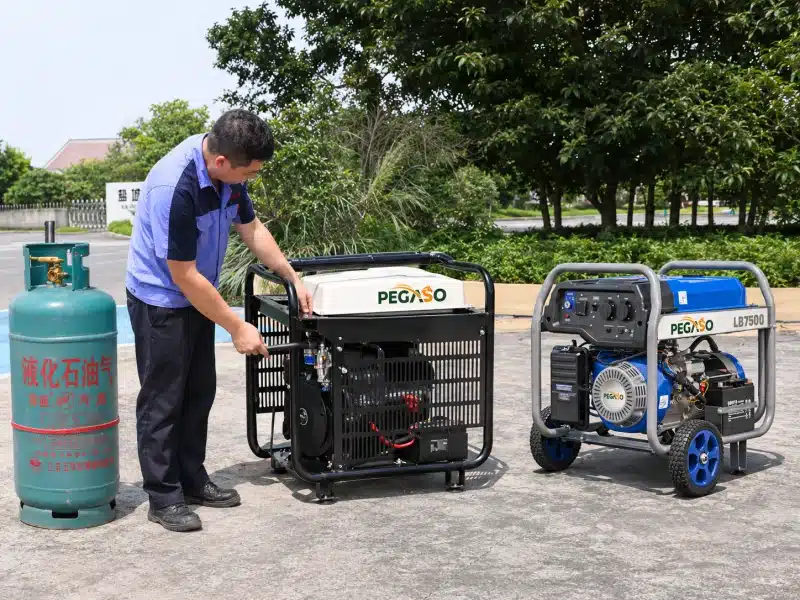
When operating the generator at the same electrical load, the engine usually consumes more gallons of propane than gasoline per hour. To keep the engine at the required 3,600 RPM speed, the propane regulator must provide more fuel. To plan for a blackout, consider how fast the engine burns fuel and what amount of fuel you have in your containers.
| Type of Fuel Container | Usable Fuel Volume | Estimated Burn Rate (100% Load) | Time of Operation | Method of Refilling |
|---|---|---|---|---|
| 5-Gallon Gasoline Can | 5.0 gallons | 0.55 gal/hr | ~9 hours | Pouring manually through the spout |
| 20-lb Propane Cylinder | 4.7 gallons (80% full) | 0.85 gal/hr | ~5.5 hours | Changing the quick-connect hose |
| 100-lb Propane Cylinder | 23.6 gallons (80% full) | 0.85 gal/hr | ~27.5 hours | Changing the regulator hose |
| 250-gallon Home Tank | 200 gallons (80% full) | 0.85 gal/hr | ~235 hours (~9.8 days) | Connection of the permanent pipe line |
5-Gallon Gas Can vs 20-Lb Propane Tank
Some portable generators work off of five-gallon gas cans or 20 pounds grill cylinders. The 20-pound propane cylinder has a capacity of approximately 4.7 gallons of liquid when full up to 80%. This room is needed for expansion of the propane liquid as the temperature rises.
Assuming that we have a five thousand watt generator working at 100% load, which powers two refrigerators, furnace blower, sump pump, and LED lighting. If the fuel consumption of this generator is 0.5 to 0.6 gallons(1.8L-2.2L) of gasoline per hour, then the five-gallon can will last around 8 to 10 hours. The propane burn rate will be 0.75 to 0.9(2.8L-3.4L) gallons per hour and the 20 pounds cylinder will last 5 to 6 hours. For eight hours operation without changing the cylinder, one should go for a 30- or 40-pound cylinder, manifold of two tanks, or inverter generator.
Generator Run-Time with Home Propane Tank
The bulk home tank makes the equation very different. Restrictions apply to the storage of gasoline due to fire regulations and insurance requirements, and a seven-day power outage will require many trips to refuel gas containers. Moving six five-gallon containers every 48 hours during an ice storm will be quite a hassle.
If you have a 250-gallon or 500-gallon tank for heating or cooking purposes, a certified plumber can install a low-pressure tee and a generator connection. With an 80 percent fill rate, the tanks will contain 200 and 400 gallons of liquid. With an hourly consumption of 0.85 gallons, a 250-gallon tank will supply electricity to the portable generator for almost ten days. The source suggests 4 to 6 days for a whole home standby generator.
Gas vs Propane Generator: Which Costs Less to Run?
From the examples shown below, it is clear that gasoline has lower cost per hour compared to propane purchased in portable tanks. In terms of long-run cost analysis, waste fuel as well as carburetor adjustment of a gasoline engine must be considered.
Hourly Fuel Costs
The example generator consumes around 35% to 50% more volume of propane per hour. So, where you buy your propane plays a significant role in operating cost. Below calculations are based on the same prices for fuel and load of 3,000 watts as assumed in the source article:
- With gasoline USD3.50 per gallon and burning rate of 0.55 gallons per hour costs you USD1.93 per hour, or about USD0.64 per kWh.
- Cylinder exchange at USD22 per cylinder, which contains 15 pounds, or 3.6 gallons of fuel will cost you about USD6.10 per gallon. The cage cylinders usually give 15 pound fill. At 0.85 gallons per hour it will cost you USD5.19 per hour, or USD1.73 per kWh, about three times higher than gasoline example.
- Metered propane refill at USD3.75 per gallon will be filled into the cylinder to about 4.7 gallons and will cost you USD3.19 per hour at 0.85 gallons per hour burning rate, or USD1.06 per kWh. You could probably buy your propane at farm co-op, U-Haul, or welding supply stores.
- Bulk propane delivered at USD2.50 to USD2.80 per gallon costs USD2.13 to USD2.38 per hour, or USD0.71 to USD0.79 per kWh, at 0.85 gallons per hour. That assumes a residential order of hundreds of gallons.
To make a comparison of generator fuel cost useful, use the price in your locality and the burn rate at the expected load. Refills from a meter or a bulk tank will be significantly cheaper than cylinder exchanges.
Notice:The prices provided here are examples based on projected average prices for 2026; you may calculate precise figures yourself using the method outlined in this article.
Upfront and Maintenance Costs
The gasoline-only portable generator will have the lowest purchase cost. According to the source, there is additional USD50-USD150 for a dual fuel generator with a regulator, hose, and multi-fuel carburetor. If one connects the generator to a stationary propane tank, then the cost of pipe, regulators, and shut-off valves installation will be between USD300 and USD800 by a licensed gas fitter.
Storage costs become important if the generator is needed once or twice per year. For example, the disposal of 15 gallons of spoiled gasoline will be a waste of more than USD50 at the provided price. Cleaning or replacing of clogged carburetor, fuel lines, and petcock at a small-engine shop cost according to the source USD150-USD300.
How Do Gasoline and Propane Compare for Storage and Maintenance?
A backup generator can remain idle for 18 months in a shed. The state of its stored fuel, carburetor, and engine will dictate whether it will start in case there is a power outage.
| Storage and Maintenance Issues | Gasoline | LP Gas |
|---|---|---|
| Shelf Life without Stabilizers | 3 to 6 months | Indefinitely |
| Does It Need Fuel Stabilizer? | Yes (extends shelf life to 12 to 24 months) | No |
| Draining Carburetor after Outage | Must be done before storing | Not needed |
| Carbon Buildup inside Engine | High to moderate (causes plug fouling and valve damage) | Low (combusts as dry gas) |
| Oil Soot Contamination | Susceptible to fuel wash and oil darken due to soot formation | Oil remains clean for longer |
| Suitable Storage Places | Outdoors or in ventilated detached shed in approved containers | Outdoor use only; must be upright and not near vents |
Gasoline Shelf Life and Carburetor Clogs
Regular gasoline consists of hydrocarbon mixture and up to 10% ethanol (E10). In the vented canister or generator fuel tank, lighter components evaporate and the rest may oxidize in 3 to 6 months. Additionally, ethanol draws moisture from the surrounding humid environment. Should there be enough moisture in the mixture, it will separate from ethanol and settle on the bottom of the tank.
The stale gasoline can form a varnish in the carburetor jets and float bowl, the needle can stick, the jets can get clogged, and the engine will fail to start. Should it happen after storage, you need to check the old fuel and clogged carburetor jets before refueling. While storing, follow the instructions for the fuel stabilizer, rotate the gasoline, and drain the carburetor bowl if required by the manufacturer.
The propane, stored in the hermetically sealed metal cylinder, is not prone to oxidation or moisture accumulation like gasoline. It can be used after 6 months or 10 years, provided that the valve and certificate of the cylinder are valid. Additionally, you do not need to drain gasoline from the carburetor after each usage.
Carbon, Oil, and Emissions
Gasoline comes into the combustion chamber in the form of an aerosol; propane comes in as vapor. During cold starts, the gasoline droplets may stick to the cylinder wall, displacing some of the oil for lubrication, passing through the piston rings, and entering the crankcase. Incomplete combustion results in deposits of carbon on the piston, exhaust valves, and spark plug.
Propane's vaporized supply is likely to result in reduced soot accumulation on the spark plug and reduced fuel washing, meaning that engine oil remains cleaner until the next planned change. The alternative fuel emissions information from DOE also indicates the low carbon content of propane fuel compared to gasoline.2 Carbon monoxide is also produced by a propane generator.
Safe Fuel Storage
While both fuels carry hazards of fires and explosions, fuel leaks differ. The following precautions will be helpful in storing and operating the fuel type you have:
- Shut down the gasoline generator and wait for 15 minutes until it cools down before refueling. The gasoline spill on a warm muffler may catch fire; this is especially hazardous when the refueling process is difficult to observe under low visibility conditions.
- The vapor of propane is 1.5 times heavier than that of natural gas. A propane leak from a valve or from a hose may flow into the basement window well, the floor drain or crawlspace and catch fire coming from a pilot light of a water heater.
- Store the 20-, 30-, and 100-pound propane cylinders upright on the ground outdoors in a well-ventilated shaded place away from building openings. Do not store the cylinders in basements, attached garages and living rooms.
- Deadly and odorless carbon monoxide is generated by either fuel type. CPSC generator carbon monoxide and fire safety tips.3
Which Generator Fuel Starts More Reliably in Cold Weather?
Weather and prolonged downtime affect the performance of both fuels. Propane may be unable to generate vapor due to extremely cold weather, but gasoline needs fresh fuel to perform well and proper storage.
Propane in Freezing Weather
Liquid propane will be found in the cylinder below the pressurized vapor. The generator will use up the vapor, which means additional boiling of the liquid will have to take place to replace the used fuel. During the boiling process, heat is taken from the steel cylinder and the environment.
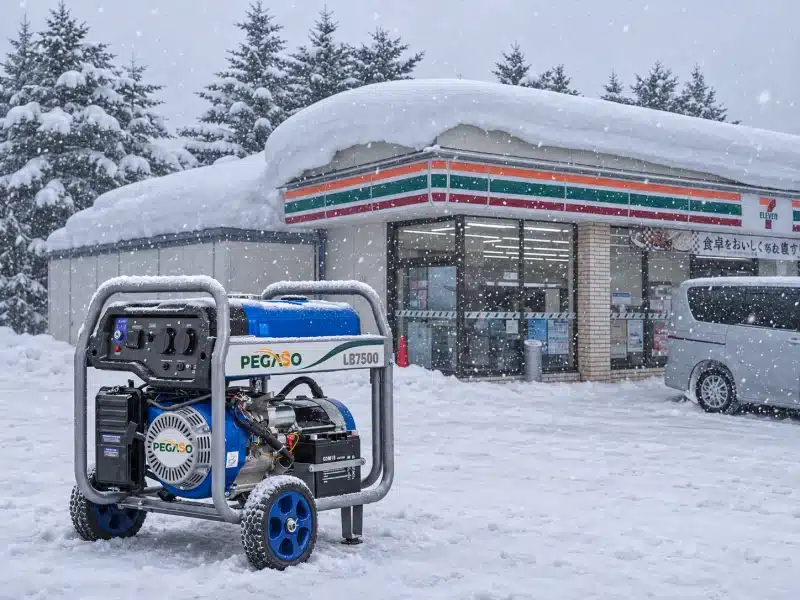
The temperature at which propane boils is -44°F (-42°C). However, loss of fuel supply can happen even at higher temperatures in a generator. At 5,000- to 8,000-watt power consumption, a generator using vapor fuel rapidly from the cylinder causes the liquid in the cylinder to cool down. Below 20°F (-6°C) and particularly 0°F (-18°C), the small cylinder is not able to absorb the heat. As a result, frost forms, vapor pressure drops below the level needed for a regulator, and the generator stops working despite having fuel in the cylinder. This phenomenon is known as auto-refrigeration.
Gasoline is drawn as a liquid from the tank and vaporizes in the engine, so it avoids this cylinder-pressure problem. For propane use in freezing weather, the source suggests a cylinder of at least 100 pounds, two 30-pound tanks connected in parallel, or a UL-listed thermostatic tank warming blanket.
Refueling During an Outage
Power is needed at the gasoline station to enable fueling operations. When there is a power failure, stations with no backup supply would not be able to fuel their cars; the stations that remain open would probably run out of fuel in about 24 hours.
Another way to get fuel would be from a second car or from a lawnmower, the source provides a figure of 10-15 gallons of fuel from the second car. The arrival of propane could be hindered by road blocks due to falling trees or ice. On the other hand, you can stock 4-5 filled 20-30 lb cylinders outdoors long before the storm comes.
Should You Choose a Gasoline, Propane, or Dual-Fuel Generator?
Think about how often you use the generator, how cold it gets, and which appliances need power. If noise and fuel use at light loads are concerns, consider inverter generator models too.
Select a Gasoline Dedicated Generator When:
- You seek the lowest cost and maximum start-up watts per dollar spent.
- Outages typically occur at temperatures lower than 15°F (-9°C), and you do not have a substantial stationary propane tank.
- You operate the generator once a week for commercial, farming, or RV needs, which keeps the gasoline fresh enough.
Select a Propane Dedicated Generator When:
- You own a 250- or 500-gallon stationary propane tank capable of supplying fuel to the generator for several days.
- Your trailer already stores two 30-pound cylinders, and you require little overnight power without transporting gasoline containers.
- You wish to eliminate the use of fuel stabilizer, gasoline pouring, and carburetor deposits due to stale gas.
Select a Portable Dual Fuel Generator (Most Suitable for Homeowners) When:
- You intend to utilize propane during ordinary outages while having access to gasoline in case the cylinders are empty or when severe cold decreases their pressure. Running the generator on propane alone will keep gasoline out of the fuel tank and carburetor.
Which Fuel Is Right for Your Backup Plan?
Gasoline provides more horsepower, more time on the job from a portable supply, and fewer issues with pressure in the propane tank at low temperatures. Propane is more stable and leaves less residue in the engine than gasoline does. Having both engines in a portable generator gives you flexibility to run either one. It’s recommended that you keep 2-3 refilled propane tanks and a five-gallon stabilizer gas tank.
Frequently Asked Questions About Propane and Gasoline Generators
What If a Generator Runs Out of Fuel?
The engine's speed can fluctuate before the generator stops due to the lack of fuel. Voltage and frequency might drop affecting connected electric motors and other devices. Lawrence Berkeley National Laboratory's research on voltage sags' impact on loads' performance can be found in this publication.4 Disconnect all appliances from the generator's main breaker before switching off the machine or refueling it.
Can I Run a Gasoline Generator With Propane Fuel?
The majority of widely used portable gas generators are able to convert to propane by means of the purchased propane conversion kit or tri-fuel kit. Usually, the kit consists of a venturi adapter that goes after the air filter and before the carburetor and a vacuum regulator metering the fuel supply. This process requires some skills and will make you void your factory warranty.
Can Propane Tanks Be Stored Indoors?
No. Keep portable cylinders upright outdoors in a shaded, ventilated place, away from basements, attached garages, and living areas. Vapor escaping from a valve or pressure relief device is heavier than air and can collect in low spots near an ignition source.
How Long Does a 20-Lb Propane Tank Last?
A 20-pound grill cylinder holds about 4.7 gallons at the 80% fill limit. The source estimates 7 to 8 hours for a 5,000-watt portable generator at 100% load, or 12 to 18 hours for a 2,000-watt dual-fuel inverter model running in eco mode.
Sources
1. [U.S. Department of Energy, Alternative Fuels Data Center — Propane fuel data](https://afdc.energy.gov/vehicles/propane) ↩
2. [U.S. Department of Energy, Alternative Fuels Data Center — Propane emissions](https://afdc.energy.gov/vehicles/propane-emissions) ↩
3. [U.S. Consumer Product Safety Commission — Generator carbon monoxide and fire safety tips](https://www.cpsc.gov/Newsroom/News-Releases/2026/CPSC-Warns-of-Generator-Carbon-Monoxide-and-Fire-Hazards-Ahead-of-Hurricane-Season) ↩
4. [Lawrence Berkeley National Laboratory — Research on how voltage sags affect electrical loads](https://gridintegration.lbl.gov/publications/voltage-sag-and-recovery-influence) ↩
