

Based on the U.S. retail fuel prices as of November, 2026, the fuel consumption rate for a diesel generator used for a 4 kW load would need to be over 35.9% lower compared to a gasoline generator to be cheaper in terms of fuel. This is considering that both generators are rated 8 kW. Diesel can run for long stretches, but a unit that is too large for its usual load can develop wet stacking, a buildup of unburned fuel and soot. Gasoline often suits occasional portable backup. Diesel makes more sense when the load, operating hours, fuel supply, and maintenance plan justify it.
Diesel vs Gas Generator: Key Differences
Start with the power requirements, expected duration of run time, and portability. Fuel consumption, maintenance, storage, and cold starting are all affected by these decisions.
| Property of Comparison | Gasoline Generators | Diesel Generators |
|---|---|---|
| Engine Ignition Principle | Spark ignition using spark plugs and carburetor or low-pressure fuel injection (~8.5:1 compression ratio) | Compression ignition using high-pressure direct fuel injection into the heated compressed air (~20:1 compression ratio) |
| Price of Initial Installation | Lower cost of equipment installation; more affordable for irregular residential and recreational usage | 30% to 60%+ more expensive to buy because of heavy engine block made of Aluminum alloy and high-pressure fuel system |
| Efficiency of Fuel Consumption per kWh | Burns more fuel in an hour; less efficient, especially on partial load | Uses fewer gallons per kWh; compare the fuel consumption at the same load |
| Duty Cycle Preference | Irregular use (4-12 hours) for short power outages (2-3 days) with cooling downtime | Heavy continuous use (50% - 80% load) in multi-day power failures or construction site operations |
| Maintenance | Spark plug replacements, air filter maintenance, prevention of stale ethanol from plugging the carburetor | Oil change, filters for fuel/water separator, prevention of wet stacking on low loads |
| Shelf-Life of Fuel | 30-90 days untreated (or up to 6-12 months treated with fuel stabilizer/ethanol-free gasoline) | 12-24 months if dry, and treated with biocides to prevent microbial sludge formation |
| Vapor Volatility | Extremely volatile fuel vapors (low flash point); restricted storage inside houses due to flammability by fire codes; stored in 5-gallon cans | Low vapor volatility (high flash point); legal and safe to keep fuel in 50 -100 gallon bulk tanks |
| Weight and Mobility | Light engine frame; easy mobility by one-two people using a regular wheel kit | Heavier frame, engine weight; more than one person is required to move larger models |
| Starting in Cold Weather | Starts easily if the battery is charged, and carburetor is clean | Unable to start in the freezing weather without glow plugs, electric heaters, and winterized fuel |
| Applications | Brief outages at home, camping trips, portable contractors’ tools, and cheap backups | Outages for several days, farm homesteads, commercial standby generators, and high-surge construction welders |
If you have light electrical loads or sensitive electronics to run, the enclosed inverter generator may be quieter than the standard 3,600 RPM open frame generator. For large motor starting currents or extended operating periods, make sure to compare gasoline and diesel generators.
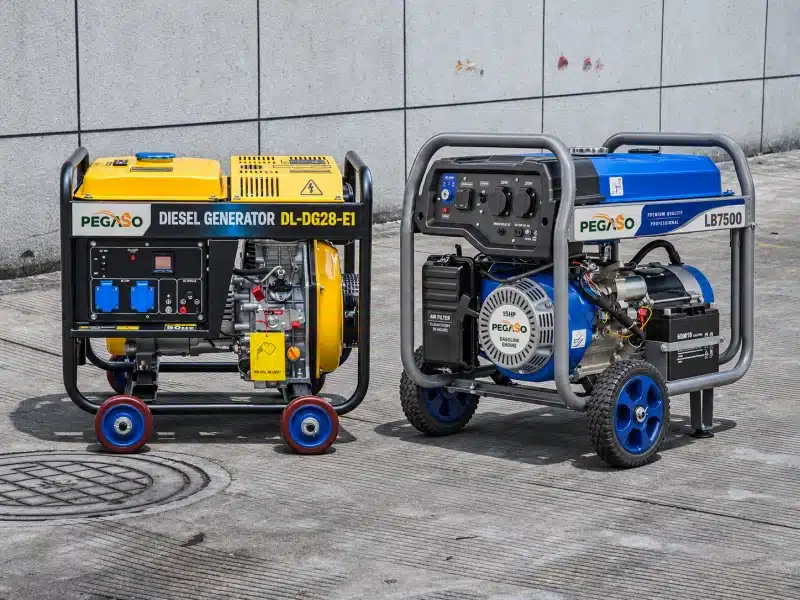
Diesel Generator vs Gas Generator: Fuel Efficiency and Cost
The traditional gasoline generator combines air and gasoline, compresses it at a ratio of 8.5:1 and uses spark plugs to ignite it. Portable generators often operate at 3,600 RPM to achieve 60 Hz output even under low electricity loads. That is why a little LED load will not help you to economize any fuel in a fixed-speed generator.
There are no carburetors and spark plugs in a diesel engine. Air is compressed at a ratio of 20:1 up to a temperature of 1,000°F (538°C) and then the fuel is injected into the heated air where it gets ignited. Diesel fuel has approximately 12% to 15% more energy per gallon than gasoline. High compression makes a diesel engine more efficient in its fuel consumption.
For comparing running costs, calculate gallons per hour for both generators at the same electricity load and multiply by the fuel prices in your area. The diesel generator may use less gallons, yet it may cost you more per hour if it consumes more expensive fuel. Cost of purchase and maintenance should be considered in the long term.
Fuel Cost at the Same 4 kW Load
The weekly retail price report by the U.S. Energy Information Administration indicated USD3.805 per gallon for regular gasoline and USD5.937 per gallon for on-highway diesel as of November, 2026. The above figures are national averages, which include taxes; diesel is USD2.132 more expensive per gallon compared to the benchmark. Prices in your locality could vary.1
Fuel cost per kWh is calculated as (gallons per hour × price per gallon) ÷ 4 for two 8 kW models each providing a continuous power of 4 kW. According to the above fuel prices, diesel should consume over 35.9% fewer gallons per hour than the cheaper fuel. This value is obtained by dividing USD3.805 ÷ USD5.937 = 0.641; no assumptions are made regarding the consumption of one particular model.
Compare fuel consumptions of each manufacturer at the same delivered output (for example, 4 kW), as well as their prices. The generator's price, servicing expenses and estimated lifespan should be included into calculations of a break-even point.
Diesel vs Gasoline Generator Maintenance and Lifespan
There are no carburetors and spark plugs to maintain with a diesel engine, although it does require clean fuel and filter changes along with appropriate load for its operations. Although fueling is easier for gasoline engine, it requires attention before storing.
Whereas in case of idle gasoline engine, you can be sure about the fuel going stale and carburetor build-ups. For a diesel engine, you should be aware of the water or dirt present in fuel and the excessive idling at low loads.
Gasoline Generator Upkeep and Carburetor Fouling
A conventional 3,600 RPM, air-cooled gasoline generator will typically operate for 300 to 800 hours before needing replacement or repair of the engine's pistons and valves. Recommended service guidelines are:
- Change the engine's oil every 50 to 100 hours after an initial change of oil after 20 hours.
- Examine or replace the spark plug every 100 to 200 hours, or annually, to avoid difficult starting and misfires.
- Clean the air filter every 50 hours, more frequently in dusty environments.
- Drain the carburetor float chamber before storing the generator after an outage.
Untreated E10 gasoline begins to deteriorate in as little as 30 to 90 days. The ethanol in the gasoline absorbs moisture that causes the gasoline and ethanol to separate and collect in the fuel system over time. Corrosion and varnish can cause the carburetor jets to become clogged. Old fuel can make a generator non-startable when it needs to be used after being stored for months.
Diesel Longevity, Filter Management, and Wet Stacking
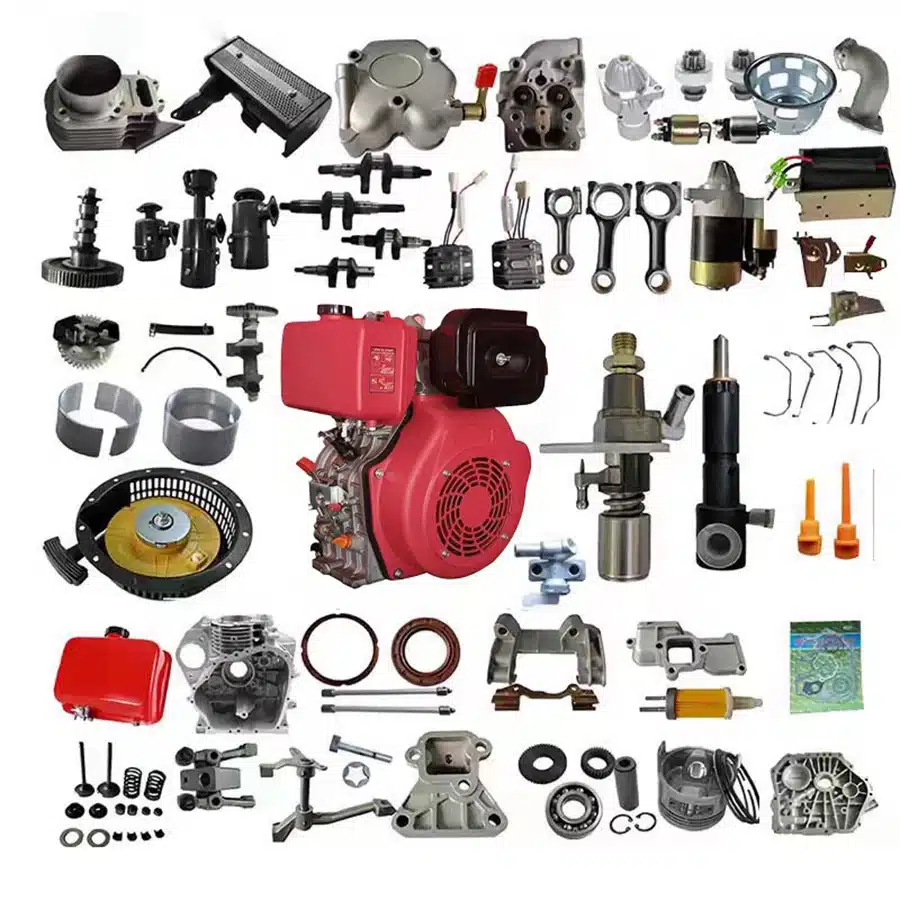
A diesel engine is characterized by massive construction, including heavy block/crankcase, forged crankshaft, and robust cylinders to endure compression ratios of about 20:1. Air-cooled diesel engine at 3,600 RPM could be expected to require rebuilding after 1,000 to 1,500 hours of use. Commercial liquid-cooled diesel engine at 1,800 RPM for 60 Hz or 1,500 RPM for 50 Hz could survive up to 10,000 to 20,000 hours.
Diesel oil is essential in lubricating the injection pump and injectors. Hence, clean diesel oil and appropriate loading will play the following roles:
- Regular oil and oil filter changes every 100-250 hours. Use the recommended type of diesel oil.
- Fuel/water separator must be drained and fuel filters be replaced according to the schedule. Passing water in the high pressure system damages the injector tips.
- Extended operation below 30-40 percent of the rating load. Engine can acquire wet stacking when cylinders are too cold to completely burn all the fuel injected.
Wet stacking causes accumulation of unburned fuel and soot in the exhaust system. Valve seats, cylinder walls, and injectors may get deposits. Moreover, the dark deposits will be observed in the exhaust outlet. Periodic load-bank testing is used by facility operators to apply the controlled electrical load on the generator.2 Operating the generator at 70-80 percent of capacity for several hours raises exhaust temperature and helps remove the deposits.
Before starting, check the oil, fuel, cooling airflow, leaks, and battery as the manual directs. On a diesel unit, drain water from the separator and exercise the generator at the specified load instead of letting it idle without one.
Gas vs Diesel Generator: Storage and Cold Starts
During a regional outage, fuel may be hard to buy. What you have stored matters, as does whether the engine and fuel can handle a cold start.
Shelf Life, Flammability, and Bulk Storage Rules
Compared to diesel, gasoline gives off more flammable vapor easily. This depends on local regulations, the container, and your property.
- The flash point of gasoline is -45°F (-43°C), meaning that it will give off vapor which ignites in even very cold temperatures. Flash point of diesel is higher – above 125°F (52°C). Make sure there are no sources of ignition near either of these fuels.
- Local fire codes and insurance policy will determine the quantity of gasoline one is allowed to store. There are some examples, such as five-gallon safety cans or indoor storage of up to 25 gallons of gasoline in a garage. Diesel fuel is usually stored in large tanks of up to 100 to 250 gallons.
- For storing gasoline for longer than 30 days, think about adding fuel stabilizer, rotating the fuel every three to six months, or getting ethanol-free fuel. Diesel fuel in bulk tank is usually good for 12 to 24 months if it does not have water. It is important to keep track of water inside the tank since it leads to microbe growth.
Starting in the Cold Weather, Fuel Gelling, and Mitigation Hardware
The high volatility of gasoline enables an engine to start in cold weather. Even at temperatures around 10°F (-12°C), the gasoline can vaporize sufficiently to ignite with a spark.
There are two challenges that prevent diesel engines from cold starting:
- It uses the compression process to raise the air temperature up to about 1,000°F. At the outside temperature around 15°F (-9°C), the cold block will absorb the heat from the compressed air.
- When cooled, wax crystals will clog the filter and cut off the supply of fuel to the injection pump. The cloud point and cold filter plugging point vary depending on the composition of the fuel.
To prepare for winters, find out the starting aids that the generator uses:
- Get a winter grade fuel from your supplier, depending on the lowest temperature of your area. Use anti-gel fuel additives before any waxing occurs if the instructions recommend so.
- Glow plugs or intake-air heaters heat the combustion chamber for 10 to 30 seconds prior to starting.
- For stationary standby generators, use an electric heater according to your manufacturer’s temperature and wattage requirements.
- The battery with adequate cold-cranking amps will help start the high-compression generator with thick oil.
Regional Fuel and Noise Planning
- In humid climates, examine the stored diesel for water and drain the tank bottom and separator, if available, as directed. If there is any suspicion of microbial contamination, test the fuel and correct the water problem before thinking about using biocides. Refer to the DOE/NREL storage guidelines.3
- In cold climates, order a proper winter blend well before freezing temperatures set in. Ask your supplier how your blend will compare in terms of cloud point and cold filter plugging performance against the anticipated temperature. NREL’s fuel guidelines describe why wax plugs the filters and when No. 1 blending or additives would be useful.4
- For residential systems, consider permit, setback, noise, and property association requirements prior to locating your system. Santa Cruz County's permit guidelines discuss noise limits and setbacks.5 Texas statute restricts some HOA bans of qualifying stand-alone generators while allowing some placement and testing criteria.6 Locations vary.
Diesel or Gas Generator: Which Fits Your Needs?
Determine the type of fuel based on the runtime estimate, motor load, and mobility needs of your generator. If choosing from gasoline generator models, make sure their duty and surge capability meet the requirements.
| User Scenario | Generator Type | Enclosure Type | Main Factors Influencing Choice |
|---|---|---|---|
| Camping, Tailgating and Sensitive Equipment | Gasoline (Inverter) | Silent enclosed portable box | Ultra lightweight one-person lifting, silent variable RPM, pure sine wave output |
| Short 1 to 2 Day Power Outages | Gasoline (Portable) | Wheel kit or mid-sized inverter | Lowest up-front cost, easy mobility for unit used less than 30 hours annually |
| Multiple-Day Power Outages and Rural Homesteads | Diesel (Standby or Heavy Portable) | Sound-attenuated canopy or weather enclosure | Reduced fuel consumption at matched load, extended duty application capability, common fueling with farm equipment |
| Mobile Handyman and Multiple Job Site Repair Teams | Gasoline (Portable) | Rugged steel frame w/ lift bar and wheels | Two-person lifting capacity for placement in pickup truck bed; saws and small compressors for 1 to 3 hour jobs |
| Full Work Shift and Heavy Welder Jobs | Diesel (Job-Site / Towable) | Skid base or silent trailer canopy | High torque output which dampens high in-rush current of welder; yellow iron compatible with site diesel fuel |
| Commercial Operations, Cold Storage and Medical Clinics | Diesel (Liquid Cooled Standby) | Permanent weatherproof acoustic enclosure | Ability to connect to an automatic transfer switch, extended duty capability if appropriately rated |
Residential Emergency Backup and Storm Preparedness
In case of a few hours or even several days of outage, a portable gasoline type will be cheaper to purchase. For instance, the price of such generator ranges from USD700 to USD1,400, depending on the power capacity (5,000 to 8,000 watts), designed to run a fridge, deep freeze, sump pump, furnace fan, WiFi router, and lights. In case of infrequent usage, consider the necessity of fuel stabilizers and draining the carburetor when comparing the cost with diesel.
However, in case of a long period of outage, especially in the areas of hurricane or ice storms, it is better to calculate the costs differently. The fuel consumption depends on the amount of the power used and on the schedule of using. The same generator of diesel type, capable of working longer, may need less fuel gallons than the gasoline one. Also, a farm usually has a bulk tank for tractors or skid steers.
Commercial Facilities and Critical Standby Power
An outage will have operational, spoilage, or safety impact on restaurants, cold-storage warehouses, clinics, stores, or offices. Automatic diesel generators are typically recommended in applications with automatic startup capability, high motor loads, long running times, and onsite fuel storage.
- The automatic transfer switch (ATS) can automatically detect a loss of utility power, start the connected generator and transfer a load panel. The block heated commercial diesel unit can make a transfer in 10 seconds. Refer to the established ATS operating and maintenance procedures.7
- Freezer compressor, chiller HVAC, elevator pumps, and three-phase fans are some of the equipment that requires the high starting current. Each generator should be compared with respect to motor starting capability of loads in question; diesel generators are usually capable of handling such a load.
- The liquid cooled 1800 RPM diesel generator unit of the appropriate prime or standby rating is able to operate continuously in 70-80 percent load range, depending on its service schedule.
- Sub-base fuel tank is able to store sufficient fuel for a set number of days of operation in 24 to 72 or more hours of runtime.
Construction Sites, Heavy Welders, and Mobile Crews
The portability of the unit and work shift durations are usually what determine the fuel type on construction sites.
Where crews move from job to job, a gasoline-powered generator would be suitable for power tools like saws, drills, and compact air compressors. It could be a wheeled, open-frame unit weighing 100 to 200 pounds.
A diesel generator would be more suited where there will be a full work shift and equipment like trash pumps, concrete mixers, large air compressors, or arc welders. Welding equipment and motors are known for their sudden peaks of demand. Diesel generators for job sites may provide extra filtering for concrete dust, and they could run on the same red-dyed off-road diesel used by excavators and bulldozers.
How to Size and Safely Set Up Your Generator
Fuel type is just one factor that should be considered when deciding on a size. You will also need to ensure your generator has sufficient capacity to handle both load and startup requirements.
1. Calculate Continuous Running Watts vs. Peak Starting Surge
When sizing a generator for industrial loads, buyers must separate resistive loads from inductive motor loads, regardless of fuel type.
- Space heaters, incandescent light bulbs, toaster ovens, and coffee makers are resistive loads that don’t require much starting current.
- Well pumps, sump pumps, compressors, refrigerators, AC condensers, and table saws have motors whose starting current may momentarily spike to twice or thrice their running wattage.
- Sum all of your appliances that might run simultaneously. Then include the additional starting watts of the motor that requires the most starting power. This will give you the minimum peak output you should consider.
2. Match Average Load Factor to Engine Type
Typical planning ranges differ for the two engine types:
- For a gasoline generator, the planning load should be approximately 50%-75% of the rating, which would allow for motor starting and would not have the engine running fully loaded for hours, since it is air-cooled.
- For a diesel generator, the planning load should be approximately 50%-80%. The 20 kW generator that supplies only a 3 kW load during the evening will be running at 15%, which may cause wet stacking. Refer to the manufacturer's specifications regarding the minimum load, rather than running it below 30%.
3. Specify Electrical Phase, Voltage Regulation, and Enclosure
- The typical voltage ratings for houses and small devices are 120V/240V single phase. For commercial refrigeration units, pumps, and machining shop equipment, 208V or 480V three phase may be required. Unbalanced loading on three-phase generator using single-phase load is likely.
- Ensure proper voltage regulation with an open frame unit. AVR variations could be ±2% to ±3%; an inverter type could have less than 3% total harmonic distortion. Ensure that you pick an appropriate unit with specified requirements.
- An open frame offers cooling airflow and lower weight. An acoustic enclosure design could add more weight but reduce sound level by 10 to 15 dBA.
4. Carbon Monoxide and Electrical Safety
- Follow CPSC placement guidance: run your portable generator outdoors at least 20 feet away from any doors, windows, and vents, keep the exhaust vented, and use CO alarms indoors. Do not run a generator indoors or in a closed area like a garage.8
- Never connect the generator to a wall outlet. Install an appropriate transfer switch or interlock system by a licensed electrician.
- For a job site installation, make sure you know your GFCI requirements and the neutral grounding configuration of the generator.
Diesel or Gasoline Generator: Which Should You Pick?
If you are planning for a trip into the woods, temporary use of portable power tools, or just an out-of-the-blue outage that could last from 24 to 48 hours, perhaps you could find it more economical to buy a gasoline generator if you properly take care of its fuel system prior to storing it. If the outage is going to be longer, a diesel generator would be better suited for your purposes.
Frequently Asked Questions About Diesel and Gasoline Generators
Is a diesel generator more fuel-efficient than a gasoline generator?
Sometimes, but make sure that you look at how much fuel each generator uses for the same power output. A diesel fuel carries 12% to 15% more energy content per gallon, and its engine may require fewer gallons per kWh. That does not guarantee that all diesel generators will outperform all gasoline generators, particularly under light load. Check the consumption of each brand at the expected load.
Does a diesel generator cost less to run than a gasoline generator?
That depends on whether the savings from a smaller fuel consumption is enough to compensate for the higher price. At the [national averages for October 16, 2026]($$USD5.937 per gallon for diesel, $$USD3.805 per gallon for regular gasoline, according to EIA), the diesel generator had to save more than 35.9% of fuel at the same 4 kW output compared to a gasoline one to have a lower fuel cost.1
What are the disadvantages of a diesel generator?
In general, diesel generators are more expensive and heavier to transport than other types of gensets. Diesel generators require clean fuel, filter maintenance, and cold weather preparation. An oversized generator will "wet stack" if it runs at low load for too much time. There may also be some federal engine emission requirements or permits and the expenses for exhaust treatment system (such as DPF or SCR).9
Can a diesel generator run 24 hours a day?
Some types of diesel generators are designed to run continuously. These include water-cooled 1,800 RPM commercial generators. However, diesel gensets will still require fuel, the proper load, and regular scheduled maintenance (shutdowns to replace oil and filters). The portable air-cooled gasoline generator will have to shut down periodically to let it cool, refuel, and check oil levels. It usually happens about every 8 to 24 hours.
Can a diesel generator power a house?
Yes, if its running and starting ratings match those of the house's chosen circuits. Add the running watts of all appliances being used, and factor in the biggest motor-starting surge. Don't get a diesel generator so big that normal household loads don't keep it close enough to its minimum recommended load level. The farm's pre-existing diesel supply may make fuel storage easier, but it won't resolve a problem of load being too low.
What is the 80% rule for generators?
The 80% figure is a planning guideline, not an absolute operating figure. In this article, the typical continuous load for diesel is 50%-80% of its rating, while for gasoline, it is 50%-75%. Running the machine with more capacity than the usual load allows room for motor-starting surges. Check the generator's continuous or standby rating and manufacturer's recommendations on load. In the case of diesel, running it much lower than its capacity will result in wet stacking.
Sources
1. [U.S. Energy Information Administration — Weekly retail gasoline and diesel prices](https://www.eia.gov/petroleum/gasdiesel/) ↩
2. [U.S. Department of Energy — Load-bank testing reference](https://www.energy.gov/documents/3schenkmansandiapdf) ↩
3. [U.S. Department of Energy / National Renewable Energy Laboratory — Fuel storage guidance](https://afdc.energy.gov/files/u/publication/biodiesel_handling_use_guide.pdf) ↩
4. [National Renewable Energy Laboratory — Fuel guidelines](https://www.nrel.gov/docs/fy04osti/36240.pdf) ↩
5. [Santa Cruz County — Generator permits](https://cdi.santacruzcountyca.gov/UPC/BuildingPermitsSafety/ApplyforaBuildingPermit/GeneratorPermits.aspx) ↩
6. [Texas Legislature — Property Code, Chapter 202](https://tcss.legis.texas.gov/Docs/PR/htm/PR.202.htm) ↩
7. [Pacific Northwest National Laboratory — Automatic transfer switch operation and maintenance](https://www.pnnl.gov/projects/om-best-practices/automatic-transfer-switches) ↩
8. [U.S. Consumer Product Safety Commission — Generator carbon monoxide and fire hazards](https://www.cpsc.gov/Newsroom/News-Releases/2026/CPSC-Warns-of-Generator-Carbon-Monoxide-and-Fire-Hazards-Ahead-of-Hurricane-Season) ↩
9. [U.S. Environmental Protection Agency — Standards for stationary compression-ignition engines](https://www.epa.gov/stationary-engines/new-source-performance-standards-stationary-compression-ignition-internal-combustion-0) ↩
