

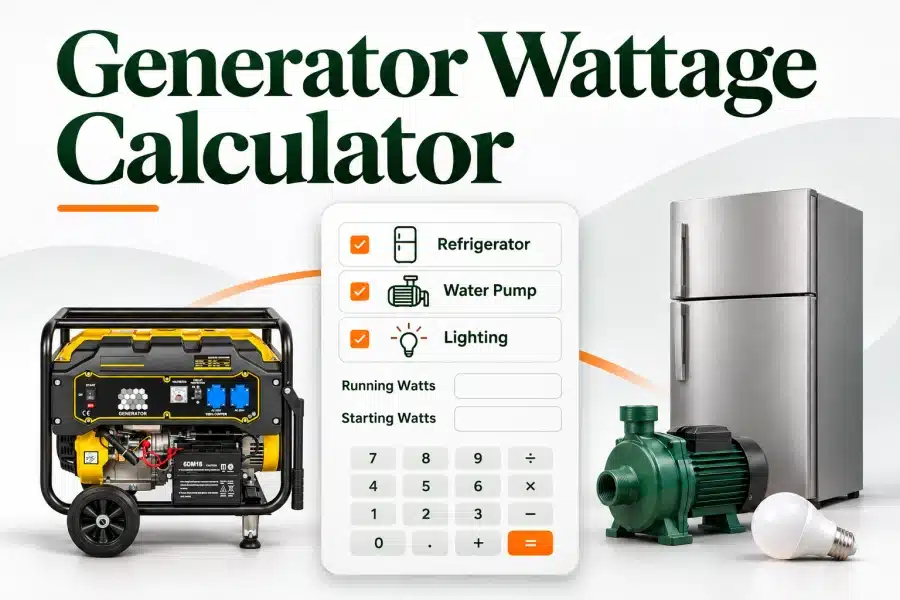
In the event of a blackout from the utility company, the two wattages that may be found on the generator box may be quite puzzling. The larger wattage will be the starting wattage. This is because it doesn’t inform you of the amount of electricity that the generator will produce constantly. After adding up the total power requirement of the appliances that will be working, then add the additional power that is required for a starting motor.
Follow these simple steps to help you determine your house load.
Running Watts vs. Starting Power: Understanding Generator Load Ratings
Check running and starting power separately:
Running rating: simultaneous running watts × optional 1.20 planning margin.
Starting rating: simultaneous running watts + the largest additional motor-starting load, if starts do not overlap.
Compare each result with the matching generator rating, then check motor-starting performance and voltage and current limits.
A gasoline engine-powered generator comes with a running rating as well as a starting rating. Running wattage refers to the amount of energy it can deliver on an ongoing basis. The starting wattage is for a few seconds of increased power for motors and compressors.
The difference comes into play especially for appliances that have motors:
- Loads without a motor-starting surge: These include lights, electric skillets, coffee makers and space heaters as they lack the type of motor-starting surge discussed above. A space heater of 1,500 watts consumes a total of 1,500 watts when working.
- Motor loads: Appliances such as refrigerators, freezers, sump and well pumps, furnace blowers and air conditioners may use more electricity at the time of starting than during steady operation.
The distinction between active, reactive and apparent power in AC circuits is also relevant when testing motor loads. The table below provides approximate startup figures; your own figures will be more accurate when available from your equipment.
Gasoline Generator Wattage Calculator
Calculate running and starting requirements separately. Review 120V leg currents and model-specific limitations before choosing a generator.
1. Choose simultaneous loads
Illustrative appliance values from this article. Edit running watts and extra starting watts to match your own equipment.
2. Planning conditions
Enter separate running and starting capacity retention percentages from the generator’s model-specific manual for the selected conditions. Leave blank if unknown; the calculator will not invent an altitude/temperature derating formula.
3. Optional generator and circuit ratings
Use the exact model’s running / starting ratings and its applicable 120V leg or breaker limit. Without these, this tool cannot confirm compatibility.
Planning model: target running watts = total running watts × headroom factor. Starting requirement = running watts + highest additional starting surge (assuming no overlapping starts).
Accuracy notes: The highest-surge method is a preliminary worksheet shortcut. Automatic motor starts can overlap. AC real and apparent power, motor starting kVA, generator surge duration, voltage/frequency response and breaker ratings require model-specific verification. Leg currents require rated RMS current or appropriate VA/power-factor data; W÷V assumes PF=1 and is not a safe motor-current substitute. The optional 60% soft-start simulation is not a verified reduction of starting watts or a promise that a 7,500W unit will work.
Explore Generator OptionsHow to Calculate Your Gasoline Generator Size in 5 Steps
First, list out what your requirements are in terms of equipment during a power outage. Same concepts apply to generator sizing for industrial applications but commercial projects require additional engineering considerations. For residential purposes, making a list of the loads will help you ensure that you don’t purchase an undersized or oversized generator.
Go through the following five steps first.
Step 1 and 2: List Simultaneous Appliances and Convert Data Plate Amps to Watts
List the number of appliances that should be operating simultaneously. For most people, this will include a fridge, sump pump, furnace blower, router and some lighting. Exclude the ones you can turn off during an outage.
Note down the data label information of each piece of equipment. This may provide the current rating in amps (A) and voltage (V) instead of watts (W). Multiplication of volts and amps yields the apparent power of the appliance in volt-amps (VA). Note that the AC motor’s VA is not its running watts.
Volts (V) × amps (A) = apparent power (VA). Actual power in watts depends on the power factor.
- 120V appliances: The apparent power of the
6.0 Aand120 Vlisted fridge is120 V × 6.0 A = 720 VA. Get its running load in watts from its data label. - 240V appliances: The well pump with the rating of
8.5 Aand240 Vprovides the apparent power240 V × 8.5 A = 2,040 VA. Find its running load in watts individually. - Locked rotor amps (LRA): You may find this data in the air conditioner or compressor. Its apparent power is multiplied volts and LRA but use it cautiously.
Step 3 and 4: Add the Highest Motor Starting Surge and Stagger Startup Loads
Determine the additional starting requirement for each of the motor driven loads. The equipment data or actual measurement is ideal; the following table is merely a guideline.
If motor starts are staggered, add the biggest additional starting requirement to the total amount of simultaneous operating loads. There could be cases where automatic appliances will start simultaneously, which cannot be covered by this technique.
During the generator startup, make sure to follow the instructions in its manual and introduce loads in phases, like:
- Start the biggest motor load, i.e., the sump or well pump, and stabilize it.
- Introduce the refrigerator and let it run.
- Introduce the furnace fan, light and electronic loads.
By staggering the loads that you can control, the possibility of simultaneous starts is minimized. However, it cannot stop a sump pump or refrigerator from starting at a later time.
Step 5: Check Running and Starting Ratings Separately (With Worked Example)
You can include a planning factor of 20% on top of the running load. Startup demand must be determined separately by including the maximum additional motor surge on top of the running load. Both should be compared with the generator ratings. The running-load planning factor will not automatically include the startup demand.
Here is a worked-out example of an outage plan for winter:
Worked example
1. Simultaneous running loads total: refrigerator 700 W + sump pump 1,050 W + furnace blower 800 W + lights / electronics 250 W = 2,800 W.
2. Highest additional startup surge: refrigerator +1,500 W; sump pump +2,150 W; furnace blower +1,600 W. Selecting the largest non-overlapping surge value gives +2,150 W.
3. Running rating target, with an optional 20% margin: 2,800 W × 1.20 = 3,360 running watts.
4. Starting rating target: 2,800 W + 2,150 W = 4,950 starting watts (without manufacturer-approved environmental adjustment).
Result: The work sheet requires the minimum running power rating of 3,360 W and starting power rating of 4,950 W based on the operational parameters given. Before making the selection, it is important to look at the starting kVA, voltage and frequency drop, surge time, and the potential for auto-starting of the motors.
Running and Starting Wattage Reference Chart for Household Appliances
This table can serve as a preliminary worksheet if there is no information about an appliance’s rating. The third column is the additional startup requirement, while the fourth one is the total startup requirement of the appliance. Make sure to check the numbers yourself before purchasing a generator.
| Household Appliance | Typical Running Watts (Continuous) | Additional Starting Surge Watts | Total Startup Wattage Required |
|---|---|---|---|
| Refrigerator or Freezer (Modern Energy Star) | 700 W | +1,500 W | 2,200 W |
| Deep Chest Freezer | 500 W | +1,200 W | 1,700 W |
| Sump Pump (1/3 HP) | 800 W | +1,300 W | 2,100 W |
| Sump Pump (1/2 HP) | 1,050 W | +2,150 W | 3,200 W |
| Well Pump (1/2 HP Submersible, 240V) | 1,000 W | +2,100 W | 3,100 W |
| Gas or Oil Furnace Blower (1/2 HP) | 800 W | +1,600 W | 2,400 W |
| Window Air Conditioner (10,000 BTU) | 1,200 W | +1,800 W | 3,000 W |
| Central Air Conditioner (3-Ton, 240V) | 3,500 W | +3,500 W | 7,000 W |
| Microwave Oven (1,000W Cooking Power) | 1,500 W | +0 W | 1,500 W |
| Portable Electric Space Heater | 1,500 W | +0 W | 1,500 W |
| Electric Water Heater (240V) | 4,500 W | +0 W | 4,500 W |
| Coffee Maker or Electric Kettle | 1,200 W | +0 W | 1,200 W |
| CPAP Machine (With Heated Humidifier) | 90 W | +0 W | 90 W |
| Wi-Fi Router, Modem, and Laptop | 150 W | +0 W | 150 W |
| LED Household Lighting (10 Bulbs) | 100 W | +0 W | 100 W |
Older single-speed compressors can require more starting power than newer variable-speed ones. Find out what your equipment is really rated for.
Why Headroom Matters for Gasoline Generators
There can be some flexibility between 20% and 25% of margin on the running load. It is simply a choice to plan, but not necessarily a code rule or a substitute of the starting power test.
Make sure you know the recommended operating range of the generator from the manufacturer. If the generator operates at close to its rated capacity, there will not be enough load capacity if another device operates at the same time. Here are several reasons:
- There is a temporary dip of voltage and frequency when a generator is loaded to full capacity, which can stop an induction motor, leading to overheating, as explained in the Lawrence Berkeley National Laboratory study on voltage sag and motor loads.
- A new load can cause a breaker to trip when the generator operates at close to its current capacity.
- Fuel consumption depends on the load and the capacity of the generator. Compare manufacturer data on fuel consumption at different loads, which also provides margin.
- High continuous loads may generate additional heat for the engine and alternator.
Gasoline Generator Wattage Tiers and What Each Size Powers
Compare your wattages while running and starting to those of both ratings on each generator. The wattage ranges provided above are only examples. It is necessary to confirm the specifications of the specific model you are using.
Safety: Never run portable gas generators inside your house, garage, cellar, crawlspace, or on covered patios, even if the doors and windows have been opened. It is necessary to use the generator outside and at least 20 feet away from all doors and windows.
| Wattage Range | Generators Types | Potential Concurrent Loads | Time at 50% Load of Fuel Tank |
|---|---|---|---|
| 2,000-3,500 W | Portable / Inverter Generators | Fridge, LED lighting, Wi-Fi/Laptops, and CPAP (or use of Microwave separately) | 8-12 hours (1-2.5 gallons fuel tank) |
| 5,000-7,500 W | Mid-Size Home Backup Portables | Fridge, deep freezer, sump pump, gas furnace blower, lights, and TV | 8-11 hours (5-7.5 gallons fuel tank) |
| 7,500W-10,000 W+ | Heavy Duty Portable Gasoline Generators | All the circuits needed for 120V + 240V well pump and central air conditioner with soft start feature | 7-10 hours (7.5-10 gallons fuel tank) |
2,000 to 3,500 Watts (Small Portable and Inverter Generators)
This could include a refrigerator, some lights and some electronic devices. The inverter generator is yet another type to consider when comparing to the regular one. The engines in some inverter generators can vary speed depending on the demand, which could lead to reduction in noise and fuel consumption during light load.
- Sample Load: 700 W of a refrigerator, 100 W of LED lights, 150 W of a router and laptop computer, 90 W CPAP. Consider the start-up wattage for the refrigerator compressor.
- Interruption required load: Turn off all other appliances before using a coffee maker or microwave (1,000 W).
- Outlets: Confirm that there are 240 V outlets available before connecting a well pump, electric water heater or central air conditioner.
5,000 to 7,500 Watts (Mid-Sized Home Backup Portables)
It could provide power to several critical circuits within a household.
- Load Examples: A 700 W refrigerator, 500 W chest freezer, 800 W – 1,050 W sump pump, 800 W furnace blower, lights and office electronics. Remember the total load required for running and start up.
- Cooling and Heating: This depends on other loads and the capacity of your generator but could possibly be enough for a 10,000 BTU window unit air conditioner or 1,500 W heater.
- Fuel consumption: At half load, the estimated fuel consumption is around 0.5 to 0.75 gallons per hour. Refer to the fuel consumption chart of your particular model in order to know the fuel refill plan.
7,500 to 10,000+ Watts (Heavy-Duty Portable Gasoline Units)
Well pumps and even air conditioners will require a larger size portable generator with an appropriate 240V receptacle, either a 30-amp or 50-amp receptacle. Make sure to verify both requirements before purchase.
- Sample load: domestic necessities such as the refrigerator, freezer, sump pump, furnace, lights and microwave, apart from the 240V submersible well pump, as long as their loads and start currents meet those of the generator type.
- Air conditioning: Certain models from this range can power a 2-ton to 3-ton AC system. Start current will be the more difficult parameter; soft start kit is capable of lowering it. Verify performance with specific air conditioner and generator models.
- Weight and fuel usage: The generators that are included in this range are weighed somewhere around 200-300+ pounds and use 0.9-1.3 gallons of gasoline per hour of operation. During a full day’s operation using this speed, you will need about 20-30 gallons of fuel.
Common Generator Sizing Mistakes and Environmental Adjustments
A paper calculation of the load total might not agree with what is able to be provided by the generator. The output according to the manufacturer’s guidelines and current on each 120V line should be considered.
Neglecting High-Altitude and Extreme Temperature Derating
Elevation and heat may impair the generator’s performance. It varies from generator to generator and depends on engine and the type. Follow the manufacturer’s derate procedures for the generator, rather than applying one percent reduction for all generators.
For a generator operated at high elevation or under hot conditions, use the ratings provided for the model under such conditions:
Environmental derate: Manufacturer information required
Apply the manufacturer’s retained running rating for sustained loading. Verify the starting rating, if provided separately by the manufacturer. Engine horse power adjustment alone will not determine either rating.
If the manufacturer indicates that a model retains 79% of its nominal running rating at your elevation, a sustained load of 6,000 watts requires a nominal running rating of 6,000 ÷ 0.79 ≈ 7,595 watts. Verify starting capacity separately.
The temperature makes airflow and cooling necessary. Most portable gasoline generators use an air-cooled engine. Refer to the manual to see what ambient temperature and clearance requirements apply, as well as to know whether there is any output reduction due to such temperatures.
Example of calculation of altitude correction: In case the assumed target running load, taking into account the 20% safety margin is 6,000 W @ 6,000 feet and some particular design of a certain brand is known to have an output decrease by 3.5% for every 1,000 feet, then the output loss will be 21% (6 × 3.5% = 21%). As a result, the running output capacity of the nominal 6,000 W generator becomes 4,740 W. Calculation of (6,000 / 0.79) yields 7,595 W.
Overlooking 240V Load Balance and Future Power Additions
You might want to consider these two elements as well:
- Balance of 120V legs: A 6,000 W, 120/240V generator can provide approximately 3,000 W for each 120V leg depending on the rating of the unit and breakers. In the current setup, the 700W refrigerator, 1,050W sump pump, and 1,500W microwave together make 3,250 W. This means that, if they are all installed on one leg, there will be overload of that leg and extra capacity on the other one. You should review the circuit setup for your particular case.
- Potential loads in the future: If you plan to install a backup pump, heat-pump water heater, or a server in your home office within the next five years, include these plans in your capacity requirements.
Portable Gasoline Generators vs. Whole-Home Standby Units: When to Upgrade
The bigger portable gas generator units have the capability of producing between 8,000 and 10,000 watts of running power. In case your total load is more than 10,000 watts, especially when using central air conditioning, cooking equipment, water heater, and well pump, you could then compare the larger portable unit to the installed one.
In case of extended blackout period, you should compare the fuel consumption and the cost of operation along with the installation. The cost of operation for the gasoline and natural gas generators varies with the efficiency, load and operational hours.
The standby generator could operate with the utility natural gas connection and with the residential propane tank. It uses the automatic transfer switch that monitors the utility power and transfers the selected loads when the utility power is out. You can check the guidance on the automatic transfer switch by Pacific Northwest National Laboratory.
| Comparison Feature | Portable Gasoline Generator (2,000W – 10,000W +) | Whole-Home Standby Generator (10,000W – 22,000W +) |
|---|---|---|
| Scope of Typical Back-up | Selectively essential circuits (fridge, sump pump, furnace, light, window ac) | Entire house with its central hvac system, electric appliances and well pumps |
| Start-up and Connections | Manual set up: wheel the unit outside, plug it into inlet box, use manual transfer switch | Automatic through Permanent Transfer Switch (ATS) |
| Fueling System | Gasoline kept in safety cans; manual refueling every 7 – 12 hours | Continuous supply of natural gas from utilities or 250 – 500 gallon LP tank |
| Practical Point to Consider | Example of planning: total load with headroom is less than 8,500 W | Example of planning: total load is more than 9,000 W |
Quick Selection Checklist
- Portable: Verify that your running and starting loads meet the specifications of your unit, your outlets, your amperage limits, and that you can use and refuel your generator safely.
- Standby: Investigate a model-specific load survey for an automatic back-up option if you have more circuits than a portable would accommodate.
Final Takeaways on Sizing a Gasoline Generator: Running Loads, Starting Power and Headroom
Also add all the electrical appliances that would be running simultaneously. There could be a safety margin for continuous load. The maximum motor-starting load could then be added for the first rough calculation in case there are no overlapping starts. Compare the values with the generator’s ratings for continuous load and for starting, as well as the ratings of the output terminals, breaker, and legs of 120/240 volts. Consider the effects of altitude and temperature according to the manufacturer’s recommendations.
Frequently Asked Questions About Sizing a Gasoline Generator
Do I need to add up the starting watts of every appliance in my house?
In case of a rough estimate, the maximum starting demand should be added up to the simultaneously running load in case the motor starts are not overlapping. Some of the automatic devices could start simultaneously; that is why this case should be taken into account and the starting demands of all the devices should be checked.
What happens if a gasoline generator is undersized or overloaded?
Overload could trip the generator’s breaker. The start of the motor at the moment when generator is almost loaded will lower the frequency and voltage.
Can a portable gasoline generator power a central air conditioner?
Maybe, depending on the generator’s capacity both running and starting, voltage of 240V and adequate circuits. The generator may be able to use a compatible soft starter to lower the starting current requirement of the air conditioner. If connected to the house wiring, a generator interlock versus transfer switch should be considered, followed by verification from a licensed electrician for your breaker box.
Why is a 20% to 25% headroom buffer recommended for gasoline generators?
A 20-25% headroom allowance could allow for some variation in load requirements or installation of additional electrical devices in the future. The allowance is optional and does not mean the generator will definitely be fuel-efficient or be sufficient in starting all motors.
