

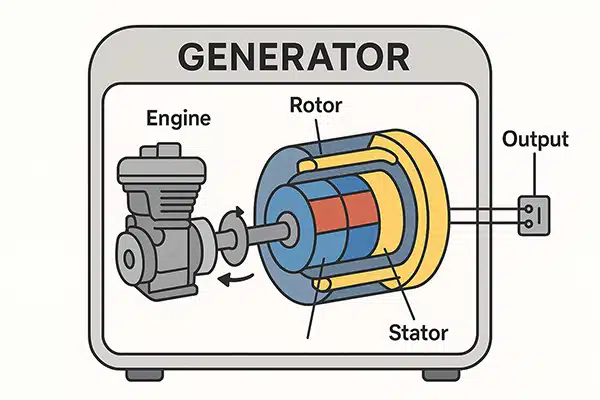
The most basic answer to the question, what is a generator? is that it is a machine which converts mechanical energy into electrical energy. This definition is correct, but it doesn't necessarily indicate if a specific unit is able to power up your motors, conform to your electrical system, or reliably operate at your site.
Whether it's powering a building during an emergency, providing temporary power at a construction site, or ensuring a reliable supply in an area where the power grid is absent, there are times when power is necessary. In all instances, one has to consider more than just the wattage listed on the nameplate. This final choice is dependent on the engine, alternator, controller, fuel, voltage, phase, frequency, starting load, and site conditions.
We will help you understand how an electric generator works, the primary components and their functions, the different types of generators and what to include in a generator quote.
What is a Generator?
Definition and Basic Meaning
An electric generator converts mechanical energy supplied by an outside source into useful electrical energy. It is not an energy or electrical charge generator.
The process can be thought of in terms of a generator–water pump analogy. A pump pumps water in a pipe but does not produce water. Similarly, a generator operates by moving electrical charges which are already available in the conductors of the generator through an external circuit by mechanical means. That motion generates the electricity required to power facilities, job-site equipment or home appliances.
This distinction is important when it comes to equipment choices. A generator is made up of one component of an energy-conversion system: the prime mover provides the mechanical input, the alternator converts the mechanical input and the distribution system provides the output to your loads.
A generator transforms mechanical power into electrical power.
The operation of the generator is based on Faraday's law of electromagnetic induction. This mechanical to electrical transformation was first demonstrated by Michael Faraday in 1831, and it is the same principle that today's generators use to generate electricity.
There are three basic stages of the process:
Relative movement: A conductor (e.g., copper winding) moves relative to a magnetic field.
That relative motion generates a voltage across the conductor is induced voltage.
Conductor is part of a closed external circuit: Current flows through the conductor and connected load as a result of the voltage.
This electromagnetic interaction is continuous mechanical rotation provided by an engine. The output is only useful if it is at the same voltage, frequency, phase, waveform and capacity as the equipment you intend to connect.
What is the Working of an Electric Generator?
Now let's take another look at the water-pump analogy to understand how a generator works. A pump does not create water, it only pumps water. In a similar fashion, a generator converts mechanical energy into electrical energy by moving electrical charges around in a circuit.
If you need to select practically, consider the unit as two machines that are connected. The alternator converts the rotation into electricity, and the engine provides the rotation. The stable conversion is maintained by the control, protection, cooling, lubrication and fuel-delivery systems.
The Electromagnetic Induction Principle
All modern generators rely on the principle of Faraday's law of electromagnetic induction:
The principle: When a conductor is moving in a magnetic field or the magnetic field moves relative to the conductor, a voltage is induced across the conductor.
The result: When a closed circuit is made, the induced voltage will cause a current to flow in that circuit.
Magnetic field can be located on the rotating component and the conductors can be located on the stationary component. The condition is that there must be relative motion between the magnetic field and the conductor.
The mechanical energy is converted to electrical power.
The conversion is done by a generator, which has two main parts:
Mechanical input: Using an engine, diesel, gasoline, natural gas, propane or other appropriate fuel is burned to generate rotational power. In larger generation systems, the same type of input can be obtained from turbines and other prime movers.
Electrical conversion: The magnetic system inside the alternator rotates in relation to the windings and the electric current is induced.
The output is not solely dependent on the engine power. It is necessary to have an engine and alternator that are properly matched to ensure that the set will maintain adequate voltage and frequency with an acceptable electrical load.
How the Core Mechanism Operates
Typically, the steps for power conversion in an engine-driven generator are:
Rotational drive: Alternator shaft is driven by the engine.
Magnetic excitation: The rotating magnetic field of the rotor is produced by the permanent magnets, slip rings and brushes, or by a brushless excitation system.
Current induction: The moving field induces voltage in the stationary windings in the stator.
Output control: With the change of load, the excitation and voltage regulation system will adjust the magnetic field, so as to maintain the specified terminal voltage.
EXTERNAL DELIVERY: Electrical output goes through external terminals or receptacles to your distribution equipment and connected loads.
If the project is a commercial or industrial project, then also verify how the set will respond to load steps. If the voltage or frequency dip is large enough, a generator could be able to run a motor but not start it.
The primary components of a generator are the rotor and the armature.
To appreciate a generator as a completed package it's important to see past the engine. To ensure reliable output there are multiple mechanical, electrical and control systems that need to function together.
The engine and fuel delivery system.
The engine is the mechanical source of power of the generator set. It transforms the fuel energy into shaft rotation. A large percentage of portable sets are gasoline or propane overhead-valve models, and diesel or natural gas is used in many of the heavy duty sets. The cylinder arrangement, cooling system, governor, materials used and other construction features differ from model to model and from duty class to duty class.
The fuel system stores fuel and provides it to the engine. It can consist of a tank, supply and return lines, ventilation and overflow lines, pumps, filters or water separators, carburetion parts, gas regulators or injectors, depending on the design.
Some manufacturers may target runtimes of 6-8 hours for their onboard tanks, but this is not necessarily the case. Tank capacity and fuel consumption vary at different load percentages so check tank capacity and fuel consumption at stated load percentages.
The alternator and voltage-control system provide power.
Also called a genhead, the alternator is a device that changes the rotation of the shaft into electrical output. The major components perform various functions:
| Component | Function | What you should confirm |
|---|---|---|
| Stator | Stationary electrical core | Fixed housing with wound conductors in which output voltage is induced |
| Rotor (armature) | Rotating magnetic element | Creates a rotating magnetic field through permanent magnets, slip rings and brushes, or a brushless exciter |
| Voltage regulator | Output-voltage control | Adjusts excitation to help maintain terminal voltage as loads and operating conditions change |
Don't compare alternators based on rated kW only. Inquire about insulation class, temperature rise, winding material, method of excitation, short circuit capacity, quality of the wave form, automatic voltage regulator performance and test standard. The fact that voltage regulation is obtained does not necessarily mean that the output is acceptable for all sensitive electronic loads. THD and transient response may also be important.
Control Panel, Battery Charger, and Frame.
One place to operate, monitor and protect the generator with the control panel. Depending on the model, it can show oil pressure, coolant temperature, battery voltage, operating hours, output voltage, current, frequency, power, alarms and shutdown status. Some standby systems can also include remote-start contacts and communication interfaces to an automatic transfer switch or building-management system.
Engine, alternator and auxiliary systems are mounted on the main frame or skid. Anti-vibration mounts reduce the mechanical vibrations that are passed on and help to protect the parts that are connected. A battery charger will maintain the starting battery at a regulated float voltage and keep it ready to crank.
Prior to purchase, be sure to check the standard and optional controller functions and communication protocols. A detailed-looking display doesn't always include remote monitoring, event logging, synchronization or ATS control.
Cooling, Exhaust, and Lubrication
Power generation also results in combustion gas, heat and friction that are to be controlled during power generation.
Cooling system: Air cooled units provide directed air flow. The liquid-cooled sets typically rely on a coolant that circulates, a radiator and a fan. Some utility scale machines require specialized methods, like hydrogen cooling, but these are not normally used on portable or standard industrial generator sets.
Exhaust system: Manifolds, pipes, flexible sections, silencers and outlets conduct exhaust from engine and other working areas. You need to consider back pressure, heat, weather protection and local emissions requirements in your installation.
Lubrication system: Oil pump, sump, passages and filter circulate oil to minimize friction and wear.
CO and other exhaust gases are generated by fuel burning generators. Use portable units in accordance with manufacturer's instructions and safety requirements. OSHA's portable-generator guidance (OSHA3286.pdf) cautions against operating indoors and direct connection to a building's electrical system without a proper transfer switch.
What are the different kinds of Electric Generators?
Each generator configuration is appropriate for a different load profile, installation scenario and operating schedule. A wider generator range can be compared by determining if mobility, automatic standby or continuous duty is required for the application.
Portable Generator Sets
Portable generators are used to power a specific load or loads from a job site, outside of a building, for service, events, or for short periods of time during a utility outage.
Engine: Most are equipped with small overhead-valve gas or propane engines; portable diesel models are available.
Structure: A tubular or fabricated frame, handle and wheel kit can ease transport and placement.
Fuel Tank capacity: An integrated fuel tank can give you 8-10 hours of running time. Don't just look at tank size; compare runtimes at a percentage of rated load.
- Output connection: Receptacle type, output voltage, grounding and circuit protection must be appropriate for intended use and local regulations.
Portable gasoline generators might be appropriate for the application if mobility and simple refueling are important factors.
Standby and Backup Generator Sets
Standby generators are permanently installed and are ready to run selected loads or an entire facility in the event of a loss of normal power.
Heavy duty construction is where many commercial / industrial sets utilize diesel or natural gas engines on a rigid skid and choose a liquid cooling system and enclosure for the application.
Automatic operation: An automatic transfer switch can sense a loss of utility power, alert the generator to start, and switch the load when it senses proper voltage and frequency.
- Support systems: Cooling, lubrication, starting batteries, chargers, controllers, alarms and fuel systems are chosen depending on the duty and site conditions.
When weather protection and acoustic control are of concern, make comparisons between a silent diesel generator and open frame and containerized types. Silent is a product category, not a guarantee of no noise. Compare sound-pressure data as measured at a specified distance and load.
Comparing AC and DC Generators
The difference is the type of current that you are using for your load:
| Feature | AC generator | DC generator |
|---|---|---|
| Current type | Alternating current that changes direction periodically | Direct current that flows in one direction |
| Operating method | Commonly uses a rotating magnetic field and stationary output windings | Traditionally uses a commutator to obtain unidirectional output |
| Typical application | Facility, industrial, commercial, and household power | Specialized processes, battery charging, and some DC motor applications |
| Distribution | Well suited to distribution | Often used for localized, application-specific DC requirements |
For most building and machinery applications, an AC output is used. When dealing with sensitive electronics or variable-speed loads, you might want to consider an inverter generator vs. an alternator generator set. Do not rely solely on the category name; use voltage, frequency, waveform, harmonic distortion and load-response data instead.
Generators are commonly Used.
A generator delivers electricity on-demand when the electric grid is down or can't be accessed at the site. The generator can be used as temporary power, as emergency standby power, as prime power or as a part of a hybrid energy system, depending on your application.
power for household loads in an emergency.
If the weather is bad, equipment fails or there is a power outage in the area, a properly sized generator will provide power for certain household appliances:
- Food storage: Refrigerators and freezers can still function, minimizing food spoilage.
Climate control: Furnace blowers, boilers, heat pumps, and air conditioners can be considered if the generator is able to supply the running and starting requirements.
Water systems: Well pumps and sump pumps may run provided the set can meet the motor starting requirements.
Communications devices and medical devices: Communications equipment, as well as some medical devices, may be available if the generator output and the method of connection are adequate.
Not all generators that have a voltage regulator are appropriate for sensitive devices. Specify equipment manufacturer power requirements and acceptable voltage tolerances, frequency stability, and waveform quality.
Standby Power for Commercial and Industrial Sites
An outage at a commercial or industrial facility can halt production, breach security, ruin materials or affect a critical process. Heavy duty generator set can be used for applications like:
Healthcare facilities: Backup systems can provide essential electrical loads and life-safety equipment when designed, installed, tested and maintained to the applicable regulations and facility requirements.
Data centers: A generator can provide power to cooling, networking and server infrastructure following the power outage while the uninterruptible power supply handles the transfer time.
Manufacturing plants: Sequential loading can ensure selected machinery, controls, conveyors and process systems continue to run.
At construction sites and remote locations: A generator can power your equipment, site offices, lighting and pumps in places where utility power is not available.
The real question is not just ‘How many kilowatts do you need? The loads that are important, those that can be dispensed with, the sequence of load start, the duration of load, and the effect of starting the largest motor when other equipment is already running should be determined.
Why you need a generator?
A generator helps you to manage the impact of an outage or erratic power supply on your operation and your finances. Its worth is dependent on the danger it poses and the weight it can truly support.
Power continuity: selected circuits can be restored manually or automatically in a grid outage.
Operational continuity: Critical machines, controls, cooling, security, communications and servers can still be maintained and kept online, minimizing avoidable downtime.
**Tools and equipment operational at construction sites, agricultural locations and remote facilities without a utility connection.
Controlled electrical output: Generator is properly specified to maintain output within defined voltage and frequency limits. Transient performance and harmonic distortion are also important characteristics to consider for sensitive loads.
Fuel flexibility includes diesel, gasoline, natural gas, propane, and hybrid systems to match the system to the fuel available, fuel storage requirements, duration of operation, emissions requirements, and maintenance requirements.
A generator is more than just a piece of equipment! A reliability system consisting of load analysis, controls, switching, installation, fuel supply, ventilation, maintenance, spare parts and operating procedures.
How to select the proper generator?
Your generator should be the same as your load, duty, electrical system, operating environment, and service plan. The decision is not just based on the rated output.
Calculate power and starting requirements.
Start by making a list of all the loads that need to function. Write down its voltage, phase, running power, starting method and starting demand.
Running watts or kW: The watts or kW that your circuits, lights, motors and machines consume when operating at steady state.
Starting watts or kVA: For motor driven equipment such as pumps, compressors, refrigeration and HVAC equipment, this is the temporary surge that the equipment requires.
Order and time of load connection: Load sequence. Operating the larger motors in succession could reduce the maximum simultaneous demand.
For some sites, a planning allowance of 20% to 25% capacity may allow for some load variation and growth, but should not be used as a general sizing guideline. Some types of engines may also have operating issues if they are oversized.
Pegaso 's commercial generator sizing guidance includes future expansion, ambient conditions, voltage and frequency dip, load steps and motor-starting requirements and total load. Use accurate equipment data and a proper sizing calculation for final selection, rather than just adding nameplate watts.
For instance, if you're calculating a demand of 5 kW, you'll only want to consider a 5000-watt gasoline generator if you've checked the figure is for run or peak output and that the generator can start your largest connected motor.
What are the differences between Gasoline, Diesel, Propane, and Hybrid Power?
The type of fuel used will have an impact on runtime, storage, maintenance, emissions, installation, and supply resilience:
| Fuel | Typical application | Main advantages | Points to check |
|---|---|---|---|
| Diesel | Heavy-duty commercial, standby, and some prime-power duties | Efficient at suitable loads and widely used on durable industrial engine platforms | Fuel storage, quality management, filtration, availability, and maintenance |
| Gasoline | Portable and short-duration power | Familiar fuel and compact equipment options | Volatility, storage life, refueling, and safe storage |
| Propane / natural gas | Residential and commercial standby systems | Cleaner combustion at the point of use than gasoline or diesel; propane storage or pipeline gas may be available | Engine output, gas pressure, pipeline reliability, and lower volumetric energy density |
| Solar / hybrid | Low-noise, off-grid, and supplemental power | No on-site exhaust from the solar-and-battery portion and low noise during battery discharge | Inverter rating, battery capacity, solar input, weather, recharge time, and required autonomy |
Final Thoughts
A generator is a savior that kicks in when there's no electricity. Its primary function is to generate electricity with the help of an energy source and deliver it to connected devices.
A generator may be used to power important equipment during a power failure, to power equipment at a remote site or as back-up power for a commercial or industrial facility. The outcome is a function of the match between the engine, alternator, controls, switching equipment, fuel system and installation to the actual load.
Frequently Asked Questions
can i put gas in a generator while it's running
No, you absolutely should
never put gas in a generator while it's running; it's extremely dangerous and a major fire/explosion risk due to hot engine parts igniting spilled fuel or vapors, so you must turn it off and let it cool for at least 10-15 minutes before refueling, allowing for complete cooling and vapor dissipation, just like any other gas-powered equipment.
Why it's unsafe:
- Ignition Risk: A hot engine and exhaust components can easily ignite gasoline vapors or spills, leading to fires or explosions.
- Vapor Buildup: Running engines produce flammable fumes that can be ignited by a spark from the refueling process.
how long can you run a generator for?
A generator's continuous run time depends on its type, fuel source, and maintenance, with some portable models running
6-18 hours on a single tank and standby models able to run for days or even weeks at a time if connected to natural gas. However, it's crucial to follow the manufacturer's recommendations for fuel, breaks, and service to prevent damage and extend the generator's overall lifespan.
Industrial generators are composed of various components.
A typical industrial generator set consists of nine major subsystems:
Mechanical input provided by engine.
- Alternator or genhead: generates electrical output with the rotor and the stator.
- Fuel system: Fuel stores, fuel filters and fuel delivery.
- Voltage regulator: Regulates the excitation to maintain voltage.
- Cooling and exhaust systems: Discharge engine heat and combustion gases from the installation.
- Lubrication system: pumps oil around to minimize friction and wear.
- Battery charger: Keeps the starting battery charged.
- Control panel: Operation, Electrical output, alarms, shutdowns.
- Main frame: Holds together the assembly and offers vibration isolation if needed.
The actual configuration will depend on the generator size, fuel type, duty, installation and control needs.
What Fuel Can Generator Engines Run On?
There are a number of fuels that can be used by generator engines:
- Diesel
- Natural gas
- Propane or LPG
- Gasoline
Hybrid systems can be a mixture of engine generator, batteries, solar charging, and power electronics. Select the fuel and system design based on local availability, storage, runtime, emissions regulations, maintenance and cost of operation.
What should I consider when choosing a generator for industrial use?
Choosing an industrial generator requires careful evaluation of power needs, operational environments, and regulatory standards to ensure reliability and safety.
