

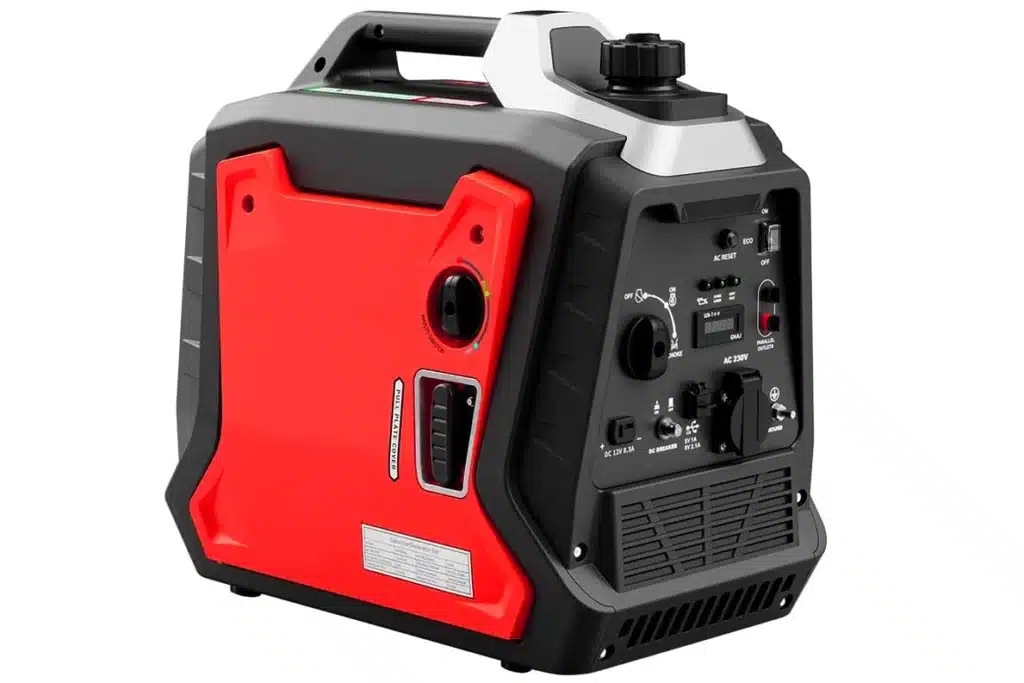
Generators are indispensable in power outage emergencies, outdoor activities, construction sites or RV trips. However, the market offers various types. Inverter generators and conventional generators are most often compared. The two differ obviously in power quality, fuel efficiency, noise level, power output and usage cost. Understanding these differences can help you choose a more suitable power generation solution based on your actual electricity demand.
Note: In this article, a conventional generator refers to a generator that typically produces AC power directly through an alternator, without an inverter-based output stage. Common examples include open-frame gasoline generators and many diesel generators.
Quick Overview
| Factor | Inverter Generator | Conventional Gasoline Generator | Diesel Generator | Natural Gas Generator |
|---|---|---|---|---|
| Rated Power | 1,000-8,500W | 1,000-10,000W | 10-500+ kW | 10-1,000+ kW |
| THD | <3% | 10-25% | 5-15% | 5-10% |
| Noise Level @25 ft | 50-65 dB | 70-80 dB | 75-95 dB | 65-80 dB |
| Fuel Consumption @50% Load | 0.1-0.3 gal/hr | 0.4-0.8 gal/hr | 0.5-3 gal/hr | Varies by gas supply |
| Runtime per Tank | 8-18 hrs | 8-12 hrs | 12-48 hrs+ | Continuous with gas line |
| Weight | 40-120 lbs | 100-250 lbs | 500 lbs to several tons | Permanent installation |
| Voltage Regulation | Excellent | Moderate | Good | Good |
| Best for | Camping, RVs, home backup, sensitive electronics | General household use, occasional backup power | Construction sites, commercial facilities, industrial applications | Standby power for homes, businesses, and critical facilities |
Note: This table is for reference only. Please refer to the actual product specifications for details.
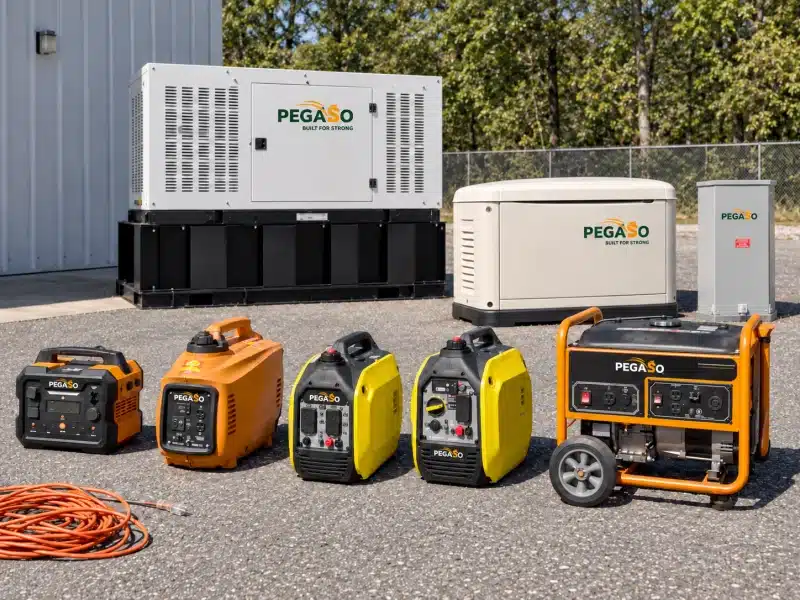
Engine Speed Control: Variable Speed vs. Constant Speed
Conventional Generator
Conventional generators run at constant speed. Regardless of the load size, the engine always maintains a fixed rotational speed to ensure a stable output frequency. For instance, in North America, generators need to operate at approximately 3,600 revolutions per minute (RPM) to output 60Hz alternating current. Under low load conditions, even if only a small number of devices are driven, the engine will still maintain a high rotational speed.
Inverter Generator
Inverter generators use variable speed. The generator first generates alternating current, which is then rectified and inverted to output stable alternating current. The engine speed no longer needs to be directly linked to the output frequency. When the load is low, the engine automatically reduces its speed. When under high load, the rotational speed is increased to provide more power.
This variable speed operation brings higher fuel efficiency and lower noise. Under partial load, reduced engine speed lowers mechanical and exhaust noise. A lower average operating speed also minimizes engine wear, extends equipment service life, and lowers maintenance frequency.
Power Quality: Clean Electricity vs. Output Stability
When the load of a conventional generator suddenly increases or decreases, the voltage and frequency are prone to fluctuations. However, inverter generators can maintain stable voltage and frequency, and have lower total harmonic distortion (THD)1. Such voltage and frequency fluctuations generally have a relatively small impact on equipment such as lighting, motors, and water pumps, but they can interfere with sensitive electronic products like computers, communications, and medical devices, affecting their stable operation.
Load Response: Handling Sudden Changes in Power Demand
- Conventional generator: It is often equipped with large engines and generator sets, so it can immediately provide high output power when facing sudden heavy loads. For this reason, when driving motor-type equipment to start, it can handle the situation of sudden load surges very well.
- Inverter generator: It can also cope with load changes, but its response mainly relies on the electronic control system and frequency conversion technology. It can monitor the load demand in real time and quickly adjust the power output, thereby providing stable power for most residential and light commercial application scenarios.
Fuel Consumption: Which Generator Uses Less Fuel?
Compared with traditional generators, inverter generators are usually more fuel-efficient, especially under low load or load fluctuation conditions.
Even when conventional generators supply power to only a small number of devices, they will continuously consume fuel, thus causing energy waste. Variable-frequency generators, on the other hand, can provide electricity based on actual power demand, thereby reducing unnecessary fuel consumption and enhancing operational efficiency.
In scenarios such as household backup power supplies, RV camping, outdoor activities, and light commercial applications, generators rarely remain at full load for long periods of time. Therefore, the energy-saving advantages of inverter generators are more significant. However, if the generator operates for a long time under conditions close to the rated load, the efficiency gap between these two types of generators often narrows.
Cost Breakdown: Initial Price vs. Long-Term Operating Costs
From the perspective of procurement costs, generators are usually cheaper, which is quite attractive to someone with limited budgets or those who only need to use them occasionally. However, the actual usage cost cannot be reflected merely by the purchase price.
During long-term use, inverter generators can save operating costs by reducing fuel consumption. In addition, a lower operating speed can also reduce engine wear, thereby lowering maintenance and repair costs and extending the service life of the equipment.
In contrast, conventional generators require less initial investment, but their fuel consumption and maintenance costs over long-term operation may gradually increase. For households, businesses or outdoor operation buyers who frequently use generators, these ongoing expenses cannot be ignored.
Pros and Cons of Inverter Generators vs. Generators
Inverter Generator
Pros:
- High fuel efficiency. The engine speed automatically adjusts based on the load, reducing unnecessary fuel consumption.
- Low operating noise. Engine speed decreases during light-load operation. More compact and lightweight, facilitating easy portability and transport.
- Low Total Harmonic Distortion (THD), with power output closely approximating the quality of utility-supplied electricity.
- Reduced engine wear, which helps extend the service life of the equipment.
- Some models support parallel operation, allowing for increased power output when needed.
- Generally lower emissions, making it easier to comply with environmental standards.
Cons:
- The initial purchase cost is relatively high, and it is usually more expensive than generators of the same power.
- Maintenance and fault diagnosis are more complex, involving inverters, circuit boards and electronic control modules.
- Selection of high-power models is limited.
Conventional Generators
Pros:
- Provides higher output power. It is suitable for high-power equipment and the simultaneous operation of multiple loads.
- Strong instantaneous startup capability, capable of handling equipment with high inrush currents, such as air conditioners, electric motors, water pumps, and large power tools.
- Boasts a relatively simple structure and mature technology, which facilitates easier maintenance and troubleshooting.
- Components are widely available, and maintenance costs are generally low.
Cons:
- High fuel consumption.
- The operating noise is relatively high.
- It is usually larger in volume and weight.
Which Type of Generator Is Better for Home Use?
For most household users, an inverter generator is usually a better choice. Modern families depend more on computers, routers, smart TVs, refrigerators and smart home devices, which require stable voltage and frequency. Household backup power usually does not run at full capacity for long. The inverter generator can adjust engine speed to the actual load. For residential communities, night use or long-term standby, quietness and energy saving are often important advantages.
However, conventional generators still have value in some household scenarios. If multiple high-power loads such as central air conditioning, water pumps and electric heating equipment need power at the same time, or if higher output power is desired at a lower budget, a generator may be a more economical choice.
3 kW Generator Comparison: Inverter Gasoline vs. Open-Frame Gasoline vs. Diesel
The actual model designations published by the manufacturer are used below.
| Comparison | Inverter gasoline | Conventional gasoline | Diesel |
|---|---|---|---|
| Rated power | 3.0 kW | 3.0 kW | 3.0 kW |
| Maximum power | 3.3 kW | 3.3 kW | 3.3 kW |
| Fuel | Gasoline | Gasoline | Diesel |
| Fuel tank | 4 L | 9 L | 12.5 L |
| Weight | 22.5 kg | ≤40 kg | 74 kg |
| Starting system | Recoil | Recoil | Manual / electric |

Inverter Generator vs. Portable Generator: Are They the Same?
Portable generators are a product category, while inverter generators are a power generation technology. Portable generators refer to power generation equipment that can be easily moved and transported. This type of generator includes both traditional generators and inverter generators.
When comparing generators, do not assume that every portable model is a conventional generator or that every inverter generator is portable. Instead, evaluate the generator’s technology, power capacity, portability, and intended application separately.
Wrap up
Understanding the differences between these generators can be highly beneficial for your business. If you need assistance in selecting the right model for your specific application, please contact us. With over 10 years of experience in generator manufacturing and exporting, we are well-equipped to help you address any questions or challenges related to inverter generators.
FAQs About Inverter Generators vs. Generators
Is an inverter generator better than a regular generator?
An inverter generator is often better for sensitive electronics, quieter operation, and fuel efficiency at partial loads. A conventional generator may be more suitable for applications requiring higher power output at a lower upfront cost.
Are all portable generators inverter generators?
No. Portable generators include both conventional and inverter models. Portability refers to ease of transportation, while inverter technology describes how electrical power is processed.
Can you run sensitive electronics on a conventional generator?
Yes, provided the generator delivers power within the equipment’s voltage and frequency tolerances. Check its total harmonic distortion (THD) and voltage regulation specifications to ensure compatibility with sensitive electronics.
Sources
Wikipedia. Total harmonic distortion. Source linked in the original article for the THD concept. ↩
