

How Does the 80% Rule Affect Generator Sizing?
The generator may appear adequately sized based on the wattage chart but may still fail when the air conditioning kicks in. If we assume that the total running load of all the gadgets in a house amounts to 11.2 kW. Applying the familiar rule of thumb method of estimating 80%, we would find that a 14 kW generator should be adequate. However, an additional 6 kW startup power for the AC would result in a momentary load of 17.2 kW. You would have to verify whether such a generator is capable of delivering the starting power required.
The 80% rule is only a sizing guide. It means using only 80% of the capacity of the generator for running load while holding back at least 20% in reserve. This implies that for a 10 kW generator, it could provide a running load of 8 kW. The 80% rule does not represent the maximum permissible size of the generator set in all circumstances.
The spare capacity can help when other appliances switch on. This can lower engine speed, voltage, or frequency, and overloading beyond the capacity of the device will cause overheating or trigger its protection. However, 20% does not guarantee that there will be no need for the motor to start. Ensure that you check the ability of the motor to start according to the manufacture.
However, it comes with a price to pay. The engine may run under a lightly loaded condition when the purpose of getting the engine is to have excess capacity. The consumption of fuel, winding, and engine wear depends on the engine, duty cycle, and load characteristics. Estimate using 80% initially, and confirm it based on the engine’s rated capacity.
Is the Generator 80% Rule Required by Law?
Neither the National Electrical Code (NEC) nor NFPA 110 establishes a universal 80% limit on generator engine capacity. The allowed load would depend upon the rated capacity of the generator set and any specific directions from the manufacturer. The well-known 125% formula in the NEC is designed for some particular continuous loads on circuits and its protection devices, not to restrict the engine power by 80%.
If an electrician mentions the “80% limit,” find out what is being sized. An ordinary circuit breaker that supplies a continuous load is supposed to follow a different rule compared with the generator capacity itself. The code requirements may vary depending upon the local NEC version and exceptions.
Brief Comparison: Engine Guidance and Electrical Code Requirements
- Generator set: It is reasonable to have an 80% operating goal as a guidance during sizing, but the actual allowable load will depend upon the generator set’s rating and its duty cycle. ISO 8528-1 divides generators into emergency standby, prime and continuous, as opposed to the uniform limit of all of them.
- Circuits and overcurrent protection: The NEC normally requires 125% sizing of continuous load with use of standard protective devices, with exceptions depending on the locally adopted NEC edition, installation conditions, and equipment listed for 100% continuous operation.
NEC 125% Continuous Load Rule for Breakers and Conductors
A continuous load is defined by the National Electrical Code as “a load where the maximum current is expected to continue for 3 hours or more.” According to NEC Articles 210, 215, and 445, a feeder conductor and standard overcurrent protective devices (i.e., circuit breakers) serving a continuous load shall have a capacity of 125% of the continuous load.
Sizing an overcurrent device to 125% of a continuous load is essentially the same as operating the device at 80% of its rated capacity for standard installations. Equipment designed as a complete assembly for continuous operation for 100% load may be an exception according to the applicable NEC articles. This circuit calculation should not be applied to a nameplate rating of a generator engine.
Math of Inversion between 125% and 80%
- Code Requirement (Sizing Up): Continuous Load × 1.25 (125%) = Minimum Breaker/Conductor Rating
- Operating Restriction (Sizing Down): 1 ÷ 1.25 = 0.80 (80%)
- Example Calculation: An 80-amp continuous load times 1.25 needs a 100-amp breaker. On the other hand, a 100-amp breaker is capable of carrying 80 amps of continuous load.
ISO 8528 Generator Ratings and NFPA 110 Requirements
The ISO 8528-1 categorizes the generator sets based on the end use intended. The widely known ISO limit in relation to the ESP rating is 70% load factor in a 24-hour day, except when the engine manufacturer disagrees with the rating. In such a case, the set can operate with higher loads within the 24 hours but still meet its allowable average. This is not the same as operating at a fixed 80% load factor in each hour of operation.
ESP ratings are usually designed for occasional yearly running for up to 200 hours with no overloading beyond the specified rating. There are differences between prime and continuous ratings. The NFPA 110 deals with the performance, testing, and maintenance of the emergency and standby power system; however, it does not make the 80% sizing shortcut legally obligatory for the generator.
NEC Generator Sizing Rules: Articles 700, 701, and 702
For the purpose of compliance with inspection regulations in the sizing of a generator, the NEC separates backup systems into three separate groups depending on their level of safety criticality. Engineering guidelines for emergency and standby power systems1 provide insight on how these regulatory levels determine the need for carrying all connected circuits simultaneously by the generator:
- Article 700 (Emergency Systems): These include life safety equipment such as operating rooms in hospitals, exit lights, and fire pump systems. The power should be restored within 10 seconds, and the generator should have the ability to carry 100% of all connected emergency load at once without having any provisions for load shedding.
- Article 701 (Legally Required Standby Systems): These include systems that may pose some threat in case of a failure, and hence make it harder to conduct firefighting and rescue operations such as sewage lift stations, smoke removal fans, and industrial ventilation systems. The power should be restored within 60 seconds and the generator should have sufficient capacity for all loads that are intended to operate at once.
- Article 702 (Optional Standby Systems): These include virtually all residential home backup power systems, office buildings and farm buildings where life safety is not at risk. Under Article 702, if a manual transfer switch is used, the generator only needs to be sized for the specific loads selected for operation. If an automatic transfer switch is used without load management, the generator must have sufficient capacity to supply the full calculated load being transferred. Alternatively, an automatic load-shedding system can be used to keep the connected load within the generator’s capacity.
How to Calculate Generator Load Using the 80% Rule
In order to get a first approximation of sizing, you can multiply the running rating of a generator by 0.80 to establish an 80% running target. Inversely, divide the anticipated simultaneous running load by 0.80 to estimate the rating of the generator. The results are for estimation only, and you need to confirm the actual duty rating and motor starting capability prior to choosing equipment.
Here are the two equations that will give you the required results:
- Formula 1: Estimate an 80% Running-Load Target
- Equation:
Rated Continuous Running kW × 0.80 = 80% Planning Load (kW) - Example: If you have a 20 kW home standby generator, multiply 20 kW by 0.80 to get 16 kW (16,000 watts) as your 80% running-load target. The remaining 4 kW is your margin of maneuver for fluctuation in the demand, however, the starting capability of the generator still has to be considered.
- Equation:
- Formula 2: Estimate Generator Size from Running Load
- Equation:
Total Continuous Running Load (kW) ÷ 0.80 = Initial Generator Rating Estimate (kW)(Note: Dividing by 0.80 is the same as multiplying by 1.25). - Example: The continuous running load on your facility/home for lighting, HVAC, refrigeration etc. is 24 kW. Divide 24 kW by 0.80 (or multiply 24 by 1.25) to get an initial generator rating estimate of 30 kW. The final generator size must still be checked against the manufacturer’s duty rating and motor starting requirements.
- Equation:
This is only the starting point for sizing your industrial generator to your equipment. The loads on the jobsite or the facility could consist of tools, three-phase motors, and equipment that are operational for vastly differing durations of time. Below are the reference values of 80% of some common nameplate values; these are not limitations from the manufacturer.
| Generator Rated Capacity (Running kW) | 80% Planning Load (kW) | 30% Load Reference for Diesel Sets (kW) | Typical Application and Usage |
|---|---|---|---|
| 10 kW | 8 kW | 3 kW | Large portable generator or small home standby; essential circuits, fridge, sump pump, well pump |
| 20 kW | 16 kW | 6 kW | Whole house residential standby; 3 to 4 ton central AC unit and other standard appliances |
| 30 kW | 24 kW | 9 kW | Large custom homes, small retail establishments, agricultural barns, and gas stations |
| 60 kW | 48 kW | 18 kW | Restaurants, medical clinics, office building commercial applications with multiple rooftop HVAC units |
| 100 kW | 80 kW | 30 kW | Supermarkets, cold-storage warehouses, mid-sized manufacturing plants |
| 250 kW | 200 kW | 75 kW | Large industrial facilities, municipal water treatment plants, multi-story hotels |
| 500 kW | 400 kW | 150 kW | Data centers, hospital wings, heavy industrial processing facilities |
Running Watts vs. Starting Watts in Generator Sizing
The 80% sizing rule is for running watts, which are the power that the appliance needs once it has started. The generator’s peak starting capability is not considered here. Compressors or pumps require way more power when just starting than what the running watts would be, so both need to be compared with the generator’s specs.
Electrical loads are generally categorized into two major types during the generator sizing process:
- Resistive Loads (Same Current throughout Usage): Incandescent lights, electric baseboard heaters, toaster oven, and electric water heater element. Such appliances consume the very same power right from the start till they’ve been running for 3 hours. They don’t have any starting surge.
- Inductive Loads (High Inrush Current): Central air conditioner compressor, submersible well pump, sump pump, refrigerator, and three-phase motors. Since these devices require making a magnetic field and overcoming mechanical inertia from rest position, they have a huge inrush current which is typically 3-6 times higher than running watts.
A standard alternator changes mechanical power from the engine into electrical energy that can be in the form of AC; this fundamental principle is illustrated in our article on AC Electric Generator. In case of a sudden increase in current load due to starting a high-power motor, a brief voltage drop may occur before governor and voltage regulator stabilize it.
| LOAD CHARACTERISTIC | CONTINUOUS LOAD | PEAK LOAD |
|---|---|---|
| TIME | Prolonged operation time, sustained (according to NEC for 3+ hours) | Short burst, usually 0.5 to 3 sec during motor startup |
| APPLICABILITY OF 80% RULE | SIZING CALCULATION: 80% running-load rating is an estimation rather than a limitation of all equipment types | SEPARATE CHECK: Check the starting power requirement against the data provided for the particular set |
| EQUIPMENT EXAMPLES | LED lights, electric heating units, computers, fully rotating motors | Central air conditioner compressor startup, deep well pump startup, commercial air compressors |
| MAIN CONSEQUENCE | Overheated engine, burnt alternator windings, tripped thermal breakers | Voltage drop, stalling of the generator engine, tripped magnetic circuit breaker |
When you are calculating the sizing of a three-phase commercial or industrial generator, then you should also take into account the Power Factor (PF). As the single-phase residential generators have their rating at 1.0 Power Factor (where 1 kW = 1 kVA), the three-phase commercial generators have the standard of a 0.8 lagging power factor. As per the engineering definition of power factor2, active power (kW) refers to real power doing work and apparent power (kVA) refers to the addition of reactive power needed for inductive motors to get magnetized. In the case of 100 kVA three-phase generator having 0.8 Power Factor, the capacity would be 80 kW and 64 kW of continuous load will be targeted as per the 80% rule.
Generator Load Limits by Fuel Type and Duty Rating
A goal of 80%, while leaving room for contingency, can lead to an oversized unit that suffers from low loading issues. The optimum load range will vary according to the type of fuel, the class rating of the generator, and the manufacturer’s recommendations. For instance, standby or prime diesel generators and continuous duty generators do not have the same load averages.
Running a generator with low loading for long periods of time can negatively impact fuel efficiency, and some diesel engines form deposits if the operating temperature is not reached. High loading might be completely suitable depending on how the engine was designed and rated. Below is a brief illustration of load ranges.
Typical Generator Load Ranges (0% to >100%)
[ 0% ———— 30% ]Very Low Load: A few diesel engines can experience poor burning and carbon deposits running at this load level for extended periods of time. Efficiency can be adversely affected too.[ 30% —— 50% ]Low Load: Acceptability is a function of the type of generator and the duration of operation.[ 50% ——————— 80% ]Typical Base Load Range: A useful base range depending on the manufacturer’s load factor recommendation.[ 80% ——— 100% ]Higher Load Level: Consideration of the rating and allowable operating duration; some continuous generators are built to operate in this range.[ >100% ]Over the Rated Level: Overload protection or other trip may trigger or the load exceeds specifications. Do not exceed the manufacturer’s rating.
Diesel Generator Minimum Load and Wet Stacking
Diesel generators may suffer from problems associated with light loading over an extended period of time, depending on their design, but the degree of light loading and maximum time are different for each type of diesel engines. 30 percent of the capacity is used to determine the extent of light loading of a diesel generator; it is not a standard percentage for all diesel generators. Low loading results in lowering of exhaust temperature and incomplete combustion.
Continuous light loading of a diesel generator leads to development of the phenomenon called wet stacking. Fuel that is not burned completely mixes with soot and forms a black and oily sludge in the exhaust manifold, turbocharger casing, and exhaust stack. The fuel, which is unburned, washes down the cylinders and dilutes the engine oil and wears out the cylinder liners smooth (cylinder glazing).
Technical Maintenance Guide published by the Department of Energy about generator load-bank testing and wet stacking3 highlights that underloaded diesel generators have to be periodically loaded by means of artificial resistive load bank between 70 and 80 percent of capacity.
Natural Gas vs. Propane Generator Load Ratings
Standby residential and light commercial generators that run on natural gas (NG) and/or LP propane also use spark plugs for the igniting of gaseous fuel-air mixture. As gaseous fuels are introduced into the cylinder as vapor (and not heavy liquid droplets), NG and LP generators will not experience diesel wet stacking at light loads.
Although NG and LP generators will not experience wet stacking at light loads, long-term light and/or heavy loading should still be considered in relation to the operating guidelines provided by the manufacturer. A homeowner could be drawing very little of its rated power during the nighttime (say 20%), then demand way more of its capacity when using air conditioners and other power hungry household devices.
Homeowner should keep an eye out for fuel-specific nameplate ratings before attempting the 80% calculation. As NG has lower energy density (BTU content) than LP, a typical unit will deliver 10%-15% less kW on natural gas than on LP. This means that your 20 kW unit on LP would have 18 kW on NG, thus reducing your 80% continuous output from 16 kW to 14.4 kW.
Conventional vs. Inverter Generator Load Performance
When buying portable gas-powered generators, one should pay attention to the differences between running watts and starting watts indicated on the label of the generator. It is well known that most 60 Hz devices have an engine speed equal to about 3,600 RPM during operation. The acceptable load for such devices equals the running rating, the cooling system and operating conditions; the 80% capacity is a sizing option, not a separate restriction.
In particular, the difference between conventional and inverter generators is particularly important at light loads. Indeed, while conventional portable generators have a constant engine speed that generates required frequency of AC power, inverter generators convert power supplied by generator with electricity and are able to reduce engine speed in the Eco mode at low loadings.
Why Electrical Panel Amperage Can Mislead Generator Sizing
The biggest mistake that many homeowners will make while looking into the 80% rule is applying it to their home’s main electrical service panel capacity. You take a look at the main breaker of your home and will find that it says 200 amps. The homeowner learns about the 80% rule and multiplies 200 amps by 0.80 which gives 160 amps. It makes them believe that the generator required is of 160 amps capacity.
160 amps at 240 volts is equal to 38,400 watts (38.4 kW); which will mean buying a huge industrial liquid-cooled generator worth many tens of thousands of dollars when actually you just needed an air-cooled 18kW or 20 kW generator.
Does a 200-Amp Panel Need a 38.4 kW Generator?
The rating of your main electrical panel denotes the maximum theoretical ampacity of your service entrance wiring and busbar, but it doesn’t represent how much energy your house really uses at one time. No matter how many thirty 15-amp and 20-amp circuit breakers you have in your main panel, there will never be a moment when you turn on your oven, all four stovetop burners, clothes dryer, water heater, furnace, and all hair dryers at once.
Main breaker rating of a panel doesn’t denote the household demand at all. Electricians conduct either an NEC Article 220 load calculation or calculate the circuits that are expected to operate during a power failure. Concerning the actual connection, the comparison between transfer switch with generator interlock should be taken into consideration.
Wrong Panel Based Sizing vs. Right Demand Based Sizing
- The Costly Fallacy (Panel Amps × 80%): 200 Amp Main Panel × 0.80 = 160 Amps. Using 240 Volts (160A × 240V), you get 38.4 kW. This makes you spend too much money on a very large commercial generator that uses too much fuel during low house demand.
- The Correct Process (Real Concurrent Watts ÷ 0.80 + Surge): Add up your real concurrent wattage (for example, 11.2 kW), divide it by 0.80 with a 20% buffer (14 kW) and confirm that it will start your largest motor surge. The result is your right sized 16 kW to 20 kW home standby generator.
Home Generator Sizing Example: Running and Starting Watts
Consider this representative load calculation for a 2,500 square feet house in summer blackout situation. In this case, we have segregated the wattage consumed when running multiple appliances from additional power requirement at the time air conditioner starts.
Step 1: Calculation of Concurrent Running Wattage\ Prepare list of appliances that can operate concurrently with some that operate occasionally:
- 3-Ton Central Air Conditioner (Operating): 3,800 W
- HVAC Blower: 800 W
- Kitchen Refrigerator & Chest Freezer: 1,200 W
- Deep Well Pump (Operating): 1,500 W
- Basement Sump Pump (Operating): 1,000 W
- LED Home Lights, Wi-Fi Modem, TVs and Computer Charging Stations: 1,400 W
- Microwave Oven or Coffee Maker (Occasional Kitchen Operation): 1,500 W
- Representative Load During Concurrent Running of Appliances = 11,200 Watts (11.2 kW)
Step 2: Use an 80% Planning Target for Generator Planning Firstly, in order to get an estimate leaving 20% of the running rating unfilled, divide the total running load by 0.80:
11.2 kW ÷ 0.80 = 14.0 kW- Thus, the initial generator rating on this running-load estimate is 14 kW.
Step 3: Estimate the Effect of Your Largest Motor Start-Surge Event Next, figure out how big the peak demand will become when your biggest inductive motor starts up while everything else in the house is running. In the estimate, you don’t have to add the motor starting surges up, since it is highly unlikely that the well pump, sump pump, and the AC compressor start at the exact same time. Consider the single largest motor starting surge—the 3-ton central AC compressor that needs 6,000 extra starting watts on top of its 3,800 running watts:
11.2 kW (Total Running Load) + 6.0 kW (AC Starting Surge) = 17.2 kW Peak Surge Demand
In the above case, the 14 kW generator is sufficient for the 80% running load requirement; however, does it mean that the generator will be able to start the air conditioner? In order to determine the answer, it is necessary to compare the maximum value with the characteristics of each possible generator.
How Altitude, Temperature, and Load Shedding Affect Generator Size
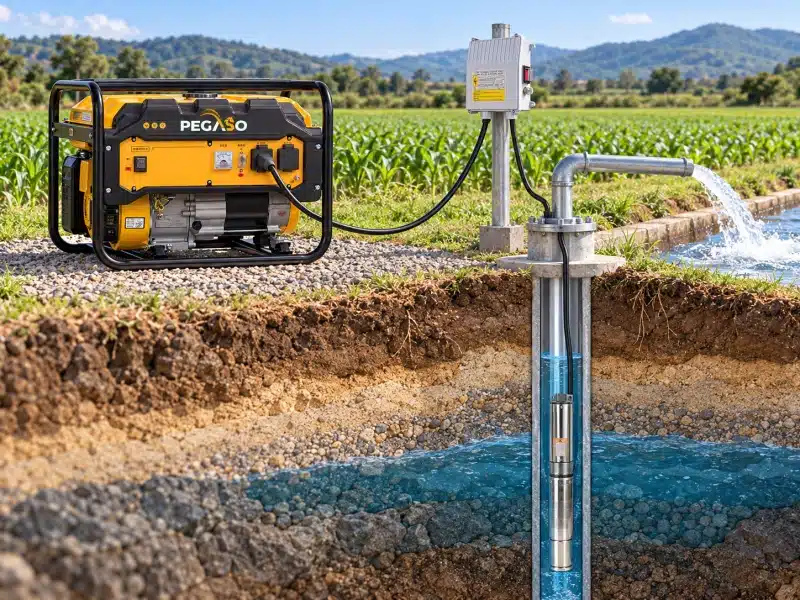
Do not forget that the kW output listed on the nameplate of the generator has been done through laboratory tests at sea level and moderate temperature. In case you live in mountainous areas or in hot areas during the summer time, the generator will not be able to give you its full rated output.
See the derating table from the manufacturers for different altitudes and temperatures before planning to use 80%. Load management can lower the peak load.
Generator Derating for High Altitude and Temperature
High altitudes may cause naturally aspirated engines to generate lower power due to thinning of the air. Additionally, high temperatures may have an effect on cooling systems of both the engine and the alternator. If the installation is outdoors, make sure that you know the limitations of air-cooled engines operating in hot conditions from the manufacturer prior to using the nameplate rating.
Derating calculations depend on whether the engine is a naturally aspirated engine or turbocharged. However, there are general derating rules used in the industry according to the following equations:
- High Altitude Derating: Subtract 3% to 3.5% of rated kW output for every 1,000 feet (300 meters) above 500 to 1,000 feet above sea level.
- Ambient Temperature Derating: Subtract 1% to 2% of rated kW output for every 10°F (5.5°C) above 77°F to 85°F (25°C to 29°C) ambient air temperature inside the generator enclosure.
Example Calculation for Generator De-rating (Denver or Mountain Areas in the Summer Time) Consider the case of installing a 20 kW air-cooled generator at 6,000 feet where the summer temperature reaches 95°F.
- De-rating due to Elevation: 5,000 feet above the 1,000-feet baseline × 3.5% for each 1,000 ft = 17.5% de-rating
- De-rating due to Heat: 10°F above the 85°F baseline × 1.5% per each 10°F = 1.5% de-rating
- Total De-rating: 17.5% + 1.5% = 19% de-rating
- Actual Generator Output Power: 20 kW × (1 – 0.19) = 16.2 kW actual max power output
- Use the 80% Rule: 16.2 kW × 0.80 = 12.96 kW as a rule-of-thumb 80% load, compared to 16 kW without de-rating.
How Automatic Load Shedding Reduces Generator Demand
Suppose your house has an electric vehicle (EV) charger, an electric water heater, and two central air conditioners that raise your estimated demand significantly above 80%, but you rarely use them. In this case, rather than installing a huge generator, you can install automatic load shedding.
The latest generation of ATSs works with a smart load management module connected to high-load 240 volts appliances. According to technical guidance provided by facilities regarding automatic transfer switch4, the intelligent transfer control is designed to keep track of the generator’s frequency and load, staggering motor starting in such a way that two compressor loads do not come on simultaneously in the exact same millisecond. When your continuous load gets close to the maximum capacity of the generator and the oven turns on, the intelligent module automatically suspends either the EV charger or the water heater for 15 minutes until the demand falls into the 50-80% zone.
Before purchasing any unit, make sure to find out the load numbers and operating conditions of the system:
- Count Concurrent Running Watts: Make a list of appliances which might run simultaneously, taking into account any non-continuous loads, without basing sizing just on the breaker ampacity.
- Find an Initial Rating: Divide the estimated simultaneous running kilowatts by 0.80 to leave some room. Consider it only as an initial rating, not as a motor-starting rating.
- Find Out About the Biggest Motor Surge: Add extra starting watts of your biggest inductive motor (AC compressor or water pump) to the running load and make sure the total is within the maximum surge capability of the generator.
- Account for Fuel and Ambient Conditions: Account for natural gas versus propane kW differences, apply altitude and heat derating factors first and then read about any requirements regarding minimal loading of the particular diesel engine.
- Include Smart Load Modules for Non-Essential Loads: Place EV charging stations, hot tubs, electric dryers, and secondary AC units under load-shedding relays in order to size a smaller generator.
FAQs
Is it possible to make a generator operate at 100% during an emergency situation?
It varies from the rating of the generator. If the generator has a continuous rating, then the generator should be able to supply 100% power for a prolonged time under certain conditions. There are restrictions regarding loading and average load factor in standby and prime sets.
Should the 80% rule be applied to running watts or starting watts?
The general rule is used as the basis of calculations of the running load of the generator. The starting watts are a special case. In other words, an 80% running load margin does not automatically mean that the generator will be able to start a heavy duty motor.
What happens if I oversize my generator in order to work under 80% of its rating?
This practice costs additional money in advance. Moreover, such a measure increases the amount of fuel per kilowatt-hour consumed by the generator. Even worse, if you oversize a diesel generator and run it below 30% of the capacity, the generator will suffer from wet stacking.
Why does the NEC specify 125% whereas the generator industry specifies 80%?
These numbers are mathematical reciprocals: 1 / 1.25 = 0.80. The NEC requirement of 125% relates only to particular electrical circuits, conductors, and overcurrent devices that supply continuous loads, including any relevant exceptions. The 80% rule for generators is an independent planning practice. It does not matter whether or not they involve the same percentage to make them interchangeable.
Things to Look at Prior to Selecting a Generator
First off, start with what needs to be powered, then look at the maximum motor starting load, as well as possible derating due to fuel, elevation, or temperature. Dividing your running watts by 0.80 will give you a good starting point, but ultimately you have to select a generator that has the appropriate duty rating and starting capability.
Sources
Schneider Electric. Emergency and Standby Power Systems. ↩
Schneider Electric, Electrical Installation Guide. Definition of Power Factor. ↩
U.S. Department of Energy. Generator load-bank testing and wet stacking resource linked in the original article. ↩
Pacific Northwest National Laboratory (PNNL). Automatic Transfer Switches. ↩
