

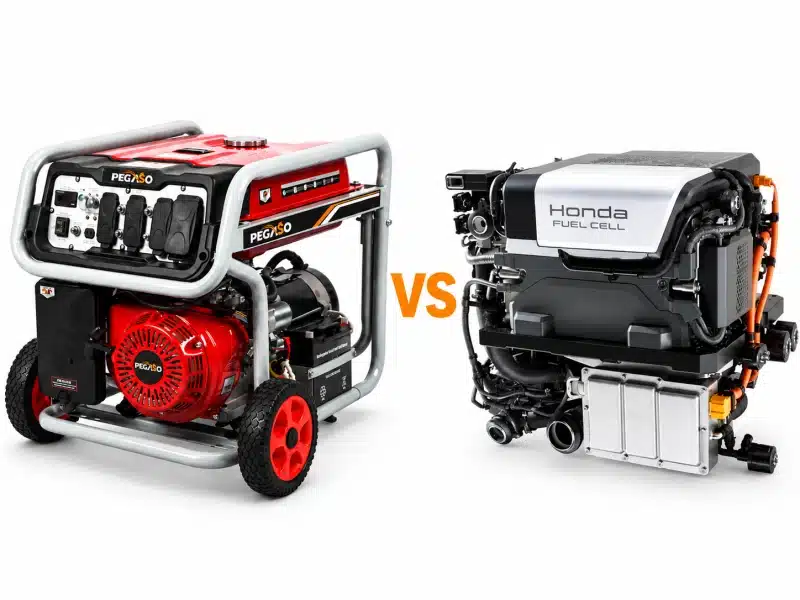
Fuel cell and gasoline generators are used to produce electricity through different processes. The former generates electricity directly from chemical energy without burning any fuel. It has an electrical efficiency of between 40% and 60%. On the other hand, the latter uses the burning of fuel in the engine to produce electricity whose efficiency is less than 20% – 35%. Fuel cells offer higher electrical efficiency and lower emissions during operation than conventional combustion-based generators. However, their higher upfront costs and fuel supply requirements continue to limit widespread adoption. For traditional portable power uses, gasoline generators are still cheaper and more readily available.
Fuel Cell vs Gasoline Generator Efficiency: How Do They Compare?
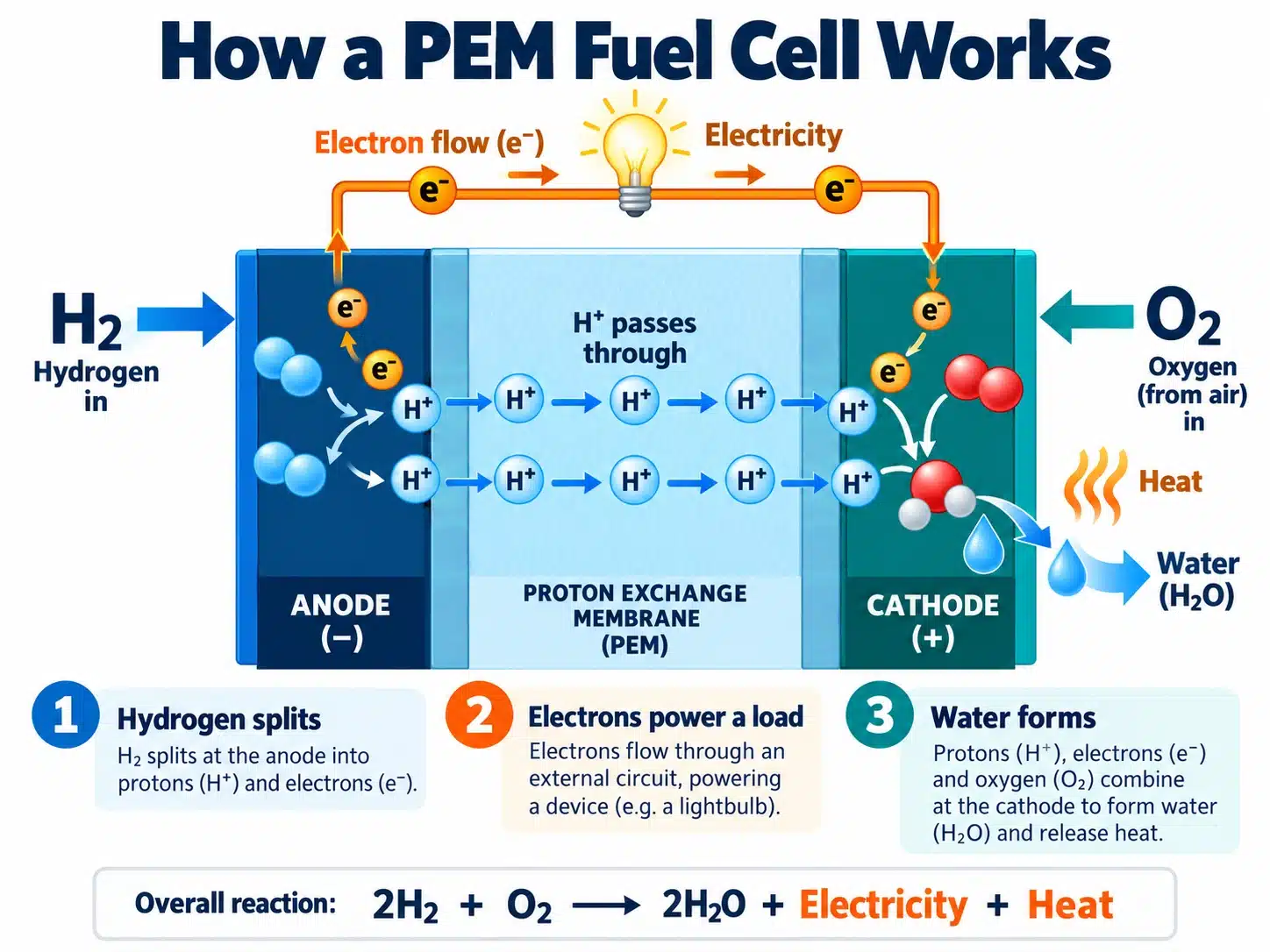
A fuel cell makes electricity through a chemical reaction. The anode and cathode make up the two electrodes of the fuel cell while the electrolyte is placed between them. The hydrogen ions migrate through the electrolyte and the electrons pass through the external circuit to generate electricity. No fire takes place inside the stack and there is no piston friction in the fuel cell; hence it is possible for the fuel cell to have a 40% to 60% electrical efficiency.
The gasoline engine works through several steps where it burns the fuel, runs the pistons and drives the crankshaft and rotor of the alternator. Most of the energy goes out through the exhaust and heat control system. Hence small portable engines have an efficiency of less than 20% while larger engines have an efficiency of 33% to 35%.
Some fixed fuel cell systems can harness the heat from their exhaust as well. The combined heat and power (CHP) system is called by the U.S. Department of Energy (DOE)1. It generates electricity and utilizes the leftover heat. The CHP efficiency information provided by the DOE puts the total efficiency at 65% to 80%. The heat generated can be used to supply hot water for a facility or run an absorption chiller, which uses heat to produce chilled water for cooling.
| What to compare | Fuel cells | Gasoline generators |
|---|---|---|
| How it makes electricity | A chemical reaction at the anode, cathode, and electrolyte | An engine burns fuel and moves pistons, which turn an alternator |
| Electrical efficiency | 40% to 60% standalone | <20% (small portable) to 35% (large stationary) |
| Combined heat and power (CHP) | Up to 80% total efficiency when the system also uses its heat | Small gasoline units rarely reuse heat because exhaust buildup can block the system |
| Exhaust at the site | Water vapor and heat with direct H2; small amounts of CO2 when the system takes hydrogen from hydrocarbon fuel | Carbon monoxide (CO), nitrogen oxides (NOx), unburned fuel, and small particles |
| Noise and vibration | Less than 55 dBA from fans and pumps; no vibration | 60 to 85+ dBA, with strong vibration |
| Mechanical parts | No parts move inside the stack; fans and pumps move air and water | Pistons, valves, crankshaft, recoil/electric starter, rotor, and bearings |
| Fuel shelf life | No set limit for pressurized hydrogen; 3 to 5 years for sealed methanol | 1 to 3 months untreated; 6 to 12 months with chemical fuel stabilizers |
| Best use | Power that runs all day, extra power at times of high demand, or long standby periods | Short emergency backup, job site tools with high startup loads, and outdoor trips |
What Fuels Are Used in Fuel Cells and Gasoline Generators?
Fuel supply is yet another consideration regarding the reliability of the fuel cells as all fuel cells receive hydrogen into their anode. But most of the business systems do not have large cylinders filled with hydrogen under pressure. The engineer selects the type of fuel depending upon the site conditions and needs of the application from four fuels available.
Direct Hydrogen Supply and Pressure Tank
Low-temperature fuel cells require pure hydrogen in composite or steel cylinders under pressure of 300-700 bar. In case hydrogen is produced via renewable electrolysis – green hydrogen – or extracted from factory exhausts, there are zero emissions at the site and only water vapors are emitted. Hydrogen in a closed tank does not corrode, oxidize, or create deposits in valves, so its storage time is unlimited. Hydrogen retail facilities are very rare outside big factories and PEM fuel cells often have agreements about cylinder exchanges. A PEM fuel cell is built around a solid polymer membrane, and deliveries plus maintenance of cylinders increase costs.
Natural Gas and Biogas via Methane Reforming
The large stationary fuel cells may tap the natural gas piped to city dwellings or the biogas piped to the site from a waste digester. These fuel cells utilize a reformer, which is a component that extracts hydrogen from methane (CH4). While some fuel cells have an external steam reformer, others perform the job internally using high temperature. An MCFC employs molten salts at high temperature whereas SOFC uses a solid ceramic. The decomposition of methane takes place on the anode at temperatures between 650°C to 1000°C without requiring expensive precious metals catalyst. This process does not involve any fire and emits minimal nitrogen oxide pollutant and a powerful stream of CO2. The CO2 could be captured from the plant to use it in manufacturing industries.
Liquid Methanol and E-Fuels for Off-Grid Logistics
Hydrogen cylinders full of heavy gas are expensive to carry on off-road transport routes, so remote sensing stations, vessels, and communication shacks may rely on methanol. The liquid fuel is dense in energy, keeps well in common plastic containers at room temperature without any pressure. DMFCs use liquid methanol at anode to provide electricity for small devices. RMFCs convert the liquid fuel to hydrogen when there is a need for kilowatt of power as an additional source of energy. E-methanol is a liquid fuel produced using renewable hydrogen and carbon dioxide emissions. It provides benefits of liquid fuel transportation and minimal local pollution with particles and NOx emissions.
Gasoline Supply Chain and Fuel Degradation
There is plenty of supply for gasoline, and one can refill the five-gallon safety can at any number of local gas stations. This will be helpful in case of a power outage, and it is also useful for portable construction crews. The main problem lies with storage since the presence of ethanol in gasoline means that it could collect moisture and degrade within 30-90 days. The old gasoline can coat the carburetor in the generator with a tough coating. One needs to rotate the fuel, use a fuel stabilizer, and empty the float bowl after each use.
Types of Fuel Cells: Operating Temperatures, Uses, and Limitations
The different types of fuel cells utilize different electrolytes that conduct ions inside the fuel cell. The stack temperature, depending on the type of electrolyte, determines the start-up time, choice of fuel, and size of the stack. The low-temperature fuel cells start up very fast, whereas the high-temperature fuel cells perform best at a steady load, in large plants.
| Fuel cell type | Electrolyte material | Stack temperature | Usual power size | Electrical efficiency | Fuel options | Main limits |
|---|---|---|---|---|---|---|
| Polymer electrolyte membrane (PEM) | Water-based acidic polymer sheet | <100°C (typically 60°C to 80°C) | <1 kW to 100 kW | 40% to 60% | Pure H2; an outside reformer can also supply hydrogen from methanol or natural gas | CO can block the catalyst; the system must also control water with care |
| Alkaline fuel cell (AFC) | Potassium hydroxide (KOH) mixed with water | <100°C to 250°C | 1 kW to 100 kW | 50% to 60% | Very pure H2 and air or oxygen with CO2 removed | CO2 in the fuel or air reacts with the electrolyte and forms solid deposits |
| Phosphoric acid fuel cell (PAFC) | Liquid phosphoric acid held in a silicon carbide layer | 150°C to 200°C | 50 kW to 1 MW | ~40% (up to 80% CHP) | Hydrogen from natural gas or biogas; pure H2 | Hot acid can corrode parts; startup takes time |
| Molten carbonate fuel cell (MCFC) | Hot liquid lithium and potassium carbonate salts | 600°C to 700°C | 300 kW to 3+ MW | 45% to 55% (up to 80% CHP) | Natural gas, biogas, or coal gas; the cell pulls out the hydrogen | Slow startup; salt can corrode parts; frequent shutdowns can cause damage |
| Solid oxide fuel cell (SOFC) | Solid, sealed ceramic called yttria-stabilized zirconia | 500°C to 1000°C | 1 kW to 2+ MW | 50% to 60% (up to 85% CHP) | Natural gas, biogas, propane, or H2; the cell can pull out the hydrogen | The ceramic can crack when heat changes fast; startup takes hours |
Stack temperature also plays a part in determining where each type is best suited. An SOFC can never be used for portable job-site power since the ceramic membrane takes a couple of hours to get up to 800°C. However, a large-scale wastewater treatment plant can utilize an MCFC or SOFC. Since these high-temperature stacks can generate hydrogen from raw digester methane, they don’t need expensive platinum catalysts.
Fuel Cell and Gasoline Generator Limitations in Real-World Use
A lab test sheet cannot show every field problem, and cold weather or underground tunnels place hard limits on these systems. Job site loads that rise and fall quickly cause other problems.
Startup Lag, Thermal Cycling, and Dynamic Load Following
In gasoline generator, the rise of load is answered quickly. If you pull the cord or click the start button, then the engine gets 3,600 RPM almost instantly. Then it will be able to provide power for the short period which is needed to start the air conditioner or circular saw. Fuel cell answers slowly because it takes several seconds or minutes for a low temperature PEM fuel cell to work at maximum capacity because the membrane cannot increase the current immediately. Sudden change in load may make it impossible for hydrogen to reach the anode and therefore small lithium or lead-acid battery is used for portable and backup PEM fuel cell systems. Battery turns on the motor and fuel cell increases its capacity and then charges the battery.
MCFC and SOFC units have strict thermal limitations due to the ceramic and salt parts which expand in temperatures from 600°C to 1000°C. Cold stack should be heated during several hours or else the sudden heating may create micro-cracks in the stack. However, MCFC and SOFC units should be in hot state for several months or years but shutdown and starting again each day will probably crack the stack sealings.
Catalyst Poisoning and Fuel Impurity Sensitivity
A gasoline engine can accept small amounts of dirt in its fuel and air. The dust that goes through a paper filter and a tiny quantity of sulfur in pump gasoline will burn in the gasoline engine and be exhausted through the muffler. The membranes and catalysts of fuel cells will require clean fuel, while the low-temperature PEM stack will have a thin layer of platinum to separate the hydrogen molecules. No more than 10 to 50 ppm of carbon monoxide (CO) is able to adhere to the platinum and disrupt the production of power. The engineers will say that the CO has poisoned the catalyst.
There is another issue connected with carbon dioxide (CO2), which creates a problem for alkaline fuel cells since CO2 in normal air reacts with the liquid potassium hydroxide electrolyte and creates solid crystals that plug the holes in the electrodes. Both the SOFC and MCFC will be able to utilize CO via a water-gas shift reaction, which is the transformation of CO and water to produce hydrogen and CO2. The hydrogen sulfide (H2S) that is contained in natural gas and raw biogas may damage fuel cells, and 1 ppm will poison a nickel anode. Operators place activated-carbon sulfur filters ahead of the stack and change them on a set schedule.
Enclosed Spaces, Urban Noise Rules, and Extreme Weather
The use of a fuel cell has certain advantages in enclosed or noise-regulated urban areas. Gasoline-powered generators cannot operate in any enclosed space, in the garage, in utility rooms, and near an air intake to the premises. According to the generator safety tips2 on the website of the U.S. Centers for Disease Control and Prevention (CDC), a portable generator emits carbon monoxide. The gas is odorless, poisonous to humans, and accumulates rapidly in an enclosed space or partially enclosed space. Even a short-term operation of the generator in a tunnel or equipment room poses an immediate threat. A pure hydrogen fuel cell does not emit carbon monoxide, small particles, or smoke from the fire. An engineer can install it in a transportation center, a tunnel utility room, or an indoor telecom closet.
Regulations on noise become another limitation of gasoline engine-based generators used in densely populated urban areas. An open-frame unit has a noise output of 70-85+ dBA (A-weighted decibels, a measure similar to the human perception of sound) at seven meters, whereas a closed inverter generator produces 52 to 65 dBA under load. According to the United States National Institute for Occupational Safety and Health (NIOSH)3, noise at work should not be higher than 85 dBA for extended exposure periods. In that case, noise control is necessary. Urban regulations can prohibit gasoline units to operate in street nighttime operations or as home backup power in urban areas. Fans and water pumps produce about 45 to 55 dBA that equals regular urban noise.
However, in cold weather, that benefit changes. The starting temperature of a gasoline generator with proper winter equipment, synthetic 5W-30 oil, and a choke can reach -20 °C (-4 °F). A low-temperature PEM fuel cell creates liquid water in the pores of the polymer membrane. In case a user turns off a fuel cell stack without heating but keeps liquid water inside the channels of the stack, the freezing of water can lead to damage to the polymer sheet. A fuel cell cabinet installed in a cold location requires insulation, an automatic nitrogen or dry-air purge system, and a heater. The heater consumes fuel or battery power throughout the winter.
Fuel Cell vs Gasoline Generator Cost, Maintenance, and Lifespan
High upfront cost is a major barrier to wider fuel cell adoption. Gasoline generators are much cheaper to buy today, although long operating hours can change the lifetime cost comparison. Portable and home stationary devices cost around $250 to $800 per kilowatt, while one hundred years of large-scale production helps maintain such a price level. A fuel cell is five to fifteen times more expensive per kilowatt for both a 100W methanol charger and a 5 kW stationary hydrogen cabinet. Fuel cells require custom-made membrane and electrodes, expensive catalysts of the platinum group, and precise gas control valves.
Fuel consumption and maintenance costs can compensate for the difference in price during extended use, and OPEX includes the expenses associated with that period. The cost of operating a gasoline generator depends on local fuel costs and energy efficiency of a particular device. The energy efficiency of a gasoline generator does not exceed 20% to 35%, which means higher fuel costs per kilowatt-hour and the need for maintenance and servicing. Pacific Northwest National Laboratory (PNNL)4 requires scheduled maintenance intervals and monthly tests. Oil and filters are changed every 50 to 100 operating hours. Technicians also inspect spark plugs, adjust valve clearances, remove fuel deposits from the carburetor, and perform monthly load tests on the generator. In addition to assessing durability, for those purchasing generators, factory testing can be another aspect that needs to be considered. At PEGASO, all the generators are tested electrically and put through load testing prior to shipping.
Fuel cell stack does not have pistons, rings, crankshaft, or engine oil. Fixed unit does not need noisy testing once a week, spreading oil on cylinder walls. It is possible to control pressure and valves remotely through a controller. Service includes changing of air filters, resin cartridges that purify water, and sulfur filters once or twice a year. Remote mountain site of telecommunication company requires transport by helicopter or four-wheel drive vehicle that costs thousands of dollars per trip, so less trips mean less expenses.
A used fuel cell stack also has a high price. Portable gasoline engine works 1,000-3,000 hours and after that it should be repaired. PEM stack operates 5,000-20,000 hours. Business-size SOFC and phosphoric acid fuel cell (PAFC) run 40,000-80,000 hours. After that wear of membrane decreases its voltage. New or rebuilt fuel cell stack costs 30%-50% of the initial price of purchase. These hours must be included into the cost calculation.
Fuel Cell or Gasoline Generator: Which Is Best for Your Needs?
Camping, Recreation, and Temporary Job Sites
When camping, working outdoors, or setting up temporary jobsites, portable gas generators are typically the logical choice for RV use and equipment needs. Wood frame saws, air compressors, and rooftop RV air conditioning units may require a spike of 2,000 to 5,000 watts. This spike can be generated by a 50 pound inverter gas generator from one gallon of pump gas. However, portable PEM and direct methanol fuel cells, rated 50W to 250W, are needed for something else. These can provide battery charging in the 12V system inside an RV or sailboat for weeks. They are quiet and odorless, but they are pricier per watt and require methanol cartridges.
Residential and Light Commercial Emergency Backup
For example, when it comes to a suburban house or a small business facility facing two to three power failures per year, gasoline and dual-fuel generators become the cheapest alternatives. When dealing with the dual-fuel generator, both gasoline and propane can serve as the fuels for the generator to operate. In case the generator works for fewer than 50 hours during the year, then lower consumption of the fuel will not compensate the higher cost of the fuel cell generator. The fuel cells can be used in areas that have regulations on engine exhausts established by the HOA or the municipal authorities.
Urban Infrastructure, Telecom, and Continuous Stationary Power
Fuel cells have been applied by urban areas and companies in the following areas of operation:
- Transportation infrastructure: Intelligent transportation system (ITS) is comprised of traffic signals, air quality sensors in tunnels, and communication equipment in the subway network. Intelligent transportation system (ITS) requires protection from vibration of engines and dangerous carbon monoxide emissions. Fuel cells for ITS are represented by small-sized PEM fuel cells installed in roadside cabinets that work for several days with the help of replaceable hydrogen cylinders.
- Communication towers: Cell phone towers and microwave relay stations situated in harsh conditions such as cold weather and mountains may apply fuel cells based on methanol or hydrogen. Such approach helps reduce monthly maintenance and reduce theft threats.
- Continuous power demand: Data centers, hospitals, and sewage plants operate 24/7. Such facilities need SOFC or MCFC which are supplied with natural gas or biogas with 50-60% efficiency and 5% line loss.

Buyer Decision Checklist of Six Items
- Startup surge or steady-state load: Does the application demand cheap energy to start up big electric motors, or clean and steady energy? In the first case choose gasoline engine generator; in the latter – fuel cell.
- Location of the application: Is the application outside with proper ventilation? Here a gasoline engine generator is what you need. A tunnel, a utility room, or a busy street suggest using a fuel cell.
- Availability of fuel: Are there any fuel stations nearby? Or a city pipeline for natural gas, or delivery of hydrogen cylinders or methanol regularly? This suggests choosing gasoline, SOFC/MCFC, and PEM/DMFC respectively.
- Period of idle storage: Does the system stay idle for nine months at an unmanned remote site? This situation calls for pressurized hydrogen or encapsulated methanol and rules out carburetion problems connected with stale gasoline.
- Noise generation: Are 60-75 dBA of noise not allowed in your local community or in a construction site where the equipment should operate? Then choose a fuel cell with noise generation under 55 dBA.
- Initial cost or total cost: Does the cost issue depend upon the initial price, or on the fuel and maintenance over 40,000+ hours? A lower initial price favors a gasoline generator, while lower maintenance requirements over an extended operating period may make a fuel cell a better option.
Fuel Cell Vs Gasoline Generator: Which Should You Choose?
A gas generator is ideal if you want power fast and affordable. It will do fine in an outdoor construction site or a campsite as well as in your home from time to time. The fuel is readily available; however, the engine requires maintenance. In cases where engine emissions and noise become an issue, a fuel cell would be more appropriate. A direct hydrogen fuel cell has no carbon monoxide emissions at point of usage, and its electrical efficiency ranges between 40%-60%. Fuel cells provide a clean and more efficient alternative for the future, but their high cost limits widespread use today.
Frequently Asked Questions
Is There Possibility of Operating the Fuel Cells on Natural Gas or Propane, and Not Hydrogen?
Yes, however, this would depend on the type of the fuel cell. If the MCFC or SOFC fuel cell is used, then the heat in the range of 500°C to 1000°C is utilized to extract hydrogen from the natural gas, biogas, or propane inside the cell. In the case of low temperature PEM fuel cell, at least 99.97% pure hydrogen is required when it reaches the stack.
How Does Fuel Cell Power Compare to Batteries for Extended Multi-Day Power Outages?
A battery power station stores a certain amount of energy within lithium-ion batteries. In this regard, a portable battery power station can be relatively cheap to use during an hour or even one-two day power outage. However, when considering the cost-effectiveness of portable battery power stations and gasoline generators in case of long-term power outages, the equation shifts at 0%. While a battery power station stops working until it is charged from the grid or a solar panel, a fuel cell and a gasoline generator store their fuel separately in dedicated fuel tanks.
Is Testing Necessary for Fuel Cells, Like in Gasoline Generators?
No, a gasoline generator has to undergo a test run of 20 to 30 minutes a month. This run lubricates the cylinder walls and keeps the seals flexible. It also ensures the dryness of the water and prevents the formation of film from old fuel in the carburetor. A fuel cell doesn’t have pistons, crankshaft, or engine oil, hence it doesn’t require this test run. A stationary fuel cell can self-check the gas pressure, its own battery, and fans.
Why Are Fuel Cells Allowed in Closed Areas When Gasoline Generators Are Forbidden?
The gasoline generator uses fuel to produce energy, which produces carbon monoxide (CO), nitrogen oxides, and soot. CO is odorless and these gases can be lethal very quickly inside a tunnel, basement, or machine room. The direct hydrogen fuel cell uses fuel to produce energy without fire and produces heat and water vapor. It can operate in any closed city area and underground place, yet there must be ventilation and a gas leakage detection system for avoiding unused hydrogen on the roof.
Sources
U.S. Department of Energy (DOE), Better Plants. Combined Heat and Power. ↩
Centers for Disease Control and Prevention (CDC). Generator Safety Fact Sheet. ↩
Centers for Disease Control and Prevention (CDC), National Institute for Occupational Safety and Health (NIOSH). Occupational noise guidance. ↩
Pacific Northwest National Laboratory (PNNL). Standby Generators. ↩
