

Natural gas and gasoline generators get fuel in different ways. They can also differ in power output and total setup cost. A gas line can save you trips to buy fuel during a long outage. Gasoline works where there is no gas line.
Natural Gas vs. Gasoline Generators: Key Differences
Before you pick, check three things:
- Will the fuel be available in case of extended blackouts?
- Is the generator able to start the largest motor with the selected fuel?
- How many hours of fuel savings are needed to offset the cost of installation of the gas line?
When you pick a tri-fuel generator, consider its starting and running watts for each type of fuel. The starting watts denote how much power the generator can produce for a while when the motor is being started. The running watts indicate how much power it can provide when the appliances continue operating. When using natural gas, consult the natural gas specifications.
| What to check | Natural gas | Gasoline |
|---|---|---|
| Fuel for a 72-hour blackout | Unless utility gas service is interrupted, you will not have to top up fuel canisters. You should ensure that the meter and gas line can provide the necessary amount of fuel. | The generator will consume 0.75 gallons an hour at a 4 kW load. For 72 hours, it will require 54 gallons of fuel. Consider fuel storage regulations and a source of fuel replenishment. |
| Starting a big engine | Check the natural gas starting and running watts of the model. These are different from gasoline. | Check the gasoline ratings of the same model and compare its starting watts to the startup watts of the AC or pump. |
| Installation | Check the gas meter, gas flow, and gas pressure under load. Use the sizes of the pipe and the hose mentioned in the manual. | No utility gas connection is required. Hire an electrician to connect the generator to home circuits according to local regulations. |
| Cost of fuel only at 4 kW | About $2.30 per hour in the August 2026 example. | About $3.04 per hour in that example. Use the difference to work out how long fuel savings take to pay for the gas connection. |
Which Fuel Is More Reliable During an Outage?
If the power is out for a long time, you need a steady fuel supply. EIA's outage data show that U.S. customers lost power for an average of about 4.5 hours in 2025. Major events caused about 53 percent of those outage hours.1
Natural Gas Supply During Outages
During a power failure, there will be no interruption of natural gas service. In case of power failure due to storms and any other causes, natural gas will continue to be supplied through the gas line in your house.2
If the natural gas remains in use, there is no need to bring fuel cans or refill the fuel tank in the generator. The generator should be turned off to service the machine. This should be done according to the schedule in the owner’s manual of the generator.
The natural gas supply may get interrupted for some reasons, such as:
- Earthquakes that may cause damage to the underground gas lines.
- Floods and washouts that may remove the soil cover from the gas lines.
- Damage caused by digging when cleaning up or repairing the house.
- Cold weather that may have an impact on gas supplies or increase gas demands.
Gasoline Storage and Refueling
If you use a gasoline generator, you need to store fuel and buy more when it runs low. Suppose it burns 0.75 gallons an hour. It would need 18 gallons for 24 running hours, or 72 gallons for 96 running hours. Check how much fuel your model uses at the power level you need. Then plan how much to store and where to buy more.
Check local fuel storage rules and your home insurance policy before buying a large fuel supply. Use approved fuel cans and follow your generator's storage instructions.
Gasoline can go stale in storage. Fuel that has ethanol may absorb water. The rate at which fuel deteriorates depends on age and the environment in which it is stored. Deterioration may be faster where there is heat, moisture in the air, or oxygen in the tank. Always follow the guidelines provided by your generator and the fuel stabilizer on how to store gasoline.
Old fuel can leave sticky deposits that clog the carburetor, the part that mixes fuel with air. This can make the engine hard to start. If your generator has old fuel in it, see how to fix a generator with old gas. The guide explains when to drain the fuel and clean the fuel system.
Plan for fuel during an outage: If your fuel cans run dry, a nearby gas station may not be open. A station without backup power may not be able to pump fuel or take payments.
Do Gasoline Generators Produce More Power Than Natural Gas Models?
Many multi-fuel generators produce less power on natural gas than on gasoline. The drop varies by model. Check the starting and running watts for the same model on each fuel.
A British thermal unit, or Btu, is a unit of heat energy. A gallon of gasoline contains about 114,000 to 120,000 Btu. A cubic foot of natural gas contains about 1,030 Btu. One therm equals 100,000 Btu.3 The heat in natural gas can vary, so 100 cubic feet is not always the same as one therm.
This reduction in power generation is referred to as fuel derating. The values below demonstrate the process, and they are examples only and not rating values for any particular model.
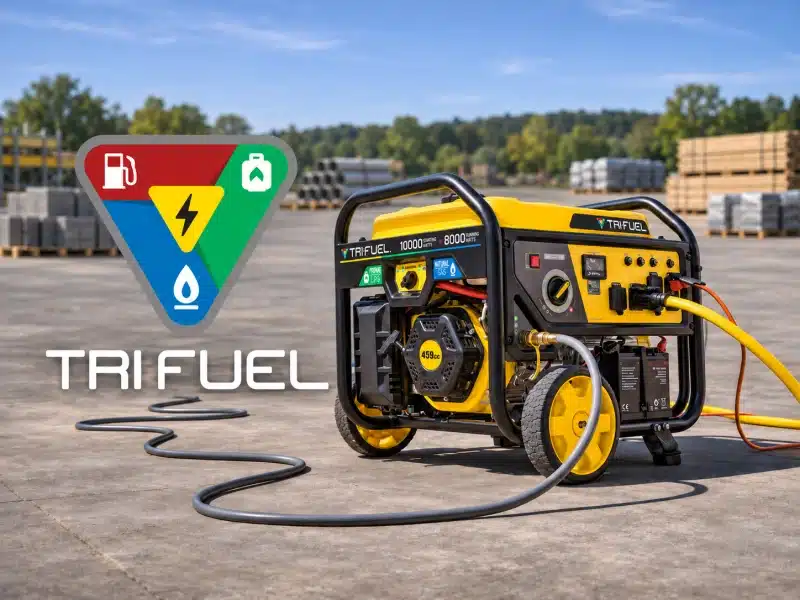
Wattage for tri-fuel example:
- Gasoline: 10,000 starting watts and 8,000 running watts for comparison.
- Propane: 9,000 starting watts and 7,200 running watts, which is 10% lower than the gasoline values.
- Natural gas: 8,000 starting watts and 6,400 running watts, which is 20% lower than the gasoline values.
From this example, using natural gas will mean 1,600 less running watts and 2,000 less starting watts.
Add up the running watts of the appliances you plan to use at the same time. Then check the power your largest motor needs to start while the other loads are on. This industrial generator sizing guide shows how to list your loads and check motor starting power. pick a model whose natural gas ratings cover both needs.
Starting Central AC on Natural Gas
If the generator stalls or its breaker trips when turning on the AC, you should pay attention to the following:
- Pipe and Hose Inspection: The dimensions of your hose and its length should meet the requirements indicated in the manual for your generator. Your generator might not get enough fuel from a grill gas connection. Ask a professional to check the gas flow at peak load for the generator. It is crucial that gas pressure in the generator meets the values indicated in its manual.
- Gas Meter Check: When your furnace, water heater, and stove use gas together, you should ask your utility company or installer to check the total demand for gas. Your meter should provide enough gas for all devices with the required pressure.
- Power Consumption by the AC: You should compare your AC's power consumption for starting with the starting wattage of your generator on natural gas. If it is too much, contact an AC technician to see whether a soft starter can reduce it sufficiently.
Which Costs More: A Natural Gas or Gasoline Generator?
Compare the cost of buying and setting up the generator with the cost of fuel. A gas connection can save you trips to buy fuel during an outage. Whether it pays for the hookup depends on local fuel prices. It also depends on how many hours you run the generator each year. Compare fuel use while both fuels provide the same amount of power.
Equipment and Installation Costs
The cost of a typical 7,500 to 10,000 watt open-frame portable gasoline generator is USD700-$1,400 retail. Extension cords designed for outdoor use are required to power individual appliances. They should be capable of handling the power load required by those appliances.
To power home circuits, you need a different setup. A manual transfer switch and an outdoor power inlet may add USD500 to $1,200 in electrical work. Talk to your electrician about a transfer switch or generator interlock that meets local rules. These devices control how the generator connects to your home's wiring.
Permanent air-cooled natural gas generator is usually rated 14 to 24 kW. The cost of equipment and transfer switch included ranges from USD4,500 to USD7,000. Professional installation requires USD3,000-USD8,000 depending on the property. Let a licensed electrician install and test the transfer switch. For more information on its proper use and testing visit PNNL's automatic transfer switch guidance page.4
A portable tri-fuel generator costs USD900 to USD1,800. A licensed plumber can add an outdoor low-pressure natural gas quick-connect valve near the meter. That work usually costs USD300 to USD700. The total rises if you need a larger meter, a longer gas line, or a connection to home circuits.
Standby Installation Cost Breakdown
A permanent natural gas standby system needs electrical work, gas pipes, and a suitable place to stand. Use these price ranges to plan your budget. Then get a quote for your property:
| What you pay for | Typical costs | What can increase your costs |
|---|---|---|
| Automatic transfer switch (ATS) installation and electrical installation | $1,200-$2,500 | Distance from main breaker box, upgrade of the panel or rewiring of a smaller panel. |
| Gas piping and trenching | $800-$2,500+ | Length of pipe runs, difficult soil or cutting concrete. |
| Utility gas meter replacement | $0-$1,000+ | Utility fees, changes to the gas pressure control system. You may need to ask about the cost and how long it will take before scheduling your project. |
| Permits, load checks, inspections | $250-$800 | Permit requirements. Homeowner’s association restrictions can also limit where you can install your unit. |
| Concrete or composite base | $150-$500 | Site preparation and installation of required pad. |
Ask if the electrical quote includes the transfer switch. Don't count its price twice if it already comes with the generator.
Fuel Cost per Hour and kWh
Use prices from the same month for a fair comparison. EIA reports these U.S. averages for August 2026:
- Regular gasoline: $4.058 per gallon.5
- Residential natural gas: $27.05 per thousand cubic feet (Mcf).6
The table below shows prices above and makes assumptions about providing 4 kW of electricity using both types of fuel. Here are some examples of fuel use that will differ from those provided by the generator manufacturer.
| Fuel at 4 kW | Example fuel use | Fuel cost per hour | Cost of fuel for 24 operating hours |
|---|---|---|---|
| Gasoline | 0.75 gallon/hour | $3.04 | $73.04 (18 gallons) |
| Natural gas | 85 cubic feet/hour (0.085 Mcf/hour) | $2.30 | $55.18 (2.04 Mcf) |
A kilowatt-hour (kWh) measures the amount of electricity used. In this example, fuel costs about $0.76 per kWh on gasoline or $0.57 per kWh on natural gas. That saves about $0.74 per running hour in this example. These figures cover fuel only, not the generator or hookup.
The fuel cost of running on gasoline or natural gas depends on where you live. EIA's national average may differ from what your utility charges for the extra gas you use. Before buying, compare your local pump price with the charges on your gas bill that rise as you use more gas.
When Does a $500 Natural Gas Hookup Pay Off?
In this example, you will assume that you already have a tri-fuel generator that fulfills your requirements. The generator will produce the same 4 kW of power with any fuel source. The extra cost of the installation will be $500 for quick-connect service. Refer to the prices from August 2026 and example fuel consumption stated above:
- Calculate the cost of gasoline per hour: 0.75 gallons/hour × $4.058/gallon = $3.0435 per hour.
- Calculate the cost of natural gas per hour: 0.085 Mcf/hour × $27.05/Mcf = $2.29925 per hour.
- Calculate the difference in fuel costs per hour: $3.0435 - $2.29925 = $0.74425 per hour.
- Calculate the number of hours for break-even: $500 ÷ $0.74425 ≈ 672 operating hours.
Here is how those fuel savings add up over five years:
| Generator use | Hours over five years | Example fuel savings | Does it cover the $500 hookup? |
|---|---|---|---|
| 24 hours/year | 120 | About $89 | No |
| 72 hours/year | 360 | About $268 | No |
| 135 hours/year | 675 | About $502 | About enough |
You need about 135 hours of use each year for five years in this example. That is almost two 72-hour outages each year.
Use your local fuel prices and the maker's fuel-use figures for your own math. If you also need a generator, meter, pipe, or other service work, add those costs to the $500 hookup cost. Then divide that total by the hourly fuel savings. If natural gas costs as much as or more than gasoline per running hour, fuel savings cannot pay for the hookup. Work out the full cost of a permanent automatic standby system on its own.
Can a Natural Gas Generator Be Portable?
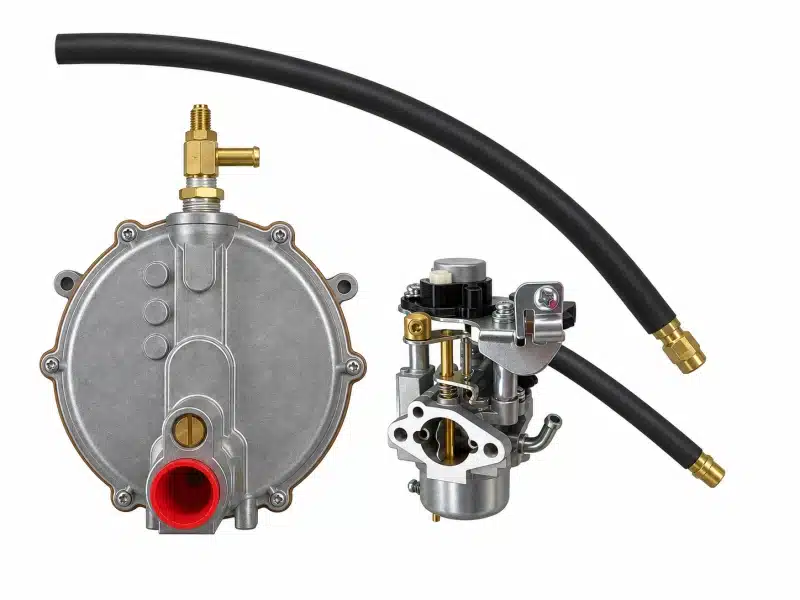
Yes. A portable tri-fuel generator will work on natural gas when at home and on gasoline or propane when off the gas line. It must still be manually moved and connected.
- Fixed natural gas standby generators: These remain outside on a pad and are automatically transferred through an automatic transfer switch. They turn on themselves after an outage. However, they still need regular maintenance.
- Portable gasoline generators: These provide power far from the utility gas line. Look at the noise level and the weight of the unit when you want a portable generator for your hunting camp. Also compare the starting watts to the load you intend to put on the generator.
- Portable tri-fuel generators: Use at home a hose recommended by the manufacturer to connect your generator to an authorized natural gas line. Far from the gas line, use gasoline or propane and verify the power rating of your choice.
Propane gives tri-fuel owners a fuel they can store for times when utility gas is not available. Follow the generator's rules for fuel and cylinders. Follow the cylinder supplier's storage instructions too.
Natural Gas vs. Gasoline Generators: Exhaust, Fuel Safety, and Maintenance
Both generators emit carbon monoxide gas. It is recommended that a portable generator be used outdoors at least 20 feet away from any building. The exhaust of a generator should be positioned away from any doors, windows, or vents. Generators should not be operated inside any house or garage even with windows or doors open. Please see the following CPSC guide on outdoor placement and carbon monoxide prevention.7
The fuel requirements of each type vary. With natural gas, one does not have to worry about transporting fuel in the form of cans or pouring fuel. However, the piping system and connections should satisfy the fuel requirements of the generator. Gasoline should be stored properly and the generator engine cooled before refilling.
Fuel-Specific Maintenance
Both types need the oil, filter, battery, and spark-plug care listed in their manuals. With gasoline, you also need to care for stored fuel and prepare the fuel system before storing it for a long time.
With natural gas, check the approved hoses and connections. Have an installer check for drops in gas pressure while the generator powers your appliances. Follow the model's service schedule. For a fixed standby system, PNNL's standby generator maintenance guidance also lists checks to keep it ready to run.[^8]
Natural Gas Hookup Checklist
Ask the utility or a licensed installer these questions before buying:
- Fuel flow capacity: Is the meter able to provide sufficient fuel flow for the generator at peak performance while the other natural gas-powered devices are operating?
- Pressure at the generator: What size of pipes and hoses will be required based on the proposed distance? Are these sizes sufficient to maintain gas pressure at the generator within the parameters stated in the manual?
- Installation location and schedule: Does the installation location comply with the manufacturer's guidelines and regulations? Can a meter or pipeline upgrade delay installation?
Natural Gas or Gasoline Generator: Which Should You Buy?
The gasoline generator is less costly if you will use it in a short period of time for infrequent power outages or when you need to go somewhere far from your place. Tri-fuel generator that operates on natural gas will help to save fuel if there are prolonged outages but there should be enough amount of fuel available through the meter and the gas pipeline. Also, you need to make sure the model has enough running and starting watts.
Frequently Asked Questions
Do I need a larger gas meter for a generator?
Yes, you may need a larger gas meter in case the generator, along with other gas-powered household items, consumes more gas than the current gas meter can deliver. Get the total gas consumption from all items combined, including the generator, furnace, water heater, and any other gas-consuming devices. Then compare this amount with the capacity of the gas meter.
Why does my generator stall when the AC starts?
The generator may lack sufficient fuel supply or cannot produce enough power for the AC to start up. Also, make sure that the hose you used complies with all requirements stated in the manufacturer's manual. Get the fuel pressure measurement when the generator supplies energy to your appliances.
Also, get the value of starting watts needed by the AC, and compare it to the value of natural gas starting watts for your generator.
Do natural gas generators start better in freezing weather?
Fuel type alone does not decide how well a generator starts in the cold. The model, battery, oil, and any cold-weather equipment it needs also matter. Natural gas means you don't need to store gasoline, but the generator still needs enough gas to run. Follow your model's instructions for oil, storage, battery care, and cold-weather kits.
Can I use a tri-fuel generator before installing a standby system?
Yes, if the generator is capable of providing energy to all the required appliances using the selected fuel type. At the same time, the gas supply and electrical connections should meet the requirements of the generator. You still will have to place the generator outside, attach the hose and cord manually, as this generator does not provide automatic protection of a stationary system.
Sources
1. [U.S. Energy Information Administration — U.S. electricity reliability data](https://www.eia.gov/electricity/annual/table.php?t=epa_11_01.html) ↩
2. [U.S. Energy Information Administration — Natural gas heat content and unit conversion](https://www.eia.gov/tools/faqs/faq.php?id=45&t=8) ↩
3. [Pacific Northwest National Laboratory — Automatic transfer switch operation and maintenance](https://www.pnnl.gov/projects/om-best-practices/automatic-transfer-switches) ↩
4. [U.S. Energy Information Administration — Monthly retail prices for regular gasoline](https://www.eia.gov/dnav/pet/pet_pri_gnd_a_epmr_pte_dpgal_m.htm) ↩
5. [U.S. Energy Information Administration — Monthly U.S. residential natural gas prices](https://www.eia.gov/dnav/ng/hist/n3010us3M.htm) ↩
6. [U.S. Consumer Product Safety Commission — Generator carbon monoxide and fire safety](https://www.cpsc.gov/Newsroom/News-Releases/2026/CPSC-Warns-of-Generator-Carbon-Monoxide-and-Fire-Hazards-Ahead-of-Hurricane-Season) ↩
7. [Pacific Northwest National Laboratory — Standby generator operation and maintenance](https://www.pnnl.gov/projects/om-best-practices/standby-generators) ↩
