

A low noise level can also be key for both campers and people who own an RV. Although the dB(A) rating provides an indication of a generator’s noise level, there are a number of different factors which can influence the sound it actually produces. These include: the test environment, the amount of electricity being drawn from the generator, the revolutions per minute of the generator and even the environment in which it is being used. Recognising these can enable you to select an inverter generator which not only performs well, but is also suitably quiet for your camping requirements.
What Makes an Inverter Generator Quiet?
Compared to conventional generators, inverter generators tend to be quieter. Unlike conventional generators, they can control an engine’s revs to meet energy requirements. Therefore, the engine does not always have to run at its maximum revs. It can slow down when there is less power required, and so become quieter.
Many inverter generators also come with a sound-dampening, weather resistant outer shell. Again, the generator fan and exhaust silencer will both influence the level of noise produced.
Thanks to their ability to control engine revs, inverter generators can be made even quieter. They also benefit from improved efficiency and lessened strain on the engine. For this reason, they are ideal for use in ‘noise aware’ situations such as camping and motor homes.
How to Choose the Right Quiet Inverter Generators for Camping and RVs
Consider the Noise Measurement Distance
Many products state their noise levels as 52 dB(A), 58 dB(A), and 60 dB(A). However, noise values may not be comparable due to different test distances being used. Distances that can be seen on product information include 23ft (approximately 7m), 10ft (approximately 3m) and even less.[^1] Usually, the further away something is tested then the quieter it is. It is usually more relevant for campers and people who own an RV to recognise what a generator will actually sound like when it is situated close to your campsite.
Particularly within campsites and RV parks, where generators will frequently be positioned relatively near to either your or other people’s campsites, it is advised that you select generators which conform to the same test distance and also have a noise rating of under 60 dB(A). This will then provide a better evaluation of the effects a generator is likely to have within its environment, both during the day and also whilst engaging in leisure pursuits and using the generator at night.
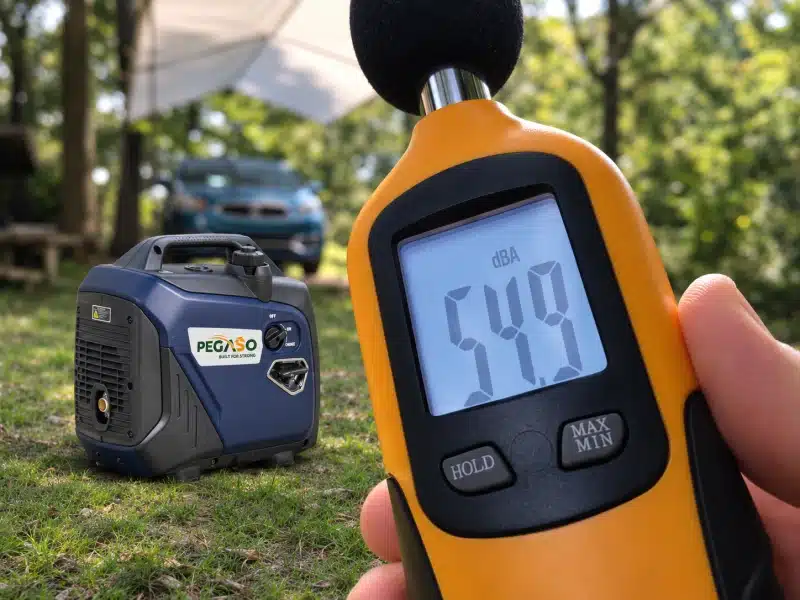
Match Noise Levels to Real Electrical Loads
Inverter generators can produce differing sound levels. As well as considering the minimum sound production, it is important to consider what you will actually be powering. Often whilst camping in a tent, you may only be powering items such as a camp light, phone, laptop and small devices. Usually, in these situations, the engine will turn at a slower rate and so will therefore also tend to produce less sound. Nevertheless, for those who live or travel in an RV, the power demand is frequently greater. If for example both the air-con, microwave, electric kettle and battery charger are in operation then there will be a much higher power demand. To meet this demand, the engine will need to speed up and so sound production will also increase.
If you intend to use either a 13,500 or 15,000 BTU air conditioner unit for your RV then in addition to looking at its noise levels at 25% load, you should also consider those at 50%, and even full, load. It is only in this way that you can correctly evaluate the noise that will be produced by the generator in an actual campsite situation.
Understand What dB(A) Ratings Really Mean
Decibels (dB) is a widely recognised way of quantifying noise. People often fail to truly comprehend what is meant though. Often, for both camping and motor homes, 50-60dB(A) is regarded as an acceptable noise level, similar in volume to everyday speech. Although units of 60-70dB(A) can also still be described as fairly quiet, they can become more readily apparent within a campsite environment either in the early hours or late evening. Generators above 70dB(A) are in a similar noise bracket to conventional non-inverter generators.[^2] It is worth highlighting that the scale of decibels is logarithmic.
Thus even small increases in dB can produce significant changes in how noisy something is thought to be. Often then, despite the difference in figure size, there can be a much bigger disparity in real life experience between a generator producing 55dB(A) and one generating 65dB(A), if they are of equal power.
Consider Site Restrictions and Camping Conditions
Generators for camps can only be used within certain times of day. Generators are often not permitted to run in the early mornings, evenings and when the camp is particularly quiet. Therefore, campers that camp for long periods or often may receive complaints, be fined and potentially even be told they cannot continue to run a generator despite it having enough power.[^3]
As a general guide, you may refer to the following:
| Noise Level | Camping Experience |
|---|---|
| ≤50 dB | Very quiet |
| 50–60 dB | Acceptable at most campsites |
| 60–70 dB | Acceptable at open-plan campsites |
| >70 dB | Likely to disturb fellow campers nearby |
Eco Mode and Variable Engine Speed Matter More Than Peak Noise Numbers
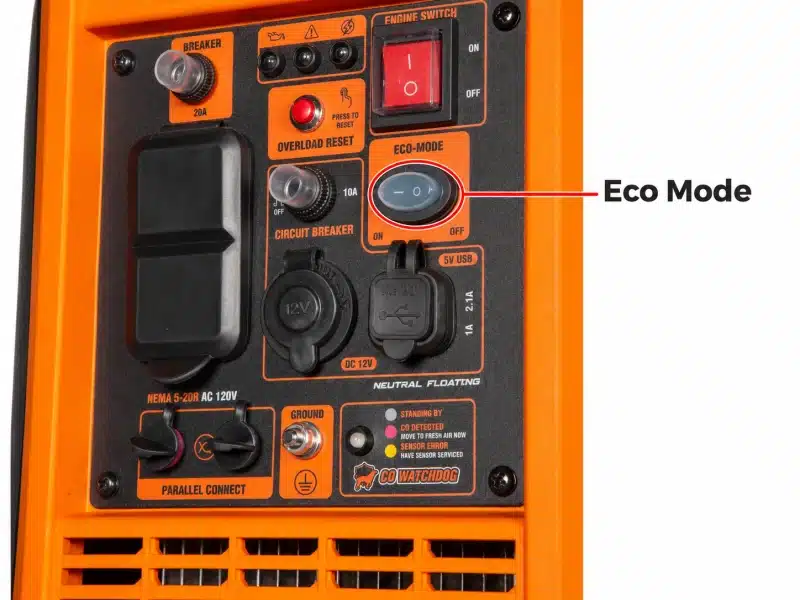
Many people look at the quietest rated sound level for a generator (for example 52dB(A)) when buying one. This is generally measured in ‘Eco’ mode (the energy saving mode) and under light load. But for campers it is usually more important that a generator can continue to operate at a low engine speed for much of the day. If a generator has a good Auto Throttle or Eco Mode function then it can often run at a low engine speed for long periods. Under these circumstances, how quiet it actually is tends to be of greater importance than its rated sound level.
Noise Frequency Can Affect Perceived Comfort
When there are 60dB(A) sounds, people’s experience of these also depends on their frequency. Lower frequency noise can be transmitted further and is more readily absorbed into the body.[^4] Higher frequency noise is generally perceived as more shrill. Consequently, although two generator units can each produce 58dB(A), they may in reality provide very different comfort experiences.
Placement Can Reduce Noise More Than Buying a Quieter Generator
In many cases, how a generator is situated will make a bigger difference to noise levels than its specification.
Some good practices are:
- Putting it on the other side of the vehicle.
- Ensuring that it is not situated near your tent door.
- Utilising the vehicle's body to help deflect noise.
- And not situating it so that it is facing towards a lake or valley.
All of these can make a big difference to what people think they hear. Even if you have a quiet inverter generator, you should still give thought to where it is placed.
Conclusion
When assessing a quiet inverter generator it is important to take into account the testing method, the sound levels produced on normal load and also the generator’s end use (for example within a camping or RV environment). This will assist you to select a suitable generator which not only supplies adequate electricity, but also contributes towards a more pleasant and sociable experience within a campsite environment.
