

There are many different energy requirements when camping. While people may simply need to charge devices and illuminate areas of their tent for a weekend, more extended stays may also require items such as refrigerators and coffee machines. Both an inverter and conventional generator can be used to produce energy however, there are distinctions between them in terms of noise, mass, fuel usage and their response to fluctuating demand. Consider the energy requirements, the amount of kit that must be taken and whether generators can be used within the specific campsite prior to deciding which is most suitable.
What Should You Consider When Choosing Generators for Camping?
There are a number of key criteria to consider when selecting a generator for camping.
- Noise levels: Most campsites do regulate the volume of generators and in particular at night. Ideally this should be between 50-60dB. Sounds above 70dB will stand out even in a relatively quiet setting.
- Runtime: Many people do not want to have to refuel during the night.
- Weight and size: Generators in the 40-50lbs bracket are popular for camping.
- Wattage: Calculate how much power you will require to operate all of your devices at one time.
- Fuel efficiency: Try to find generators which have ‘Eco-mode’ or a controllable engine. This means the engine can automatically change its revolutions per minute in line with the power that is being used.
The significance of these considerations will differ, depending on how you choose to camp. Those who pitch a tent may place greater emphasis on weight and mobility. Conversely, those camping in an RV may require more power in order to run items such as an air-con unit.
What Are the Differences Between Inverter and Conventional Generators for Camping?
Camping Loads
Whilst generators are seldom driven hard by campers, there are still times when a camper may need to place a high load on their generator. It is here that the distinction between an inverter generator and a standard generator can be seen most clearly.
| Camping Equipment | Typical Running Watts |
|---|---|
| Smartphone Charger | 5-20W |
| Laptop | 50-100W |
| Drone Battery Charger | 60-200W |
| LED Camping Lights | 10-50W |
| Portable Fan | 30-100W |
| Electric Cooler | 40-120W |
| Coffee Maker | 600-1,200W |
| Microwave | 800-1,500W |
| Portable Electric Grill | 1,000-1,800W |
| RV Air Conditioner | 1,500-2,000W+ |
An inverter generator has the benefit that it can adapt to a changing electrical load. Whilst a camper may only need a generator to charge their phone, drone and computer, which does not require a high level of energy, it is able to quickly boost the power it produces to cater for higher loads, such as those required by a coffee machine, microwave and air-con. An inverter generator is therefore well suited to the variable loads often encountered whilst camping. Usually, a 1000-2000W inverter generator will be appropriate for most campers.[^1]
Conversely, conventional generators are often preferable for long periods of sustained high load. This might be for example, when several tools are in use at a distant building site. Or for continuous use of substantial machinery. Alternatively, a conventional generator may be more cost effective for providing electricity to a mobile workforce, where the electrical load is continually close to the generator’s maximum rating for extended periods. Here, a 4,000-8,000W conventional generator is often favoured.
Site Constraints
Whilst considering which generator best meets a camper’s needs, location is often an even more significant consideration than power. Camps, motor homes and leisure facilities all have rules that may impact upon where and how generators can be used. Factors such as noise, space requirements, access to fuel and distance from other campsites can all play a role. As a result, an inverter generator is frequently a better choice than a standard generator.
As previously noted, space is also a key issue. Camps, particularly tents, small motor homes and wild camping sites, often have restricted space. Campers need to leave room for their tents, seating, fridge, utensils and other items. As a rule, inverter generators are developed with leisure in mind and therefore tend to be smaller in size. This facilitates their placement in a campsite. Conventional generators, and particularly those with an open frame, usually need greater space for both storage and use.
Furthermore, the location of other campers should be taken into account. Within a campsite, a generator will not function in true isolation. Again, sound, shuddering and emissions will all affect surrounding campsites. Although a conventional generator may be highly effective at generating electricity, its functionality can be less appropriate within a communal leisure setting. Designed with location in mind, inverter generators are often promoted for leisure, motor homes and wild camping rather than for construction and industry.
Site Constraints Case
Actual campsite rules that apply to engines and generators include:
- Quiet period: Usually between 10pm and 6am (sometimes 7am). It is illegal to run or leave to idle an engine, including generators, during this time.
- Allowed times of operation: Many campsites also impose daytime limitations on generator use. Common periods include between 8am and 10am and 4pm and 8pm. This is so that people can continue to enjoy a quiet environment.
- Noise levels: In most National Parks and Forest Service campsites, generators cannot exceed a noise level of 60dB, at a distance of 50 feet away.[^2]
- Away from site: For both noise and fire reasons, it is usually not allowed for a camper to leave a generator running when they are not onsite.
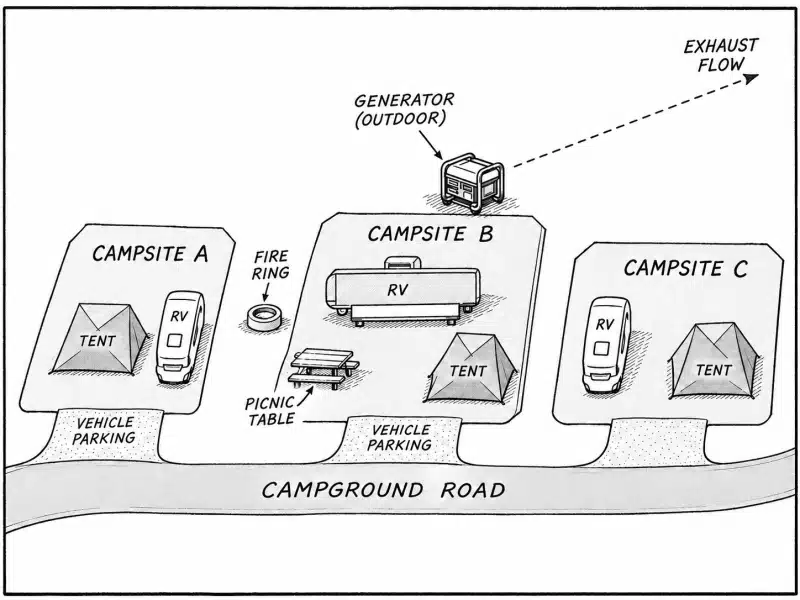
- Ventilation and distance: Generators cannot be used within tents, motor homes or under awnings. Furthermore, generator exhausts need to be directed away from adjacent sites and vegetation so that carbon monoxide is not trapped and so that the risk of fire is reduced.
- Spark arrestor: On public forest land (USFS/BLM) all combustion engines including generators must have a spark arrestor fitted. This stops sparks from hot generator exhausts causing a fire.[^3]
- Storage and fuelling: Fuel must be stored in appropriate and secure containers and must not be near sources of ignition. Also a generator should be switched off and allowed to cool down prior to fuelling.
Portability and Transportation
Compared to conventional generators, inverter generators are often easier to move. Campers often need to transport, carry and store their generators.
Many people will transport their generator from their house to the boot of a pickup truck or SUV. It can then be carried from a car park to where they are going to set up camp and may even be transported between camps. Usually the mass and dimensions of a generator are more important considerations in these situations than its power rating.
Typically, a 2000W inverter generator has a mass of between 40-55lbs (18-25kg). For the majority of people this is easily transportable by one person. However, a conventional generator of comparable power can weigh 70lbs (32kg) and upwards. As well as being less space efficient for storing within a vehicle, it is also much less easy to manually transport.[^4]
- For Tent Camping: Often, car parks do not permit vehicles to be parked adjacent to tent sites. People can therefore have to walk (sometimes many dozens, or even in excess of 100 metres) from a car park to where they are setting up camp. Again, a 50lb inverter generator can still be manually transported for short distances. However, a larger traditional generator (often in excess of 100lbs) is often harder to carry and will frequently need either two people to do so or an extra trolley.
- For RV camping: Transportation issues are largely concerned with weight and space. As well as needing to store personal effects, recreational vehicles also need to provide room for furnishings (tables and chairs), cooking facilities and extra fuel. Furthermore, an RV will often need to store a variety of tools. Encapsulated inverter generators are generally smaller and so are easier to store in for example, an RV or within the boot of a pickup truck.
Whilst there are benefits to traditional generators, some people are prepared to compromise on the size and weight of a generator if they require a greater level of power (for example whilst on a base or hunting camp. Or where many high power items are to be used).
Fuel Consumption and Runtime During Camping Trip
Due to the often remote nature of camping sites, it is important to consider both the fuel efficiency and running time of a generator. Unlike traditional generators, inverter generators can modify their engine speed in response to power requirements.
Often, traditional generators will run their engine at a steady speed so that the correct power frequency can be produced. However, fuel efficiency does not necessarily improve proportionally as electrical load is reduced.
As previously mentioned, inverter generators can alter their engine speed. Therefore, when electrical load is reduced, the engine can slow down – and in turn potentially become more fuel efficient.
For camping applications, consider the following factors:
- Average Load: Often, generators will not be working at maximum power. Typically, the lower the load, the greater the benefit of an inverter generator’s ability to change engine speed and so improve fuel efficiency.
- Fuel Tank Capacity: Usually, the bigger the fuel tank, the greater the running time between refuelling. As highlighted above, this must then be balanced against the impact of added size and weight on portability.
- Eco Mode: For low power camp equipment, switching on ‘Eco Mode’ is often a good way of further improving running time.
Conclusion: Which Is Better for Different Camping?
An inverter generator is often a better solution for recreational camping. It is compact, and has good noise and supply performance. The throttle also allows the generator to adapt to differing power requirements and is well suited for use in a campsite setting.
Conventional generators may also be a good solution where greater power is required despite the associated issues of size, noise and fuel consumption at part load.
