

“Stage 5” isn't only a cleaner-engine term if you're looking for an engine or generator for the European market. The engine category, reference power, type of ignition, duty cycle and target market must be matched with a specific approval document. This guide walks you through narrowing down the choices, comparing Stage V to EPA Tier 4.
What Is a Stage 5 Engine?
A Stage 5 engine – or formally an EU Stage V engine – is an engine that has been approved to a defined category and a power range as per Regulation (EU) 2016/1628. The regulation does not prescribe one single limit for all engines; rather, it prescribes various limits for various applications, and does not require an engine to be equipped with one after-treatment package. [Regulation (EU) 2016/1628, 2016][1]
When it comes to procurement, it is not just a matter of whether a brochure reads “EU5.”. It is essential to confirm that the engine family, rating, speed and installation is correct for the approval of your equipment.
What “Stage V” Means Under EU Emission Regulations
Stage V establishes emission limits and approval requirements for your particular non-road engine. EU Regulation 2016/1628 distinguishes between engine classes such as NRE for most land based non-road machines, NRG for engines above 560kW used for generating sets, NRS and NRSh for some spark-ignition engines, as well as for rail and inland-waterway applications. Normally, generator engines at or below 560 kW will be NRE or NRS based on their characteristics, and NRG is reserved for generating-set engines over 560 kW. [Regulation (EU) 2016/1628, Articles 2 and 4, 2016][1]
This distinction will impact your emission table, test cycle, marking and paperwork requested. Therefore, your initial screening criteria should be based on application, engine type, reference power, and fuel and ignition type, and not solely on the marketing name.
Stage V applies to all engines and equipment, except for those excluded in the Annex.
Stage V will come into effect when the engine or covered non-road machine is marketed in the EU. Among the applications mentioned by the European Commission are construction machinery, agricultural and gardening machinery, material handling and rail and inland-waterway machinery. Also included in the framework [European Commission NRMM guidance, accessed 2026][2] are generators, pumps and compressors.
Follow this screening sequence when asking for prices:
- Indicate the country where the completed product will be sold.
- Explain if the engine is shipped loose or in a generator or other equipment.
- Record the reference power, the rated speed, type of ignition and fuel.
Stage V vs. Stage IIIA, IIIB, or IV.
Stage V is an extension of the existing EU legislation and introduces the regulation of particle numbers for defined categories and power bands. Previous stages gradually introduced lower emission ceilings and implementation dates for Nox and particulate matter, with different dates for different sizes of powers. The aftertreatment below is a common engineering solution, and not mandated by law for all engines. [Regulation (EU) 2016/1628, Annex II, 2016][1]
| Emission stage | Main procurement difference | Typical system you may see | What you must verify |
|---|---|---|---|
| Stage IIIA | Older limit set with fewer aftertreatment-dependent configurations | Engine calibration, mechanical or electronic injection | Whether the engine can still be placed on your target market |
| Stage IIIB | Tighter particulate limits in relevant power bands | DOC and, on some engines, DPF | Exact engine family, power band, and PM-control hardware |
| Stage IV | Tighter NOx control in relevant power bands | SCR, DOC, EGR, or combined systems | Reagent, sensors, ECU calibration, and approval scope |
| Stage V | Broader categories plus PN limits for specified sub-categories | DOC, DPF, SCR, EGR, or integrated combinations | Category, sub-category, approval number, marking, and installed configuration |
Installing a Stage V engine in place of an existing engine of an earlier stage may result in changes to exhaust packaging, wiring, cooling, diagnostics and service access. Therefore, when making a purchase decision, an integration review is required, not only a comparison rated power.
The difference between EU Stage V and EPA Tier 4 Final
Always select the standard from the destination market, never from a statement of one standard being “higher.” Non-road engines are regulated by two distinct sets of legislation, EU Stage V and EPA Tier 4 Final, which come with different test procedures, categories, certificates and labels. [Regulation (EU) 2016/1628, 2016][1] [40 CFR Part 1039; US EPA, accessed 2026][4]
Regulatory Scope and Target Markets
EU Stage V provides for covered non-road engines and machinery's placement on the EU market and EPA Tier 4 provides for covered compression-ignition non-road engines on the U.S. market. The non-road applications under regulation include construction equipment, agricultural equipment, forklifts, generators, pumps, and compressors. Note: This reference is the US EPA non-road compression-ignition guidance obtained in 2026.
Avoid assuming that an EU approval will be sufficient to demonstrate US approval or vice versa. If your fleet is going to transfer to regions, include both approvals in the RFQ and ask for the same configuration of the physical engine.
EU Type Approval vs. EPA Certification and Labeling
The EU and US compliance are for different proof packages. EU Implementing Regulation 2017/656 specifies the template of statements of conformity, of statutory engine marking, of type approval certificates, of numbering and of test reports. The statutory marking is used to identify the manufacturer, engine type or family identification, unique engine identification and applicable approval information. [Commission Implementing Regulation (EU) 2017/656, 2017][3]
In the U.S., an EPA Certificate of Conformity shows that the engine family meets the applicable requirements, and the engine will have an emission-control label. Based on the US EPA certification guidance (2026)[5]
It is not sufficient to have a PDF certificate. Properly match the certificate's engine family to the nameplate, serial number, model year, rating and installed emission-control equipment prior to shipping.
One engine to achieve both Stage V and Tier 4 Final?
Only one of the engine packages will satisfy both markets where both jurisdictions have the necessary approvals. The two different emissions hardware does not necessarily generate double certification and a lower limit in one metric does not necessarily lead to certification for the other jurisdiction's administration.
That is a myth: “Because Stage V is stricter, it must automatically include Tier 4 Final.” In truth, it's the certificate and label, not a comparison of the headline limits that governs legal acceptance.

What is the principle behind the PEGASO Stage V engine reducing emissions?
We quote on the certified engine with complete emission control setting. PEGASO engine and generator product lines claim it is suitable for EU5 and EPA certified configurations.
What PEGASO Stage V Engine Models are on offer?
The usable model list is the engine-family matrix that is currently "documented"—not a claim of a generic power range. The table(only engine) that PEGASO will follow is the following one for your project:
| Engine Type | Engine Model | Emission Standard |
|---|---|---|
| Gasoline, single cylinder, 4-Stroke, OHV, Air-cooled | 170F | EU 5 / EPA |
| Gasoline, single cylinder, 4-Stroke, OHV, Air-cooled | 188F | EU 5 / EPA |
| Gasoline, single cylinder, 4-Stroke, OHV, Air-cooled | 190F | EU 5 / EPA |
| Gasoline, single cylinder, 4-Stroke, OHV, Air-cooled | 192F | EU 5 / EPA |
| Gasoline, single cylinder, 4-Stroke, OHV, Air-cooled | 196F | EU 5 / EPA |
| Diesel, single cylinder, Vertical, 4-Stroke, Air-cooled | 186FA | EU 5 |
| Diesel, single cylinder, Vertical, 4-Stroke, Air-cooled | 195F | EU 5 |
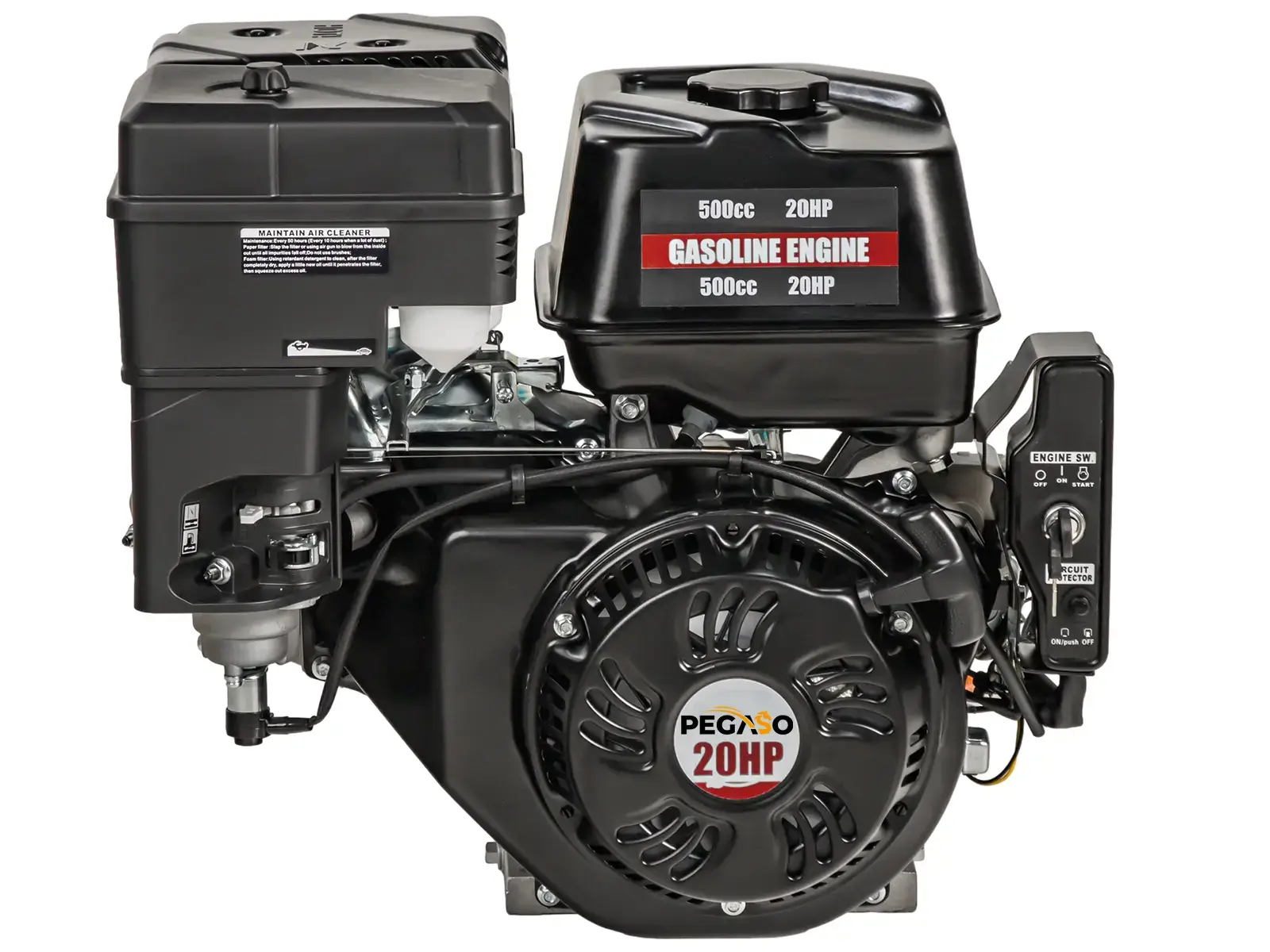
If what you need is the generator and not just an engine, we can use the same data to match the engine, alternator, control system and generator setup.
What Are the Benefits and Trade-Offs of Stage V Engines?
Stage V offers market opportunities and reduced regulated emissions but also integration and service requirements. Many parameters are part of the selection, including legal requirement, duty cycle, fuel quality, service capability, and total installed cost, and not just the emission-stage label.
Lower Emissions and Access to Regulated Markets
Stage V approval is required for covered machinery to be placed on the EU market, but does not give access to all tenders or low emission zones. There are additional noise, safety, CO₂ or operating-hour requirements, which project owners/lokal authorities may introduce beyond the engine-emission regulation.
If the destination is a Stage V, then do not accept an offer that does not have the same type-approval and physical marking.
Power Density, Load Response, and Equipment Performance
Stage V does not automatically equate to improved power density, fuel economy, load response. Make comparisons of those results at the same rated speed, ambient condition, altitude, fan load, aftertreatment back pressure and rated generator.
Don't accept terms like “high performance” and use this specification comparison:
| Field | What to enter in your spec sheet | Why it changes the decision |
|---|---|---|
| Rated mechanical power | kWm at stated speed and conditions | Sets the usable alternator pairing |
| Peak torque and torque rise | Manufacturer curve | Influences transient recovery |
| Fuel consumption | Mass or volume per hour at defined load points | Supports operating-cost comparison |
| Dimensions and wet weight | Engine plus complete aftertreatment | Determines enclosure and transport impact |
| Certification | Exact family, category, and approval number | Determines legal suitability |
| Warranty | Months, hours, scope, and territory | Reveals uncovered commercial risk |
The number that is put in your commercial comparison is the verified net output at your condition, not the highest power figure on the brochure. That's the one you should put in your spec sheet.
Where Are Stage V Engines Commonly Used?
Stage V engines are the engines that are used in covered non-road applications where EU market access and reduced regulated emissions are important. However, application suitability is dependent upon load profile, packaging, fuel, service access, local project rules etc.
| Application | Procurement priority | Main mismatch risk |
|---|---|---|
| Construction and earthmoving | Transient response, cooling, vibration, service access | Aftertreatment damage or poor regeneration during light duty |
| Agriculture and material handling | Seasonal uptime, torque delivery, dust protection | Sensor or filter downtime during critical operating periods |
| Mobile and rental generators | Variable-load operation, transportability, documentation | Oversizing, low exhaust temperature, and multi-market certificate gaps |
What is a Stage V Engine for a Generator?
Choose the engine based on generator rating, load profile, transient requirements, site conditions and aftertreatment behavior. Use supplier data to calculate mechanical power and integration margin after electrical duty is calculated.
Prime Power vs. Standby Power Requirements
Prime and standby ratings do not indicate and should not be compared as interchangeable power numbers. Generating-set application, rating and performance classification for continuous, peak-load and standby use in accordance with ISO 8528-1:2018. [ISO 8528-1:2018][6]
| Decision point | Prime-power project | Standby-power project |
|---|---|---|
| Load profile | Variable operating load over the planned duty | Emergency load during loss of normal supply |
| Data to request | Load histogram, expected running pattern, overload terms | Start sequence, critical loads, test schedule |
| Aftertreatment concern | Sustained low-load periods and regeneration opportunity | Cold start, short exercise runs, and readiness |
| Acceptance evidence | Fuel map, thermal behavior, load-step test | Start time, load acceptance, alarm and derate logic |
Avoid copying an annual-hour/average-load claim from a generic table. The duty statement in your RFQ should be the engine manufacturer's rating sheet and the relevant ISO rating definition for this particular model.
Matching Engine Output to Alternator Capacity
Required engine power = electrical output / efficiency of the alternator + verified auxiliary loads. Operate at the supplier value:
Required Engine Output (kWm) = Required Electrical Output (kWe) / Alternator Efficiency + Engine-Driven Auxiliary Load (kWm)
This is a sizing framework, not the go-ahead to apply a generic alternator efficiency. Include cooling fan demand, altitude and temperature derating, and any site-specific fan reserve indicated in the manufacturer's data. [ISO 8528-1:2018][6]
Load Acceptance and Motor-Starting Requirements
Load acceptance is a specified permitted voltage, frequency deviation for a defined load step. ISO 8528-5:2025 focuses on design and performance requirements for the engine–alternator combination, including the performance of a generating-set as a unit. [ISO 8528-5:2025][7]
Create these inputs prior to selecting the engine:
- Most significant motor or nonlinear load
- Method and starting kVA from equipment manufacturer
- Number of load steps and time interval between them
- Allowed voltage dip, frequency dip and recovery time
- Ambient temperature, altitude, enclosure and restriction of ventilation.
- Typical load profile, minimum sustained load, regeneration opportunity
- Performance class or project specific acceptance criteria required
Another myth is that more power = better start-up performance. In reality an oversized Stage V generator can spend more time underloaded and inadequate selection of alternator can still fail to meet the voltage/capacity requirements.
Select the smallest size that has been verified for step load and continuous duty as documented by site derating. That will give you the generator specification that you can defend.
Before buying, what documents should you check?
Check for approval, marking, configuration, test evidence prior to order release. You can't verify that the engine you're getting at your warehouse is the same as the one on the site with the certificate logo.
| Document or record | What it proves | What you should match |
|---|---|---|
| EU type-approval certificate and annex | Approved engine type or family | Model, family, category, power, fuel, and approval status |
| Statutory marking photograph | Identity of the physical engine | Manufacturer, type/family, unique ID, approval information, production date where applicable |
| EPA Certificate of Conformity, if required | US engine-family certification | Model year, family, power band, fuel, and certificate validity |
| Emission-control label, if required | Physical engine’s declared US compliance | Family and model information against the certificate |
| Genset datasheet and report | Output and functional acceptance | Rating, frequency, voltage, load steps, alarms, and serial numbers |
EU Type-Approval Number and Emission Marking
The EU type-approval number and the statutory marking will be the same as the approved engine family. The certification, marking, numbering and test-report formats as well as the required marking information are provided by the implementation of Regulation (EU) 2017/656. [Commission Implementing Regulation (EU) 2017/656, 2017][3]
Request a copy of the readable nameplate photo of the actual engine (or a sample agreed upon prior to shipment) and not just the certificate scan. Compare all identifier prior to packing the unit.
EPA Certificate of Conformity and Engine Label
For a U.S. project, check the EPA Certificate of Conformity and the emission control information label on the engine. EPA offers a certificate database and states “The certificate shows compliance with the emission requirements.” The US EPA's guidance on certification has been reached out to for 2026.
Never use EPA compatible or the same as the certified model. You will require the certificate for the specific engine family and model year and label information for your file.
Certificate, Test Report, and Engine Identification
The documentation package should link legal identification to physical identification and performance testing. Ask for the engine serial number, engine-family code, approval number, genset serial number and record in one traceable record.
This relates your compliance inspection to a real shipment instead of a sample document.
Frequently Asked Questions About Stage V Engines
Why is Stage 5 equal to EU Stage V?
Yes, ‘Stage 5’ is indeed a reference to EU Stage V in its normal use within the industry. Use the Roman numeral V in contracts, certificates and RFQs, under Regulation (EU) 2016/1628. [Regulation (EU) 2016/1628, 2016][1]
Yes, EU Stage V is the same as EPA Tier 4 Final.
No, although they both control non-road engine emissions, but with different legal frameworks, classifications, certificates, labels and some different emission metrics. If you need access to both markets, specify and verify both approvals. [[1]][1] [[4]][4]
Do all stage V diesel engines have to be fitted with a DPF?
There is no across-the-board statement in the regulation that requires all diesel engines in Stage V to be fitted with DPF. The wall-flow DPF is a typical engineering solution for certain sub-categories such as NRE engines from 19kW to 560kW; check which is certified for the specific engine family. [Regulation (EU) 2016/1628, Annex II, 2016][1]
Is it possible to use a Stage V Engine outside of the European Union?
It can, of course, be used elsewhere but legal acceptance and suitability for service is dependent on the destination. Check for local certification, fuel and reagent availability as per manufacturer, diagnostic access, spares and if approved will entail any commercial benefit in that market.
Avoid an emissions-system removal or “de-tiering” as a procurement workaround. If the destination will not support certified system, select a legally acceptable engine prior to ordering.
Are Stage V Engines Good for Continuous Running at Low Loads?
Once they have been confirmed by the engine supplier for the load profile and regeneration strategy. On DPF equipped engines, soot management may be more difficult due to low exhaust temperature, but minimum load threshold and response are engine-specific, and can be requested from the OEM for their guidance, regeneration logic, warning sequence, and derate behavior. According to the Caterpillar technical guidance for 2026 [9].
When actual demand is low and consistent, a smaller set or managed multi-set system will typically be a better shortlist than an oversized single generator.
Related Sources
- Regulation (EU) 2016/1628 — emission limits and type-approval for NRMM engines, European Parliament and Council, 2016.
- European Commission: Emissions from non-road mobile machinery, accessed September 16, 2026.
- Commission Implementing Regulation (EU) 2017/656 — certificates, markings, numbering, and test reports, European Commission, 2017.
- US EPA: Regulations for emissions from heavy equipment with compression-ignition engines, accessed September 16, 2026.
- US EPA: Overview of certification and compliance for vehicles and engines, accessed September 16, 2026.
- ISO 8528-1:2018 — Application, ratings and performance, International Organization for Standardization, 2018; confirmed current in 2023.
- ISO 8528-5:2025 — Generating sets, International Organization for Standardization, 2025.
- PEGASO official website — generator and engine product portfolio, accessed September 16, 2026.
- Caterpillar: Managing the transition from EU Stage IIIA to EU Stage V, accessed September 16, 2026.
