

When the power goes out, what should you do: get a temporary power solution or use a power generator?
If the grid goes down and/or your job site extends beyond the reach of the utility network, downtime can become very costly. Thus, you must consider the load, deployment time, runtime, fuel or charging accessibility, site restrictions and total cost to compare temporary power solutions. In high load applications when the location changes over time and/or is remote, a properly sized generator is generally the most practical overall solution, but the comparison should arrive at that conclusion for you.
This guide has made the decision easy. You'll learn about the operation of a temporary power, how generators differ from temporary grid connections and battery storage, how to size a temporary power system, and when it's better to rent or buy a generator.
What Are Temporary Power Solutions?
Temporary power solutions are the alternate power when permanent utility power is not available, not adequate, or lost. Your system can provide power to a construction site, industrial plant, remote project, outdoor event or emergency recovery until permanent service is available or normal supply is returned.
The answer to your project isn't just the power source. You'll also require the devices that manage, switch, distribute, protect and monitor power throughout your facility.
Key Components of Temporary Power Systems
Typically, the equipment you bring to provide your full temporary power is a mixture of the following:
Primary power source: A diesel, petrol, gas, hybrid, battery or temporary power source that you choose for your required duty and load profile.
Automatic transfer switch (ATS): This switching device is used to automatically switch designated loads from the utility to the generator source, when your design calls for automatic switching.
Power distribution panels and switchgear: Panels, portable distribution boxes and branch protection are used to subdivide the main supply into site circuits.
Heavy duty feeder cables: Your cables must be rated, insulated, connected and physically protected to the environment, current and voltage.
Transformers and load banks—Transformers are used to tie equipment into the system when necessary and load banks are used when commissioning and planned testing of generators is required.
You might need to use GFCI or other RCDs, overcurrent protection, bonding, grounding conductors, and grounding electrodes in your design.
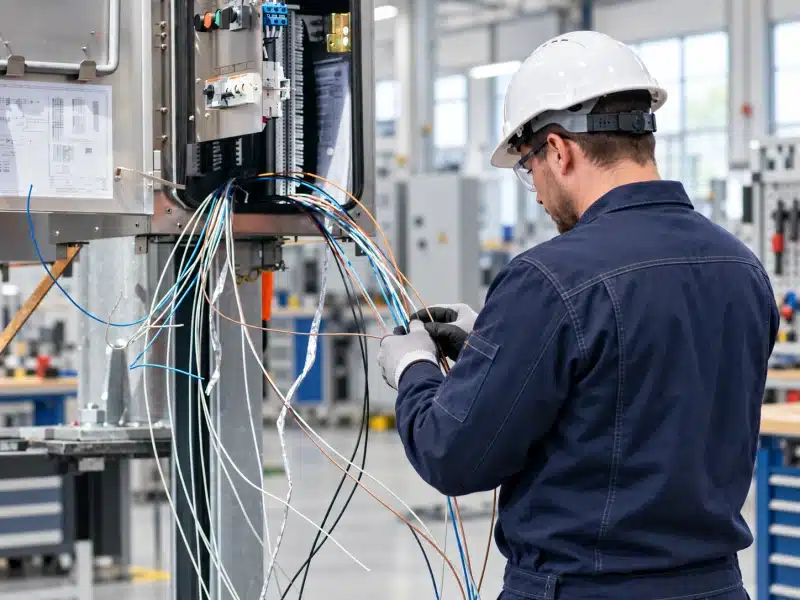
How Temporary Power Works
Your temporary power system produces, controls and supplies power to your endpoint loads.
| Stage | Process | Function |
|---|---|---|
| 1. Energy supply | Generator, battery inverter, or temporary utility connection | Provides alternating-current power to the system |
| 2. Voltage regulation | AVR, inverter, or utility transformer | Maintains the voltage required by connected equipment |
| 3. Main distribution | Switchboard and feeder lines | Routes power to secondary distribution points |
| 4. Endpoint delivery | Distribution boxes and branch circuits | Supplies the voltage, phase, outlets, and protection required by each load |
| 5. Active monitoring | Generator or system controls | Monitors electrical values, alarms, fuel or state of charge, and operating status |
The generator-set application classes, ratings and performance classification are defined in ISO 8528-1 to ensure that you and the generator-set manufacturer can speak the same rating language [ISO 8528-1:2018; Source 1]. For your buy, examine the generator nameplate instead of the complete temporary power system.
Types of Temporary Power Equipment
The generation, distribution and connection equipment are required. Your equipment must function as one chain (not as a separate unit, but as one whole chain), and a good source can't make up for undersized cables, incompatible connectors or incorrect protection.
Portable Generators
Portable and mobile generators can provide independent, dispatchable power when the grid is not available or reliable. The option of compact units powered by petrol is available for separated loads, while larger units with sound attenuation but powered by diesel are available for longer duty and centralized site distribution.
Capability – Options range from compact mobile sets through to larger industrial sets, but your selected model will need to go through running-load testing as well as motor-starting testing.
Consumption and operating time depends on engine, fuel, load factor and ambient conditions and should be specified; give an estimate for consumption and operating time under stated conditions.
If the enclosure is to be protective, the specifications for the weather and acoustic requirements should be given separately, and the test evidence requested.
Depending on the configuration, voltage, frequency, engine condition, fuel status, load and alarms are monitored by your selected digital controller.
PEGASO can correlate your load and duty information with the rest of its generator range as well as portable and sound-attenuated generators [PEGASO supplier capability statement, 2026; Source 7].
Power Distribution Units and Spider Boxes.
Portable distribution units and spider boxes segment the main generator feed to provide protected circuits at your tools and machinery.
| Equipment type | Primary function | Specification points |
|---|---|---|
| Portable distribution box | Divides the main feed into multiple circuits | Input rating, branch breakers, connector system, enclosure rating, and transport frame |
| Job-site spider box | Provides point-of-use receptacles | GFCI arrangement, outlet ratings, pass-through capability, and weather protection |
Don't take it for granted that all outlets are protected as they should be for your site. OSHA mandates that covered 120-volt, single-phase, 15 and 20 ampere receptacles be protected by a GFCI with the exception noted in the regulation [29 CFR 1926.404(b)(1); Source 2]. Your electrical design should be consistent with the rules adopted by the project authority.
Temporary Power Panels and Cables
Your transmission cables and control panels close the electrical circuit and ensure that power flows to all endpoints safely.
Heavy duty feeder conductors should be specified by conductor size and conductor material, insulation type, conductor ampacity and voltage rating, conductor routing distance, conductors, conductors ambient conditions, and conductor groupings.
Outline the following for your specification: Main breaker, Branch protection, Neutral arrangement, Short circuit rating, Metering, Outgoing connections, and Temporary distribution panels.
Cable protection: Routing, ramps, covers or elevation that can be used for vehicle traffic, pedestrians, water, sharp edges and other site hazards.
It is our experience that one of the easiest details to overlook is the length of the feeder – the generator might pass a no-load test, and the furthest motor drops out when starting up due to voltage drop being not considered [PEGASO supplier capability statement, 2026; Source 7]. Approve the Generator, Distribution Equipment and Feeder Schedule as one integrated package for the procurement decision.
Using a generator is the most effective way to provide temporary power.There is no better choice of temporary power than a generator.
A generator is the best generator of temporary power when you require high load, dispatchable electric power, extended duration of operation by refueling and mobility remote from the utility grid. The best way to make that decision is where your project is building, industrial maintenance, remote, emergency recovery, or one that carries a high level of electrical loads.
When you size your generator using the complete generator-set transient response, your generator can handle changing loads and motor starting events. While the data from the alternator is important, motor-starting validation must take into account the ability of the set to accept the kW load, as well as the voltage dip and recovery [Cummins Power Generation white paper, 2018; Source 3].
The advantages of generator power are summarized below:
No need to wait for a permanent utility connection to operate, but site preparation, fuel, permits, and distribution still need to be planned.
Extended operation: Your site can run until you run out of fuel then refuel and maintain it, rather than wait for a depleted battery to recharge.
Correctly sized set can be loaded with motors, compressors, pumps, temporary HVAC, tools, lighting, and mixed loads.
Installed infrastructure not required – where temporary power is sufficient at your site, but the generator and logistics are cost-effective for the project.
| Decision factor | Industrial generator | Temporary utility connection | Battery storage alone |
|---|---|---|---|
| Deployment dependency | Requires unit, fuel, safe placement, and distribution | Requires utility capacity, approval, and connection work | Requires charged storage, inverter capacity, and distribution |
| Operating duration | Can be extended through refueling and planned service | Continues while utility service remains available | Limited by usable stored energy and available recharge time |
| Motor-starting capability | Strong when the complete set is sized from transient data | Usually strong when utility capacity is adequate | Depends on inverter overload capability and battery discharge limits |
| Noise and local exhaust | Engine noise and exhaust must be managed | No engine at the point of use | Quiet with no combustion exhaust at the point of use |
| Mobility | High for portable, towable, or skid-mounted sets | Low because the connection is tied to one site | Moderate; depends on battery capacity and transport design |
| Best-fit project | Remote, high-load, changing, or extended-duty work | Fixed sites with an economical connection and sufficient lead time | Smaller loads, noise-sensitive periods, or sites with dependable recharging |
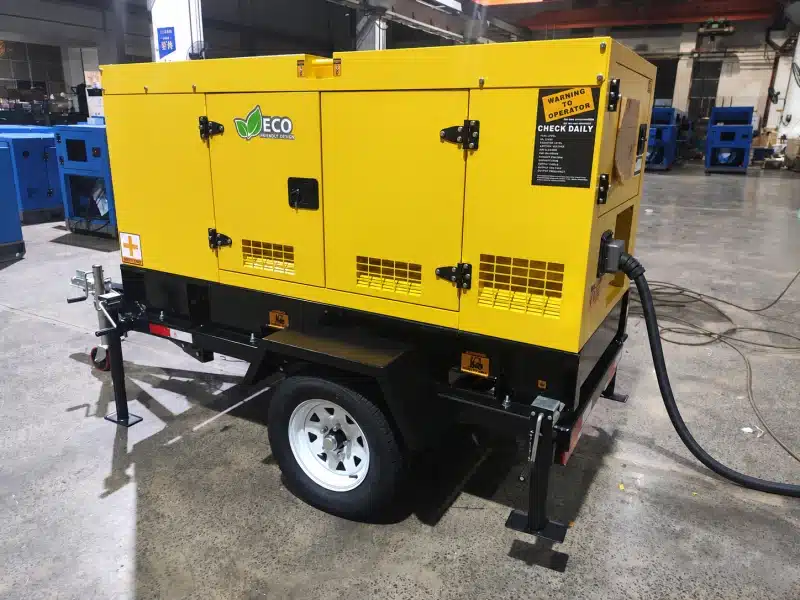
The trade off is that generators require exhaust control, maintenance, acoustic planning, and fuel handling. Battery storage may be more appropriate for smaller, more certain loads with frequent charging or long-lived fixed sites, whereas a utility connection may be more appropriate for a different longer-lived fixed site. If a United States diesel project, check that the engine is nonroad or stationary type before accepting an emissions claim [U.S. EPA, accessed 2026; Source 6]. When load capacity, runtime, mobility and independence are more important than zero local exhaust or permanent connection economy [my judgment] a generator becomes the best overall solution.
If the application is a higher load, but the requirement is for quiet operation, you may want to check out the sound-attenuated diesel generator configurations available from your team, or if the load is smaller and sensitive, you can look at the inverter generators available from your team. If dispatchability and runtime are the most important requirements of your project, then only add a generator to your shortlist after comparing the options.
Determine the best temporary power solution for your needs.Select the best temporary power solution for your requirements.
Select the solution depending on the load profile, environment, project duration, logistics and compliance needs. If the equipment is not able to start the load, or if there are unexpected changes made on the site, then the lowest quoted equipment price may become the most expensive option.
The first step is to determine load requirements.The first step is to identify your load requirements.
Steady operating load and the most severe credible start-up event must be calculated.
The kW, kVA, Current, Power Factor, Voltage, Phase and Frequency produced while operating your equipment normally should be recorded.
You must have the locked-rotor current or starting kVA, type of starter, load inertia and acceptable voltage and frequency dip for your motors, compressors, HVAC, and pumps.
Voltage and phase: Ensure that the nameplates and distribution design match your actual equipment; assume no site loads operate at the same voltage and phase.
Sizing margin: A documented allowance for load growth and uncertainty is acceptable, but must be checked against the manufacturer specific transient and derating data.
| Equipment type | Running-load input | Starting or power-quality input | Decision implication |
|---|---|---|---|
| Site lighting and small tools | Nameplate or measured demand | Inrush and electronic-driver characteristics where applicable | Often suitable for portable or inverter solutions |
| Pumps and compressors | Running kW, kVA, and current | Locked-rotor current, starter type, and load inertia | Motor starting may determine generator size |
| Heavy construction machinery | Coincident operating schedule | Largest simultaneous start and acceptable dip | Usually requires three-phase distribution and a transient study |
| Site trailers and offices | HVAC, sockets, lighting, and IT load | Compressor start, UPS, and nonlinear-load behavior | May suit a generator, hybrid, or split system |
The many common misconceptions are that multiplying all running watts by a universal starting factor and then increasing by 20-25% will always give the safe size of generator. The actual starting demand will vary based on the motor, starter, driven load, sequence, alternator, engine response, and allowable voltage dip [Cummins Power Generation white paper, 2018; Source 3]. That is why your specification should be in terms of the inputs to the system and the required performance rather than just a final kW value.
Rent vs. Buy Generators
Use when flexibility is the most important factor, service is the most important factor, when local.Own when repeated deployment, guaranteed availability, configuration control are important.
| Decision factor | Renting a generator | Buying a generator |
|---|---|---|
| Project pattern | Short, uncertain, seasonal, or one-off work | Recurring projects, long use, or permanent backup |
| Upfront capital | Lower initial capital; treated as a project operating cost | Higher initial capital with retained asset value |
| Maintenance | Usually defined in the rental contract | Managed by your team, dealer, or warranty provider |
| Customization | Limited to the available rental fleet | Voltage, controls, enclosure, tank, connectors, and branding can be specified |
| Availability | Depends on local inventory and booking | Controlled by your team after delivery and commissioning |
Avoid taking a common month boundary. Analyze and calculate purchase, freight, finance, maintenance and storage value versus rental value, mobilization and demobilization, exposure to damage, and configuration availability over the same project duration [Author's judgment]. Opt for the power technology first and the rent-or-buy model second to your procurement decision.
Best Practices for Installing and Maintaining Temporary Power Generator.
When the electrical design, manufacturer instructions and requirements are used by the local authority, then a safe installation starts on your site. If exhaust, transfer, grounding, protection or cabling is incorrect even with the right size generator, the system can be unsafe.
The most important safety guidelines and equipment ratings.
The placement and equipment ratings should be matched to the actual site conditions.
The location and clearance should be made on stable ground away from standing water intake and occupied-air intakes. Apply manufacturer's required ventilation/exhaust/fire and service clearances instead of a single distance.
Grounding and Bonding: According to the connection topology and local code, your design should specify the neutral, equipment grounding conductor, bonding point, transfer arrangement, and grounding electrode.
You should specify if your project needs an IEC IP rating, NEMA enclosure Type, or if it requires separate evidence for both.
| Site condition | Requirement to specify | Evidence to check |
|---|---|---|
| Outdoor exposure | Rain, dust, temperature, icing, and drainage conditions | Enclosure test or certification for the required system |
| Coastal or washdown area | Water exposure and corrosion resistance | Material details and the applicable enclosure claim |
| Portable cable route | Current, voltage, insulation, flexibility, traffic, and environment | Cable marking, connector rating, protection method, and voltage-drop calculation |
Please do not consider IP and NEMA to be interchangeable. Both IEC 60529 and NEMA deal with ingress protection, but IEC 60529 does not include other characteristics, and NEMA does not state that an IP rating can be translated into a NEMA Type [IEC 60529:1989+A1:1999+A2:2013 and NEMA, 2020; Sources 4–5].
OSHA permits the use of the generator frame as the grounding electrode for construction work in the United States only under the conditions for portable generators in 29 CFR 1926.404(f)(3) [Source 2]. When connected to premises wiring and/or transfer equipment, ensure the neutral, grounding, bonding and backfeed-prevention design is confirmed by a qualified professional.
The system is ideal for frequent maintenance and support needs.
The precise maintenance schedule provided with the model you have chosen for your engine and generator set should be followed.
Your team needs to perform routine inspection of the engine oil, engine coolant (where applicable), fuel, battery connections, battery cable damage, engine ventilation path, leaks, alarms, and exhaust condition as specified in your manual.
Running-hour service: Change oil, filters, belts, coolant, and other services items as outlined in the model-specific service schedule and operating environment.
Your team should test according to the commissioning and periodic test method mandated for your application, manufacturer, and site plan, and document the voltage, frequency, load, alarms, and the behavior you observe when the system recovers.
PEGASO can match service access, controller choices, spare parts, technical documentation and certification assistance to the ordered configuration [PEGASO supplier capability statement, 2026; Source 7]. Before the unit is shipped, specify installation responsibility, commissioning tests, scope of maintenance and response to support for your purchase order.
Frequently Asked Questions
A generator is not always the ideal temporary power option.
No. Usually the best overall solution for remote, high-load, mobile or extended-duration projects with dispatchable electric requirements is a generator. Battery storage is more suitable for small, predictable, noise-sensitive loads with predictable charging and temporary utility service is more suitable for a fixed site with reasonable lead time [Author's judgment].
What is the difference between a generator and battery storage?
Contrast generator kW and kVA, transient response, fuel logistics, noise, exhaust and maintenance with battery usable energy, inverter kVA, overload duration, recharge rate, cycle requirements and end-of-life responsibility. Use the same load profile for the same 1 hour interval for both options.
Can temporary power solutions be used for outdoor events or emergency situations?
Yes. Temporary power solutions are commonly used for outdoor events and emergency situations across the United States. They provide electricity where permanent power is unavailable, insufficient, or has been interrupted.
What is the typical cost of temporary power pole rental and installation?
The total cost for renting and installing a temporary power pole (often called a temp service or construction pole) in the United States typically ranges between $US1,700 - $US 4,500.
What are the main benefits of renting temporary power systems for construction sites?
Renting temporary power systems for construction sites provides incredible flexibility, safety, and financial advantages compared to permanent installations or purchasing equipment outright.
Here are the main benefits organized for quick reading:
- Cost-efficiency: Eliminates the heavy capital expenditure of purchasing industrial-grade generators, distribution panels, and transformers. You only pay for the equipment during the active phases of the project when power is actually needed.
- Scalability and flexibility: Power demands change as a project progresses from initial excavation to interior finishing. Rental fleets allow you to easily scale up, scale down, or swap out equipment (like upgrading from a small 30 kW to a heavy-duty 500 kW generator) as site requirements shift.
- Reduced maintenance and repair costs: Rental providers typically handle routine servicing, preventative maintenance, and emergency replacements. If a generator malfunctions, the supplier swaps or fixes it, minimizing costly project downtime.
- Reliability and productivity: Modern temporary power packages (including generators, load banks, and distribution systems) ensure uninterrupted operations for heavy machinery, lighting, and tools, keeping construction schedules on track regardless of local grid availability.
- Compliance and emissions standards: Renting gives you access to the latest tier-rated, eco-friendly, and quiet-running equipment that complies with local noise ordinances and environmental regulations without long-term ownership commitments.
- No storage or depreciation worries: Once the project concludes, the equipment is picked up by the provider. You don't have to worry about long-term depreciation, finding secure off-season storage, or reselling used heavy machinery.
Conclusion
When your project requires a significant amount of power, long-lasting operation, mobility and freedom from a permanent utility, you are most likely looking for a power generator. This comparison remains relevant: it may be possible to achieve better performance from batteries on quiet, low-energy applications, or from utility service at a fixed long-term site.
There are four things you need to do before you make your selection:
- Correctly size running kW and kVA, motor starting, power quality and site derating.
- Compare generator, grid, battery and hybrid solutions under the same duty profile.
- Safety and compliance: Organize distribution, protection, grounding, exhaust, enclosure and evidence for the destination market.
- Commercial fit: Rental vs ownership on the same scope and same project time horizon.
Assuming that dispatchable power and extended operation are key factors following that review, the generator is the temporary power option you should choose.
Sources
- ISO 8528-1:2018 — Reciprocating internal combustion engine driven alternating current generating sets, Part 1, International Organization for Standardization.
- 29 CFR 1926.404 — Wiring Design and Protection, U.S. Occupational Safety and Health Administration; current e-CFR accessed September 2026.
- Specifying and Validating Motor Starting Capability, Cummins Power Generation white paper, 2018.
- IEC 60529 — Degrees of protection provided by enclosures, International Electrotechnical Commission.
- NEMA Enclosure FAQ, National Electrical Manufacturers Association, 2020.
- Regulations for emissions from compression-ignition heavy equipment, U.S. Environmental Protection Agency; accessed September 2026.
- Supplied by the manufacturer, 2026.
