

An important factor to consider is the load you want to run overall. When looking at the size of inverter generators you should consider what running wattage you need and the starting watts needed. Once you have a total figure for the load you are running and add in a suitable safety margin, you can find out what the minimum generator that will reliably run your equipment.
Inverter Generator Size Chart
| Power (Running)1 | Starting Watts | Recommended Applications |
|---|---|---|
| 3000 Watt | 3500 Watt | Small appliances, laptops, lights, fans, small power tools, and camping equipment |
| 3500 Watt | 3800 Watt | RV essentials, refrigerators, microwaves, lights, and basic household appliances |
| 4000 Watt | 4500 Watt | RV air conditioners, refrigerators, sump pumps, power tools, and multiple household appliances |
| 5000 Watt | 5500 Watt | Essential home backup, window air conditioners, refrigerators, freezers, well pumps, and power tools |
| 6000 Watt | 6500 Watt | Home backup systems, central household appliances, larger well pumps, air compressors, and jobsite equipment |
| 9000 Watt | 10000 Watt | Whole-home essential circuits, larger HVAC systems, electric water heaters (depending on load), multiple power tools, and demanding jobsite applications |
How to Calculate Inverter Generator Size You Need
Step 1: Create a Comprehensive Load Inventory
Many errors are made here due to only including the most important equipment. Not including the extra equipment, back up equipment or loads that could be added to the future will give you completely inaccurate results.
As you build up your list of loads, you should know how much power each item uses, how much power they use when starting up, how many there are and how they’re used. For example, in a mobile office environment, you could have computers, routers, monitoring equipment, printers, lighting and cell phone charging. In a food truck you may have a freezer, venting system, POS terminal, LED lights and coffee machine. They individually don’t use much power but together they can make up 20-40% of the total load.
You should also consider if the equipment will be running at the same time. Some equipment will only be used in emergency back up situations. Most of the equipment in a commercial situation will be running all day. If you just add up the power ratings of all your equipment you could easily over specify your inverter generator. If you leave some equipment out then your generator could be working at high loads for a long period of time.
The following information must be collected for each device:
| Parameter | Reasons |
|---|---|
| Rated Watts | Calculate normal operating power |
| Starting Watts | Assess additional power requirements during equipment startup |
| Voltage | Verify that the generator output voltage matches requirements |
| Amperage | Assist with calculations when power data is unavailable |
| Power Factor | Evaluate the actual apparent power requirements of AC equipment |
| Operating Hours | Estimate runtime and fuel requirements |
Check the equipment nameplate, manufacturer’s specifications, or product manual first. If a device is labeled only with voltage (V) and current (A), you can use the following formula for a rough estimate:
W( Real Power)=V(Voltage )A(Current)PF (Power Factor )
For example, a device with 120V, 10A, and a power factor of 0.9:
120×10×0.9=1,080 W
Power factor is a consideration here. It means that two pieces of equipment could have the same real power consumption, but different current consumption. When considering generator compatibility with any piece of equipment it is important to know the wattage, voltage and current requirements. If 3-phase equipment is being used use the correct 3-phase calculation.
Step 2: Identify the Operating Power and Starting Power
When choosing an inverter generator you need to not only think about the running power but also the starting power of the device. If there isn’t enough starting power issues can occur such as failure to start, circuit breakers tripping and voltage drop.
For example, a small 1500W air conditioning unit will have a running power of around 1500W, but when starting it can have a surge of up to 4000-5000W. If a 2000W generator is chosen based on the running power, then the air conditioning unit will often not start.2
When creating your load sheet, you need to not just know the running power but also look at the starting current, Locked Rotor Amps (LRA) or starting wattage given by the equipment manufacturer. If there isn’t any specific information available for the equipment then general industry multipliers can be used as a guide. However it is always best to refer to the actual product specifications when making purchasing decisions.
Step 3: Calculate the Total Running Load
Once you have determined the power of your equipment, you will then need to work out what the total loading is when everything is running.
Many people make the mistake of adding up the power of all the devices. The professional way to do it should focus on demand factors. The aim of working out the total running load is to understand how much power is needed to keep everything running over a long period. Most engines aren’t designed to run constantly at 100% so keeping them running at full load will cause them to use more fuel and increase wear.
Most manufacturers recommend:
- Optimal operating range: 50%–75%
- Acceptable operating range: 75%–85%
- Avoid long-term operation at: 85% or higher3
Also remember to apply a simultaneous use factor. A simultaneous usage factor allows you to calculate how much of that particular load is likely to be running at one time.
The calculation is:
Adjusted Running Load = Rated Running Watts × Quantity × Simultaneous Use Factor
For multiple types of equipment:
Total Running Load = Σ (Running Watts × Quantity × Simultaneous Use Factor)
This can be useful to calculate demand however the simultaneous usage factor should be based on real usage, load profiles or logical assumptions from your project. Don’t just plump for a random percentage.
Step 4: Add Safety Margin
The goal of a safety margin is not to pursue the largest possible number, but rather to strike a balance between reliability and cost. Below are common recommendations for margins.
- Emergency Backup: 20%-25%
- Commercial Operation: 25%-30%
- Continuous high-frequency operation: 30%-40%
- Future Expansion: Above 30%4
Step 5: Account for Environmental Derating
The inverter generator will have an output rating stated for certain circumstances. The actual output could be affected by different conditions.
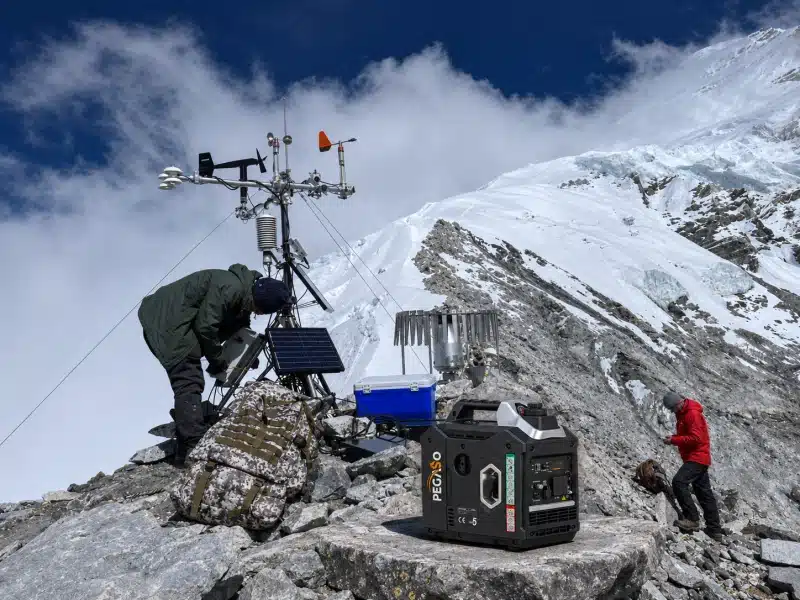
Before deciding on the generator size, ensure that there is a derating factor for the location of the installation.
| Environmental Factor | Potential Effect | What to Check |
|---|---|---|
| Altitude | Higher elevations can reduce engine power and available generator output | Manufacturer's altitude derating data |
| Ambient Temperature | High temperatures may affect engine performance and available output | Manufacturer's specified operating temperature range and derating guidance |
| Other Operating Conditions | Certain fuel, installation, or operating conditions may affect performance | Model-specific operating instructions and output specifications |
Not all generators will have the same derating factor. Different engines and generators have different limits and performance. Refer to the manufacturer's information for your model. This will state what derating factors are needed (altitude/temperature). This figure will give you an actual output to use to compare to your load calculation.
If the manufacturer states that there will be a reduction in the actual output of this model under the intended conditions, then the generator will need to have a large enough output rating to account for this.
This ensures that the inverter generator, whilst appearing to have a suitable size, doesn’t end up being undersized for the actual installation location.
What Should You Do If the Generator's Capacity Is Just Barely Enough?
The rated capacity of the generator will most likely satisfy the demand. However, the start-up power will not be sufficient. At this point you may assume that upgrading to a larger generator is required.
There are several options to consider:
- Stagger the start up of equipment: A number of motors may be coming on at the same time.
- Limit the number of high power devices running at the same time: Some devices can be intermittent.
- Fit soft starters: Some motors may have equipment that causes high start-up currents.
- Parallel inverter generator: This will require more output capacity and the equipment must be compatible with parallel operation.
- Reassess the load on the equipment: The original capacity may have been miscalculated.
Soft starters may not be suitable for all equipment and the generator models must be checked for compatibility with parallel operation.
Conclusion
Ensuring that you get the correct sized generator can help prevent two common issues, which is not having enough power available and paying extra for excess capacity. Think about what you are going to be using it for, what tools you will need to run and if these will kick in simultaneously. This is an important factor to consider when choosing your inverter generator rather than just looking for a generator with a higher wattage rating. Planning ahead can really help improve the performance of your inverter generator.
FAQs for Inverter Generator Size
What is the 80% rule for inverter generators?
The 80% rule states that the inverter generator should be used at less than 80% of its rated watts for long periods of time to avoid overheating. This will improve fuel economy and reduce engine wear. So if you have a 4,000W generator it should ideally be used at a constant load less than 3200W.
Is 30 kW enough to run a house?
Yes, for most homes. You can generally run your vital appliances, HVAC, lighting, fridge plus a lot of the domestic circuits from a 30kW generator. The amount you can run depends on how big your home is, the amount of high power appliances you have, and if you're using electric heating or EV charging.
Can an inverter generator run at its maximum rated wattage continuously?
Generally speaking, no. The rated watts will be the highest continuous power that the generator can provide. However if you run it at 100% of its capacity it can cause increased fuel consumption, increase in heat and wear. Most manufacturers would recommend trying to keep continuous loads at less than 80 or 90% of its rated power.
What happens if my inverter generator is too small?
If your inverter generator is too small for the application it could cause issues starting motorised tools, overload, voltage drop and sudden shutdown. Overloading can also cause premature wear on your generator and any attached equipment.
Can I use two inverter generators together to increase power output?
Yes. Many inverter generators allow you to run them in parallel. Using an approved parallel kit from the Manufacturer you can connect two compatible generators together to increase the total power output. Just make sure the models you are using are compatible with running in parallel.
Source pending — The chart's running and starting ratings are not accompanied by dated model datasheets; the existing product links have been preserved without independent verification. ↩
Source pending — The air-conditioner starting-power example is not linked to an identified appliance manual, test result, or generator datasheet. ↩
Source pending — The stated load-percentage recommendations are not attributed to a named manufacturer or model manual. ↩
Source pending — The safety-margin percentages are stated as recommendations in the supplied article; no referenced standard, calculation basis, or model-specific source is provided. ↩
